Tuesday, March 26, 2013

Finnegans Wake Billboards in China

Billboard in China promoting Chinese translation of Finnegans Wake.
(Photo credit: Ng Han Guan, AP)

Right around the time of James Joyce's birthday (February 2nd) this year the newswires were all buzzing about Finnegans Wake. The first-ever Chinese translation of Joyce's notoriously opaque masterpiece sold out of its first 8,000 copies in China after a big advertising campaign helped spread the word around.

There are so many strange things about this story, but this part is my favorite:
The book, widely considered Joyce's most experimental and inscrutable work, was promoted by an unusual billboard campaign in major Chinese cities — with 16 of them in Shanghai alone. The official Xinhua News agency said it was the first time a book had been promoted that way in China.
There were 16 billboards throughout Shanghai (in the 21st Century) ADVERTISING A NEW EDITION OF FINNEGANS WAKE.

This is something out of an alternate universe, a hilarious Joycean oddity just like the other recent bit of Joyce news.

What's so funny about this is that Finnegans Wake is filled with advertisements and references to advertising, starting with the second page: "the skysign of soft advertisement!" The key role of advertising is made clear on page 181 where there's an ad referring to Joyce himself, sounding like a a hilarious parody of a singles ad on Craigslist:
[Jymes wishes to hear from wearers of abandoned female costumes, gratefully received, wadmel jumper, rather full pair of culottes and onthergarmenteries, to start city life together. His jymes is out of job, would sit and write. He has lately commited one of the then commandments but she will now assist. Superior built, domestic, regular layer. Also got the boot. He appreciates it. Copies. ABORTISEMENT.]
Joyce was very aware of the growing industry of advertising and how important it would become in modern society. His most famous character, Leopold Bloom in Ulysses, was an advertisement canvasser by trade and throughout his daily musings he ponders creative ad ideas and "the infinite possibilities hitherto unexploited of the modern art of advertisement."

I can't find any academic studies of the importance of advertising in Joyce's work so it's certainly something to look deeper into. Maybe sometime down the road I'll take a crack at exploring it more fully. Leaving aside Bloom's myriad advertising thoughts, the Wake alone is absolutely flooded with ads (just like pop-up ads, since the Wake is after all a lengthy premonition of the web surfing experience). The FWEET search engine shows 63 different references to advertising that you can look at and I'm sure they've barely scratched the surface.

For now I'm still soaking in the surreal nature of the Finnegans Wake billboard campaign in China.

Thursday, February 28, 2013

A Multimedia Examination of "The Mime of Mick, Nick, and the Maggies"

As the massive glittering galactic dream of Finnegans Wake proceeds along, its universal sleeper falling deeper into unconsciousness, the book's content becomes darker, denser, deeper until we reach the most difficult (and multi-allusive) chapters at the very center. As dawn grows nearer, the book grows a little bit lighter until the gorgeous poetic prose of the early morning hours represented in the final chapter.

The first chapter of Book II sets off a stream of difficult but resplendent material with a detailed playbill for "The Mime of Mick, Nick, and the Maggies" (p. 219) featuring all of the book's characters putting on a show in the "Feenichts Playhouse". The play revolves around the children of the book: Mick (the twin brother Shaun representing the Archangel Michael), Nick (twin brother Shem representing Lucifer or the Devil), and the Maggies (little sister Issy and her friends, representing the colors of the rainbow). The playbill promises to enact "a Magnificent Transformation Scene showing the Radium Wedding of Neid and Moorning and the Dawn of Peace, Pure, Perfect and Perpetual, Waking the Weary of the World" (p. 222), a sentence which sounds like a promotion for the Wake in its entirety.

Sunday, February 3, 2013

Glossing The Wake Through Two Pictures

"wipe your glosses with what you know" - FW p. 304

During some pretty idle and aimless book perusing and internet browsing I came across two images which I decided are good illustrations of important elements in Finnegans Wake. A saying goes that if a picture is worth a thousand words then a symbol is worth a thousand pictures. Let's take a brief look at how these two symbolic pictures sum up massive pieces of the Wake.


This is a woodcut by Japanese artist Utagawa Hiroshige from 1853. In imagining the recurring "characters" of Finnegans Wake, a family of five (sort of), I've found that it helps to maintain the idea of these figures as morphogenetic organic elements, not as individual people. A seemingly simple nature scene such as this one then manages to serve as a family portrait when you consider each character's earthly element:

HCE as Mountain
ALP as River
Shem as Tree
Shaun as Stone
Isabelle as Cloud

That's entirely what's represented in that picture. "Because it's run on the mountain and river system" (FW 288.F3). If you want to count the image in the Wake of the Chapelizod pub in which this "family" sleeps you can even find some little buildings in there.

This next one is both simpler in its representation and more difficult in concluding what exactly it means in the Wake.


Pretty familiar scene there. What's it got to do with the Wake?

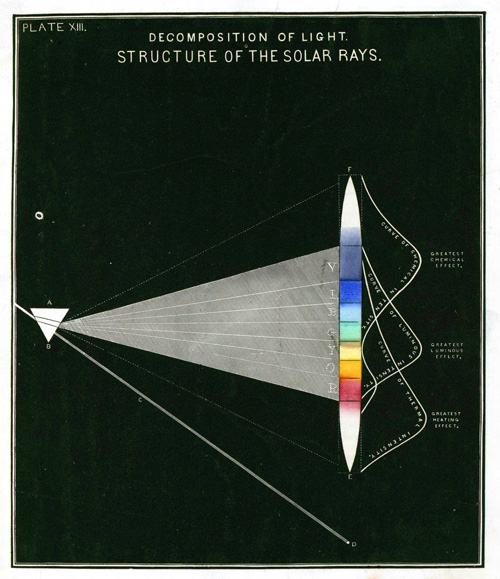
From first page to last, Finnegans Wake is positively loaded with rainbows. The entirety of the 1st chapter in Book II, the stage play of "The Mime of Mick, Nick, and the Maggies" (the enactment of "a rainborne pamtomomiom" as p. 285 describes it) frequently features the seven colors with a dance of the seven rainbow girls who are described in endlessly varying names which always refer to the seven colors, as in "Rose, Sevilla ... Cintronelle ... Esmeralde, Pervinca ... Indra ...Viola" (p. 223) or, spelling out the acronym RAYNBOW on pg. 226:
"R is Rubretta and A is Arancia, Y is for Yilla and N for greeneriN. B is Boyblue with odalisque O while W waters the fleurettes of novembrance."
Page 247 has the line "Split the hvide and aye seize heaven!" which indicates splitting the white (Danish "hvide") so the eye sees seven colors.

In the final chapter of the book, there's a debate between Bishop Berkeley and St. Patrick revolving around light and the visible universe in which the druid Berkeley refers to "the his heptachromatic sevenhued septicoloured roranyellgreenlindigan" (p. 611). There are many interpretations as to the importance and meaning of the recurring rainbows and Joyce himself indicated in his letters that the book features an elaborately developed theory of colors. John Bishop in his outstanding study Joyce's Book of the Dark devotes a lengthy chapter (entitled "Meoptics") to exploring the idea that the Wake's play of colors represents visions streaming across the inside surface of the eyelids of the sleeping person within whose body (Bishop argues convincingly) the whole book takes place. In the midst of his exegesis, we're led to some very intriguing considerations of the human eye, a fleshy filmscreen and projector. (I'll have lots more to say about Bishop's great book and his unique ideas very soon.)

Coming back to the organic scene from the first picture, I'm led to think about the bright white light of the sun interacting with the waters of the river mother evaporating into mist and daughter clouds whose raindrops bend light into rainbows, the rain eventually falling down the slopes of a mountain and turning back into a river ("Because it's run on the mountain and river system" FW288.F3). I could also start talking about the Wake's recurring use of the word "heliotrope" and moving towards the sun but I'll stop here...

Monday, January 28, 2013

iSpace

During our last Finnegans Wake Reading Group meeting here in Austin we covered what is no doubt one of the more fascinating pages of the Wake, coming at the conclusion of Chapter 5 (Book I) which discusses in myriad detail the exotically inscribed letter dug up out of a garbage heap by a hen and now being examined by all kinds of archaeologists, scholars and forensic experts. This letter, "a polyhedron of scripture" (p. 107), a "radiooscillating epiepistle" (p. 108) written in "anythongue athall" (p. 117) and considered to contain "as human a little story as paper could well carry" (p. 115) is, of course, representing Finnegans Wake itself.

It's the first chapter we dug into for the group, chosen because it serves perfectly as an introduction to the text as it frequently describes the nature of the Wake, stressing the need for "penelopean patience" (p. 123) for a reader perusing its "toomuchness, the fartoomanyness" (p. 122) in which every word is "as cunningly hidden in its maze of confused drapery as a fieldmouse in a nest of coloured ribbons" (p. 120). At one point the book frankly asks the reader, "You is feeling like you was lost in the bush, boy? You says: It is a puling sample jungle of woods" (p. 112).

In examining the letter we manage to go through the whole history of writing, paper, manuscripts, printing, etc. as we study the palimpsest-like document which "has acquired accretions of terricious matter whilst loitering in the past" (p. 114). Direct comparisons are made to the Book of Kells (especially its so-called Tunc page), another exhumed text whose pages are densely packed with intricate details and arabesques.

As the chapter approaches its conclusion, an expert breaks out "his dectroscophonious photosensition under suprasonic light control" (p. 123) to closely examine the "debts and dishes" or dots and dashes of this "new book of Morses" and we soon witness some of the most textually strange lines of any book ever made. We are told that "The original document was in... unbrookable script, that is to say, it showed no signs of punctuation of any sort." This led to interesting interpretation and discussion at the meeting as we considered what exactly is punctuation? Little symbols inserted in text to break up its flow, generally agreed upon signs that are there to direct literary traffic.

This perfectly weird selection soon follows:
accentuated by bi tso fb rok engl a ssan dspl itch ina, — Yard inquiries pointed out → that they ad bîn "provoked" ay *V* fork, of à grave Brofèsor; àth é's Brèak — fast — table; ; acùtely profèššionally piquéd, to=introdùce a notion of time [ùpon à plane (?) sù ' ' fàç'e'] by pùnct! ingh oles (sic) in iSpace?! (p. 124)
Getting the easy part out of the way, the first phrase uses broken text in a hilarious manner to depict "bits of broken glass and split china." The rest of it was marinated on for a while among the meeting participants. The notion of breakfast is popular throughout the book as the sleeping hero will soon Wake to break his fast, probably with a fork. Joyce also seems to mock the "grave" serious professors who would no doubt comb his book's pages missing the important element of humor.

Considering the medium of writing, to carve streams of symbols or letters across the space of a page is to "introduce a notion of time upon a plane surface." What is, of course, most stunning here is the appearance of the word "iSpace" which sounds perfectly like an Apple product that Joyce is describing in a book published in 1939. It's one of the book's most blatant examples of puncturing holes ("punct!") in time and space, momentarily poking its head deep into the future.

I'm happy to say that after only 5 months, the Wake group here in Austin has already attracted some very colorfully minded folks with interesting approaches to unraveling streams of meaning out of the buzzing, lively words of the Wake. One participant sent me her further thoughts upon reflecting on the iSpace theme and they really perfectly represent the kind of creative exegetical brainstorming that I hope to incite through this group, so I will close with those words:
I-space is internal space, as in the interior life, the dream state, the void, the womb, or the undifferentiated space of the spirit of God over the waters in Genesis. The pronged instrument of the fork is literally a fork (two paths) signifying differentiation or duality, good and evil, male and female, the two brothers in FW. The pronged instrument is also phallic (in the procreative act) or the writer’s pen (in the creative act) which “punctures” the page, or creates meanings through punctuation (note that Tunc is contained in punctuate), making order out of chaos. The fork of the “grave” Brofesor is the spirit of inquiry, like the Tree of the Knowledge of Good and Evil in the Garden of Eden. The I-space of unknowing is punctured by knowing: the dreamer awakes, the innocence of the Garden is ruptured, the amniotic sac tears and there is birth. There’s a pun on the word “grave”, i.e., death punctures life, Adam and Eve’s inquiry produced death. You could also say that coming into being punctures the void. Of course FW is a wake, which is both a funeral (death) and waking up. The circularity of FW is punctured by choosing to read the work in a certain order or by attributing meanings to the words. Also, Shem is “Shame”- Adam and Eve’s shame in the dualistic/differentiated/knowing state.

Sunday, January 13, 2013

Walkthrough of Relevant Links

"of increasing, livivorous, feelful thinkamalinks"
- FW, pg. 613

As this brand new blog continues to take shape, a sidebar filled with links to great material on the Wake throughout the Web has now been added. Here is an overview of what these links are all about.

Joyce Reading ALP
This is a must for anyone thinking of taking a dive through the pages of FW. From 1929, this recording features James Joyce himself mellifluously reciting the final three pages (p. 213-216) of the watery ALP chapter, the chapter on which he was "prepared to stake everything." About these pages, he once wrote, "either the end [of this chapter] is something, or I am an imbecile in my judgment of language." James Stephens called it "the greatest prose ever written by a man."

FW full audio
Unfortunately, Joyce himself only ever recorded those few pages above, but a few people have recorded this most aural of books in full. Dublin-born Patrick Healy has a particularly interesting angle to his reading (available at UbuWeb in its entirety for FREE), I was especially intrigued by his rendition of the "Night Lessons" chapter (p. 260-308) which features footnotes and marginal scribbles on every page. When I recently read the Wake cover to cover, this audio reading was absolutely essential to the experience.

Saturday, January 12, 2013

What is Finnegans Wake?

This could easily end up being a regular series. From the intro to Finn Fordham's book Lots of Fun at Finnegans Wake: Unraveling Universals comes this massive collage (mimicking the Wake's penchant for long lists) of the various ways Joyce's masterpiece has been described, both by critics and commentators and even by the book itself. Finnegans Wake is...

a sleep-story; the dreamlike saga of guilt-stained, evolving humanity; a protracted nightmare; a mighty allegory of the fall and resurrection of mankind; a gigantic epiphany of mankind; an ark to contain all human myths and types; a chaosmos of Alle; a polyhedron of scripture; a meanderthalltale; this nonday diary, this allnight's newseryreel; one of the boldest books ever written; one of the most entertaining books ever written; one of the greatest works of twentieth-century architecture; nothing short of divine vision or a new cure for the clapp can be worth all [its] circumambient peripherization; enormous, mad, unreadable; a cold pudding of a book; a Wholesale Safety Pun factory; a dull mass of phony folklore; a divertissement philologique; literatured with ... once current puns, quashed quotatoes, messes of mottage; an Irish word ballet; like a little Negro dance; music; a collideorscape; a macroscope; a last judgment and genial proclamation of doom; a monstrous prophecy; a history of the future; a tragi-comedy; funeral and funferall; made out of nothing; a paroxysm of wroughtness; Wimmegame's Fake; a big long wide high deep dense prosework; an encyclopedia of mythology; a postmodern encyclopedia ... a parody of the eleventh Brittanica; unprecedented; seen distantly and from without, like a darkened powerhouse on the skyline; a wheel...and it's all square!; a flying machine; a time machine; a hypermnesiac machine; a cybernetic history machine; a simulacrum of the machinery of God's creation; a millwheeling vicociclometer; the most profoundly antifascist book produced between the two wars; an engagement with the very matter of our being; a war on language; a wonderful game; most.

Tuesday, January 8, 2013

Riverrun to Livvy by Bill Cole Cliett

Yes, somebody did write an entire book about the first page of Finnegans Wake.  This should come as no surprise. It's often been said about Joyce's 628-page "nightmaze" that you can pick out any one microcosmic piece and it will contain within it the entirety of the whole structure, very much like a hologram.

The very first page of the Wake (first paragraph even) is extremely dense not only with the weight of multiple meanings/references/allusions contained in each word of text, but in very succintly describing what Finnegans Wake is all about. Consequently, Bill Cole Cliett's excellent book Riverun to Livvy: Lots of Fun Reading the First Page of James Joyce's Finnegans Wake turns out to be a perfect introduction to the phenomenon of the Wake as a whole while also getting deep into studying the minute aspects of one single page. As Cliett writes, "the more I uncovered on the first page the more I understood the entire book, because everything on that page ... relates in one way or another to all the pages that follow."

His book is written very much as a fun, lively, highly readable invitation for the ordinary reader to discover the brilliant (yet largely ignored) masterwork of the 20th century's greatest writer. Assuring us that he's "no scholar, simply a literary layman in love with language and all that words can be made to do," Cliett writes in an approachable manner about an unapproachable book. He's also extremely well-informed. He seems to have read every important study of the Wake published to date and quotes from them often (the bibliography stretches at least 10 pages long) while avoiding footnotes and academic jargon.