Showing posts with label books on the Wake. Show all posts

Sunday, December 21, 2025

A Few Notable Books on Joyce and His Afterlives

Dust jacket art from James Joyce: A Life by Gabrielle Carey.


A big new book related to Joyce was published this year and was received well among the critics and fans alike. The book is actually the story of Joyce's most famous biographer, it's called Ellmann's Joyce: The Biography of a Masterpiece and Its Maker (2025) written by Zachary Leader, who has previously written literary biographies of Saul Bellow and Kingsley Amis. Leader's study of how Richard Ellmann's 1959 biography of Joyce set the standard for greatness in the form of literary biography was recently praised in reviews such as this one from Seamus Perry in the London Review of Books (you can read some interesting letters in reply to that review, too). I will check out Leader's book at some point. Reading Ellmann's big 960-page cinderblock years ago was pivotal for me in my initial pursuit of learning more about Joyce's life. Since then I've read several other biographies of Joyce. I really liked Gordon Bowker's James Joyce: A New Biography (2011), a very detailed walkthrough of Joyce's itinerant life, I found it useful in some of my recent writings and research.

Among the shorter biographies of Joyce (under 200 pages) I'd like to recommend a few that I read in the past year:

James Joyce: Critical Lives Series (Reaktion Books, 2006) by Andrew Gibson 

A very rewarding and informative read. The author Andrew Gibson, who also wrote the book Joyce's Revenge (2002), delivers a fresh approach to documenting Joyce's life which emphasizes the Irishness of Joyce's entire project. This entry in the "Critical Lives" series starts off by stating that the indispensable efforts of scholars like Ellmann, with his gigantic collection of biographical details, and Hugh Kenner with his showcase of the vast multiverse of international, infinitely theoretical Joyce, have taken our knowledge of Joyce extremely far, but Gibson positions his approach by declaring those prior works of Joycean scholarship had not adequately emphasized the why of Joyce's mission nor how entirely Ireland-focused his artistic project was. What if Joyce's whole mission was based on celebrating his home city and fulfilling the destiny of the traditional exiled Irish monk crafting one intricate labyrinthine codex after another? Gibson emphasizes that while Joyce has become a global phenomenon celebrated for aspects of universal inclusivity and coexistence of many ideas, approaches, backgrounds, etc, his work can also be said to always "everywhere be addressing Irish themes and Irish questions." (p. 16) I found myself agreeing with Gibson's assertions and arguments. As I've said before, in my experience nothing sheds more light on Joyce's major works than visiting and learning about Ireland. 

What I really appreciated (and what makes me very intrigued to read more of Andrew Gibson's work) was his insightful attention to the nuances and complexities of Joyce's relationship to his home country during the last few decades of his life. Those years (mid-1910s to the late 1930s), Joyce's most productive stretch as a writer, coincided with violent and highly significant events in the history of Ireland and the Irish War for Independence, and Joyce remained an exile from his home country until his death. The question of Joyce's politics is complex, as Gibson notes, because while he seemed to harbor the hopes of a united independent Ireland free of British rule, he was not exactly a supporter of the Irish nationalist movement of the time, and tended to stray away from their extremes. There is a far more detailed and clearly explained analysis of the concurrence of the birth of the Irish Free State (1922-1937) and Joyce's literary career in Gibson's book. You should read it. It's as informed and fresh of a take on the biography of Joyce as you can find anywhere, packed into an approachable short volume. 


James Joyce: A Life (Penguin, 1999) by Edna O'Brien 

This biography of Joyce from the Irish novelist Edna O'Brien is substantive and well-written. Edna O'Brien was first inspired to be a writer when she initially encountered Joyce's work. In her take on Joyce's biography, she seems to have a knack for capturing the humanity of Joyce the person. She seemed to get him. In this short book she covers the main highlights of Joyce's life seemingly without leaving much out, while also touching on many of the figures in Joyce's circle who were important catalysts in bringing his creations to the public (especially women like Sylvia Beach, Harriet Weaver, Maria Jolas, etc). But what stood out to me about this book was how O'Brien touches on certain intimate details that reveal much. Little things like how, in the depths of his blindness and eye troubles, Joyce would identify guests to his home by their voice. Or how in love he was with his wife Nora, a country girl from the west of Ireland, like Edna O'Brien was. If you wanted to read a concise, entertaining biography of Joyce which covers the main points without getting too bogged down in history, politics, or interpretive theories, this thoughtful portrait from an Irish novelist would be a safe bet. 


James Joyce: A Life (Arden, 2023) by Gabrielle Carey 

This artistic, poetic, whimsical walkthrough of Joyce's life is a very entertaining and enjoyable book in a slim volume. A perfect example of why it is useful to have different approaches to the task of documenting the life of an artist like Joyce. The art of biography is like the art of translation, you can take the basic structure and key details then run with it in a creative way, kinda like doing a cover of a song. This author, Gabrielle Carey, hosted a Finnegans Wake reading group in Australia for many years (Carey passed away in 2023), so she writes from the perspective of one who has been deeply engaged with Joyce's quirkiest text while incorporating the perspectives of others. It's a fun book, with plenty of detail despite being fairly short (140 pgs), including some facts and details you won't find in the books mentioned above (for example, she talks about the medicinal effects of reading Finnegans Wake, and notes the TikTok trend that was going around of people talking about reading Finnegans Wake helping them with mental health struggles). Short chapters, no chunky paragraphs, terse sentences, often quoting from Joyce's texts or his letters without getting too caught up in the details of citations, the book takes a "bower bird approach" as the author describes it. It's a very worthwhile and fun read.


***

A couple other books I've been reading which I haven't finished yet, but which deserve to be mentioned here. I've been focusing on biographical studies of Joyce's life, these other books are in the realm of Joyce's afterlives.

Straight Outta Dublin: James Joyce and Robert Anton Wilson (2025) by Eric Wagner & R. Michael Johnson

This book examines the influence of the works of Joyce on the work of the Robert Anton Wilson, especially focusing on Finnegans Wake. The author Eric Wagner has been hosting Finnegans Wake reading groups for many years and has previously written a guide to the works of Robert Anton Wilson. Here, in a fragmented and digressive approach drawing from a wide array of disciplines, Wagner indulges in in-depth discussions of the Wake, drawing on the insights of John Bishop, Hugh Kenner, Joseph Campbell, while also venturing into other modernists like Ezra Pound and T.S. Eliot, and thinkers like Alfred Korzybski and Wilhelm Reich. In the latter half of the book, R. Michael Johnson (otherwise known as the OG, author of a great substack) provides a detailed survey of the Joyce elements that appear across all of RAW's books.  


Chapel Perilous: The Life & Thought Crimes of Robert Anton Wilson (2024) by Gabriel Kennedy

A perfect supplement to the above is this recent biography of Robert Anton Wilson, going through the interesting and at times harrowing life of the countercultural author. From a young man in Brooklyn during the jazz era in the 1950s, to being involved in Civil Rights protests as a teenager, working odd jobs before trying to be a full-time writer and raise a family. I like that the book even had a list of RAW's known addresses in the back, including his multi-year sojourn in Dublin in the footsteps of Joyce, and then his later years in Santa Cruz where for many years he hosted a Finnegans Wake reading group. 


***

As a bonus, here's one more notable book I've just started reading but haven't gotten very far with yet. It's a unique text called Peripatet (2019) by Grant Maierhofer, with typographical experiments in the vein of Quentin Fiore's work on Marshall McLuhan's books. A deliberately weird and obscure, very intriguing book, it is on one level a document of the author's exploration of Finnegans Wake. As Maierhofer has written, "I read Finnegans Wake... as an ode to forms, forms explored by Joyce himself and referenced throughout the text; forms shattered and rendered useless to traditional interpretive means by intuitive, heartily experimental—almost spiritually so—pages of linguistic forest fires simultaneously enacting and subverting their own interpretation... "
You can read more about the author's approach to reading Finnegans Wake here.

Here's a look inside Peripatet:


*

Have you read any of these books yet? What did you think? Let me know in in the comments. 

Saturday, December 23, 2023

The Solstice Maybe Wake Night

Maybe the longest night of the year is the night on which the dreamworld of Finnegans Wake unfolds? A remark by Joseph Campbell & Henry Morton Robinson in their Skeleton Key to Finnegans Wake (1944) suggests they believe it may be so. From there sprung the premise for celebrating Finnegans Wake on the longest night of the year, HERE, meticulously arranged by Bobby Campbell. This webpage features comics, videos, links to various Wake-related subject matters (including links to recent blog posts by Oz Fritz on crossovers between the likes of Aleister Crowley and Francois Rabelais with Joyce), and other audio-visual Joycean treasures. There's a recording of a panel I participated in with several others, discussing all things Joyce and Finnegans Wake, plus Robert Anton Wilson, and also touching on Terence McKenna's Timewave Zero theory. 


Maybe Night, Solstice 2023

In the panel session, I mentioned Harry Levin's book James Joyce: A Critical Introduction, which was originally published by New Directions in 1941. Despite being one of the earliest critical works discussing Finnegans Wake, it still stands as a great entry point, on par with the Skeleton Key. (Later in the discussion I mentioned a quote that I forgot the attribution for, and it turns out that was from Levin's book: "The peculiarity of Joyce’s later writing is that any page presupposes a reading knowledge of the rest of the book. On the other hand, to master a page is to understand the book. The trick is to pick out a passage where a break-through can be effected.") 

Time Magazine reviewed Levin's book in 1942, noting that Joyce himself felt it was a rare reading which caught onto what he was doing: "The review of Finnegans Wake by Harvard's Harry Levin was one of the few that gave James Joyce the sense that his book had a reader."

It's worth quoting more from that Time article of 1942, which perceptively captured the Wake's relevance within the context of those tumultuous times:

In Finnegans Wake naturalism and the artist himself all but disappear; the book is a shimmering death-dance of chameleon-like symbols; an attempt at nothing less than a complete serio-comic history of human consciousness—in Levin's neat phrase, a "doomsday book," culminating in a Phoenician paradox of dissolution and resurrection. 
...
Finnegans Wake derives much from the philosopher Giambattista Vico's cyclic theory of history, which is highly apposite to the present. According to Vico, and Joyce, the first of a civilization's four phases begins, and the last collapses, in fear of thunder, and a rush for underground shelter; and in that sheltering cave, religion and family life begin again. Today the ambiguous thunder talks above every great city of the earth, and the shelters are crowded, and a civilization, if it is ending, is no less surely germinal. In one great warning work of literature after another, meanwhile, a similar mental cavern is retreated to and explored (Joyce's was a Dedalean Labyrinth).

Thursday, July 6, 2023

Reviews of Five (Mostly) Recent Books on Joyce, Ulysses, and Finnegans Wake

Consuming Joyce: 100 Years of Ulysses in Ireland (2022) by John McCourt

Last year in June, I was in Dublin for the James Joyce Symposium at Trinity College where I presented a paper. That was my third trip to Dublin in a span of nine months, prior to which I'd never been to Ireland before. The city was bustling for the centennial celebration of Ulysses, which first appeared in 1922. On Bloomsday, June 16th, after attending some panels at Trinity, I wandered around the city and watched locals in the pubs genuinely thrilled for Bloomsday like they were celebrating a local sports team's victory. Dublin was lit and I had a great time hanging with friends throughout the symposium. 
I acquired a few new books during that trip, including this recently published study by John McCourt detailing the reception and impact of Ulysses in Ireland over the last century. Once I started reading Consuming Joyce, I couldn't put it down. I completed it in one long reading session on the flight back to the US. McCourt's approachable yet academically rigorous study goes decade-by-decade showing how Ireland's initially intense hostility against Joyce (and his devoted readers) evolved into hoisting Joyce up on a pedestal as a national hero.
    As an American in Ireland soaking in and savoring the local connections from Joyce's texts, one thing I found especially compelling in Consuming Joyce was the early hostility from the Irish against American readers of Joyce's work and how much that changed over the century. McCourt's book is peppered with quotes from Irish critics and commentators who, in the initial few decades after Ulysses appeared in 1922, relished the opportunity to trash Joyce's American readership. One example (from a review of Stuart Gilbert's guide to Ulysses which appeared in 1930) delivered Joyce some backhanded praise while needling the Americans who love his work: "Joyce is constantly pulling the long Homeric bow in order to astonish the uninitiated; and he has succeeded to some extent, especially with the Americans, where classical learning is not very widely cultivated." (pg. 60) 
    Joyce's old frenemy from Dublin, Oliver Gogarty (immortalized as Buck Mulligan in Ulysses), published an editorial in a Dallas, Texas newspaper in the year 1950 mocking the "Joyce fetish" of Americans, remarking that they all belong in kindergarten, and concluded, "This is a moment in the history of art where cross-word puzzles, detective stories and distortions take the place of literature and beauty. And when we consider that America is the original home of smoke signals, the popularity of Joyce here can be explained." (pg. 110)
    In 1965, an article in the Irish Times mocked "the Joyce posers (or symposers)" and complained that Joyce would be rolling his grave if he'd known what an enthusiastic international readership he'd attained: 
'The bould Jamsie Joyce was writing for Irishmen and for nobody else. I wish the Americans would learn that simple fact. They would be happier if they did.' Joyce would be 'vastly annoyed if he had the gift of clairvoyance to foresee that his books would take on the veneration which is accorded the Talmud. Joyce is now a money-spinner for Dublin hoteliers and if he revolves in his Zurich grave I shall not be very much surprised.' (p. 169)
McCourt's book is filled with quotes like this. The impression I get was that the trajectory of Joyce's reception in Ireland began as disgust and hatred at his portrayal of his fellow countrymen, followed by a sort of nationalist covetousness which disdained foreign admirers hijacking their hero, until the widespread attitude suddenly flipped in the 1980s after the centennial of Joyce's birth. Ireland as a country had changed drastically from its tumultuous revolutionary period in the first couple decades of the 20th century, to its era of repressive Catholicism and strident nationalism, and now strived to become a cultural and economic force on the global stage. McCourt's tracing of these changes alongside the reception of Joyce makes for an insightful recent history of Ireland. The once-reviled Joyce had become central to Ireland's ambitions as a nation: "The post-nationalistic, anti-Catholic, pro-European (but more crucially pro-capital) Ireland of the 1990s—proudly the world's most global economy—found the perfect symbol in Joyce, who had earlier rejected so many of the pieties that the country was now finally beginning to question and demolish." (pg. 210)
While it is an academic study packed with information and footnotes on every page, Consuming Joyce is also an engaging read and I learned much from it. The book mostly shies away from direct engagement with Joyce's texts themselves, mainly focusing on the Irish reception of Ulysses and Finnegans Wake over the years. Also included in here is a fascinating and informative history of the development of the "Joyce industry" including the stories of how places like the Joyce Tower in Sandycove and the Joyce Center on North Great Georges Street became the Joyce museums they are today, as well as background on the origins of the annual international Joyce Symposium. I've attended several of these symposia over the last decade and it was eye-opening to learn how these events began with hostility from the locals until eventually the widespread ostracism of Joyce and his readership evolved into hero-worship, accepting and celebrating Joyce as a leading source of tourism in Ireland, all leading up to the grand celebrations of Ulysses at 100. McCourt skillfully captures the details of how this all came to be. Towards the end, he also surveys the vast landscape of Joyce criticism and scholarship to have appeared over the decades pointing to some of the open frontiers of untapped research. (McCourt is noticeably dismissive of the John Kidd side of the "Joyce wars" and adopts the party line of Joyce academics in accepting the Gabler edition of Ulysses.) Historical nuggets of interest to Joyceans abound in this study, the context provided will be useful to any Joyce reader, and I expect I'll be drawing more anecdotes from Consuming Joyce for blog posts in the near future.


*   *   *

The Book About Everything: Eighteen Artists, Writers and Thinkers on James Joyce's Ulysses (2022) ed. by Declan Kiberd, Enrico Terrinoni, & Catharine Wilson
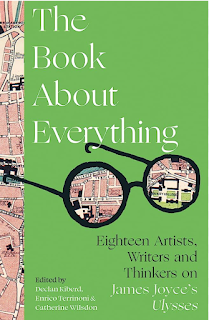
Another book I acquired in Dublin on its publication day on Bloomsday 2022 (at The Winding Stair bookshop on Ormond Quay a few steps away from the Ha'penny Bridge), this is a colorful collection of reflections on Joyce's art from eighteen different contributors from diverse backgrounds. There's some intriguing stuff in here like an Irish Times newspaper correspondent discussing the newsroom scenes of the Aeolus chapter of Ulysses, a Michelin-starred chef from Dublin digesting the lunch-time episode of Lestrygonians, and a Palestinian-born Jewish Irish sociologist insightfully examining the political implications springing from the Nestor episode. Despite eighteen different voices with vastly different approaches to discussing a complicated novel, the prose throughout this book is refreshingly easy to consume, the collection feels well-edited and stands among the best recently published Joyce books for the general reader. 
Even though I thought a few of the chapters deviated too far from the topic, where authors hardly touched on the Ulysses episode they were assigned, or abandoned Ulysses to instead surf around the infinite multiverse of Finnegans Wake, there were also some absolute gems to be found in here. Eric A. Lewis, co-host of the tipsyturvy Ulysses podcast, presents a superb examination of the Ithaca episode arguing that it turns the reader into a surveillance agent gathering intelligence on Leopold Bloom. It's gotta be the most insightful and unique piece of Ulysses criticism I've read in a while. Another standout was Dublin-born novelist Joseph O'Connor's essay on Sirens, captivating for its rich prose and local context. Additionally, Jhumpa Lahiri's wide-ranging analysis of the meaning behind the flittering bat in the Nausicaa episode left a lasting impression, prompting me to seek out more of Lahiri's work. While this collection may not always offer groundbreaking new readings for the seasoned Joycean, it offers a wealth of great material celebrating the author and his work from a multitude of angles.


*   *   * 


James Joyce in Context (2014) ed. by John McCourt

This batch of 32 essays from different Joyce scholars on various topics related to reading Joyce is a dense academic tome. Unlike the previous book above, the authors here don't attempt to get too creative in their prose style, so I would not consider this an engaging or especially enjoyable read. But as a reference text for various topics related to Joyce, it proves helpful. Personally, I picked this up because I wanted to fill in some gaps in my understanding of Joyce, especially some missing contexts that became apparent during a few trips I took to Ireland. Thus, for instance, I appreciated the essay in this collection about post-colonial Joyce by Gregory Castle. I was curious to know more about Joyce's complicated and seemingly contrarian views about Irish politics since, for example, he maintained his British citizenship all his life, never opting for an Irish passport after Ireland gained its independence. There are no easy answers to these questions, but I do think the reader is provided some helpful perspective in trying to understand, Castle puts it, "that Joyce's nationalism takes the form of a transnationalism in which an anti-nationalist position enters into a dialectical relation with pro-nationalist sentiments." (p. 108) Similarly, Brian G. Caraher's essay on Irish and European politics looks at Joyce's political writings from his younger days and sees an affinity towards socialism—Joyce even attended a meeting of the Italian Socialist Party in Rome in October 1906—but the author, making reference to the book James Joyce and the Question of History by James Fairhall, concludes:
Joyce's cultural politics may share in the broad outlines of a general disillusionment consequent upon the betrayals of international socialism in the early years of the twentieth century. Nevertheless, in Fairhall's persuasive reading, 'however we try to define his ambivalent, elusive politics,' Joyce 'was in any event not a passive esthete, but a literary revolutionist for whom writing represented the supreme political act. (p. 290)
These essays attempt to summarize in a limited space the existing scholarship on certain topics. Another very complex subject that was well-explained here is the postmodernist study of Joyce, the semiotic viewpoint of thinkers like Umberto Eco and Jacques Derrida. I also found the chapter chronologically going into detail about the composition and publishing history of each of Joyce's major works to be a useful and accessible refresher with some new info added too. This volume is a good resource for undergrad or grad students studying Joyce, though hardly a top pick for a general reader interested in the subject.


*   *   *


Beating the Bounds: Excess and Restraint in Joyce's Later Works (2023) by Roy Benjamin


Roy Benjamin teaches English at Borough of Manhattan Community College and has published many articles on Joyce, mostly focused on specific themes and patterns in Finnegans Wake. Among his published articles is a fascinating exploration of the role of axial precession myths in the Wake, a paper whose insights I was inspired to write about at length on this blog several years ago. The publication of a new book-length work by Prof. Benjamin, one of the more prolific and seasoned scholars of Finnegans Wake alive today, is a valuable addition to the canon of Joyce criticism. The new book Beating the Bounds: Excess and Restraint in Joyce's Later Works is published as part of the Florida James Joyce Series (edited by Sebastian D.G. Knowles) printed by the University Press of Florida (side note: ain't it ironic that the state of Florida, of all places, has an academic book production system churning out fascinating scholarly studies of James Joyce? For real though, the series has produced some great books but they need to do something about the exorbitant list prices). 
    Benjamin's Beating the Bounds book presents a wide-ranging exploration of the role of boundaries and limits in Joyce's writing, showing how Joyce had a Jesuit penchant for structured systems organized by boundaries but also insisted on shattering any notion of limits. Beating the Bounds shows Joyce's tendency toward transgressing boundaries in several different aspects of his work. I describe this as a wide-ranging study because, while the book is laser-focused on the subject of creating boundaries and breaking them, Benjamin identifies this pattern across several disciplines; there are chapters on Joyce's treatment of these themes in philosophy, Irish politics, mathematics, aesthetics, ecology, gender studies, and scientific cosmology—while enlisting ideas and quotes from an eclectic array of thinkers like Camile Paglia, Ken Wilber, Marshall McLuhan, Jacques Derrida, Slavoj Zizek, Ludwig Wittgenstein, and Friedrich Nietzsche. The approach Benjamin takes in his examination is to crack open specific lines and phrases from Finnegans Wake, using Roland McHugh's annotations, Encyclopedia Britannica and the Oxford English Dictionary, while revealing connections and correspondences to illustrate the repeated dialectic of boundary making-and-breaking. To read of this dialectic playing out thru the realms of ecology in "the mountain and river system" of the Wake or the cosmologies of a bounded or an infinitely boundless universe, all through the freighted language of the Wake is an enlightening experience even if requiring close attention to understand. Benjamin's explications allude not only to the roster of thinkers listed above, but frequently touch on classics like Greek myth, the Bible, and Shakespeare. No doubt, the material is dense, not unlike reading John Bishop's study, Joyce's Book of the Dark—the pages of Beating the Bounds are built of paragraphs weaving in quotes from across the Wake, while annotating the portmanteaus. I'm usually hoping for new perspectives or new notes on specific lines from Joyce's text and Benjamin's book delivers plenty of that. It doesn't always make for easy reading, but also Beating the Bounds successfully avoids bogging down the reader in the analytical jargon of academic theories, managing to thread a needle in presenting a wide-scoped view of a specific subject found evident in abundance all across the Wake.


*   *   *

James Joyce's Mandala (2023) by Colm O'Shea

Stuart Gilbert's 1930 guide to Ulysses has been criticized for reading too much eastern mysticism into his analysis of Ulysses, even though Joyce himself was supposedly feeding Gilbert information and overseeing his writeup. Joseph Campbell helped to bring the work of Joyce to a wider audience of readers (myself included) with his explication of Joyce finding ample elements from Buddhist and Hindu myths. One of Campbell's vital influences was the German scholar of Indian religions, Heinrich Zimmer. One of Zimmer's books on the study of Maya in Hindu mythology was discovered in the personal library of James Joyce with Joyce's annotations and markings indicating he'd been reading it with interest. This was the trimmed-down library Joyce kept after all the relocations, from his final years in Paris, these were the books he considered important. 
Colm O'Shea's brilliant study of the eastern mystical elements glowing at the heart of Joyce's work begins with the foundation of the notable volumes in Joyce's Paris library. Besides the Zimmer book on Maya there was also a collection of Tolstoy's essays in which Joyce had underlined some striking passages in the essay "Religion and Morality" including these lines: "What is the meaning of my momentary, uncertain and unstable existence amid this eternal, firmly defined and unending universe? … The essence of every religion consists solely in the answer to the question, 'Why do I live, and what is the meaning of my relation to the infinite universe around me?" (O'Shea, p. 2)
Creating frequently compelling comparisons between the meanings involved in the "psychic architecture" of mandalas and Finnegans Wake, O'Shea presents his research in a clear and approachable writing style. James Joyce's Mandala is not only an in-depth study of mandala symbolism in Finnegans Wake, it also provides the reader a fascinating overview of the function of the mandala in eastern religions and meditative practices. The mandala is shown by O'Shea to embody an attempted response to the deep question posed by Tolstoy, "what is the meaning of my relation to the infinite universe around me?" The mandala can be considered a map of psychic states and structures, but it's also seen as a blueprint for the architecture of the universe, centered on a cosmic axis. 
    The chapters of James Joyce's Mandala examine some of the "mandalic motifs" featured in the Wake including the quincunx, the squared circle, and the sphere-cube palace/city structure. The latter structural motif evolves as a more complex version of the world-tree or world-mountain mythic image prominent in eastern myths and prominent in the Wake, as well. Making frequent use of the 1892 study Architecture, Mysticism, and Myth by the English architectural historian William Lethaby, O'Shea identifies intriguing connections with Finnegans Wake, a multi-layered universe which centers around a Chapelizod pub. Parallels are drawn between the three-dimensional versions of a mandala like a stupa or a pagoda and the architectural elements featured in the Wake, where the world-axis is represented as a building which is also a shrine, a tomb or a gate. (There's some correspondence in this part with my comparison of the Wake's portal into the bardo realm with the gopuram entrance to a Hindu temple.)
    O'Shea builds a compelling argument, even providing a whole chapter in the beginning of his book going point-by-point comparing each episode of Dubliners with the structure of the samsaric wheel, conveying the depths of Joyce early interest in eastern mysticism from his earliest writing days (the younger Joyce published a review of a book about Buddhism). One of the more notable links suggested in O'Shea's analysis is the comparison of the two main schools of Buddhism, Hinayana and Mahayana, with the different ways readers might approach Finnegans Wake. The main modes of Buddhism are "river vessels" after all (yana in Sanskrit means "ferry-boat" or "raft"), and the Wake is a book with a river flowing throughout the entire text. O'Shea argues that the Hinayana critic of the Wake imagines they could absorb all the existent critical and scholarly material and eventually reach a meaningful understanding of the text, or enlightenment. While the Mahayana critic of the Wake accepts that the journey from confusion to comprehension never really ends, never reaches a final conclusion. The journey is the point.
    The bulk of the book examines the meanings and uses of the mandala in Buddhism, Hinduism, and psychology while showing the presence and resonance of these in the text and structure of the Wake. Some of these links have been touched on by critics before (a springboard for the book is the explicit assertion that the Wake is a mandala made by Clive Hart in Structure and Motif in Finnegans Wake, published in 1962) but O'Shea's study adds immensely to this discussion. The chapters detailing mandalic representations in the Wake yield rich insights. Along the way, O'Shea uncovers noteworthy gems from Joyce's earlier writings like Stephen Hero, Portrait, Ulysses, and Dubliners. I would not hesitate to describe this book as an essential work of Wake criticism (which makes it unfortunate the list price is ridiculously high). Alongside the Wake-as-mandala theories shared, what really draws the reader into this book is O'Shea's engagement with the question of whether Joyce was descending into a psychotic break while writing his final book. At the end of the book O'Shea devotes an entire chapter to this issue.
    In the introduction he states that, "Artistic genius in a work shouldn't obscure possible evidence that it comes from a sense of personal suffering; conversely, signs of psychological 'malfunction' behind the origins of an artifact do not negate the aesthetic, psychological, or spiritual insight rendered within." (p. 22, O'Shea)

    Later on in the last chapter, O'Shea returns to this question:

The Wake bears uncanny similarity to schizophrenic speech. I'm not pointing this out to claim… that Joyce was a latent psychotic and so we should dismiss his work. I think the truth is more interesting: the Wake-as-mandala is a creative defense from psychosis; its construction is a response to the dark night that descends on spiritual refugees. … Joyce's Wake can be read as both a locus of that sickness–a focus lens for obsessional self-reflexivity—and its own unique method of dealing with that sickness: Joyce's act of writing it was his creative therapy. (p. 174-175)

    That conclusion resonates with his earlier description of the different schools of Buddhism: "Intellectual vehicles, such as the various Buddhist schools of thought, that float in the samsaric flood are, non-dually, part of that flood but also aim to save the refugee from it." (p. 140)
    Overall, this a stimulating and thorough analysis of an interesting correspondence which other authors have sometimes alluded to but never before delineated with such depth. O'Shea's book brings new light to some passages of the Wake, it also provides convincing arguments about the structure of the text as a whole, and hardly shies away from some of the thornier questions of Joyce's sanity, all while providing the reader an approachable overview of some of the key tenets of Buddhist and Hindu philosophy.  

Thursday, August 26, 2021

Beyond the Portal: Further notes from reading FW Book I.3-4

The text of Book I.3-4 of Finnegans Wake is so inexhaustibly rich (the word for it on pg 91 is "inexousthausthible") that my notes on this part of the book keep growing the more I think on it and each note could expand into its own area of study. Without going too deep into any of these subjects though, I'm going to share below some cursory and mostly disconnected observations from reading this part of the Wake. Consider these expanded footnotes to my previous post on The Portal

~~~~~~~~~~~~~~~~~~~~~~~~~~~~~~~~~~~~~~~~~~~~

Ishtar Gate reconstruction in Berlin Museum


Babel

In my last post, focusing on the scene of a confrontation at a pub gate, I talked about the image of the gate as a portal to the afterlife or to the underworld. I later learned that the name for the city of Babel, as in the Tower of Babel, comes from the Akkadian bab-ilu which literally means "Gate of God" stemming from the same root as the name of Babylon. This section of the Wake touches on this etymological link in a few ways where the attacker at the gate is described: "This battering babel allower the door and sideposts, he always said, was not in the very remotest like the belzey babble of a bottle of boose" (FW 64.10-11, emphasis added). The passage on pg 69 of FW all about the Gate prominently mentions the Babylonian goddess Ishtar (to whom the Ishtar Gate of Babylon was dedicated) and, later on, in the last two pages of chapter 4, we find references to Babylonian king Nebuchadnezzar, and ALP sings the lyrics to a song called "by the waters of babalong" (FW 103) or Babylon. I think this chapter ending on pg. 103 is an echo of the chapter ending on pg. 74 where HCE drifts off into deep sleep at the sound of rain drops, whereas here it's the sound of a rushing stream, the waters of Babylon. My last post touched on the appearance of a ziggurat on pg 100 in the phrase "beaconsfarafield innherhalf the zuggurat" where HCE himself seems to have been buried inside a tomb within an illuminated ziggurat. The Tower of Babel legend is thought to be based on the Ziggurat of Ur, the ziggurat being a meeting point or portal between this realm and the ethereal realm, in other words a "Gate of God." Generally I think the clusters of references to Bablyon and Ur (and elsewhere in the text, clusters of references to the Garden of Eden) are intended as a way of signaling the main character fallen asleep is descending back to origins---in deep slumber he's going back to the world of the womb, "backtowards motherwaters." (FW 84.30-31) 

~~~~~~~~~~~~~~~~~~~~~~~~~~~~~~~~~~~~~~~~~~~~

The Bat

The attacker at the gate wields a "fender" or some type of a cudgel weapon that morphs and changes appearance throughout chapters 3-4. Details of the story keep changing---there was an attacker banging a bottle at the locked gate, or it was an encounter in the streets with the legless strangler Billy-in-the-Bowl, or there was a no-holds-barred wrestling match with an armed burglar. Joyce intertwines random details from various real-world contemporary newspaper accounts of crimes and trials. Witness accounts vary, "our mutual friends the fender and the bottle at the gate seem to be implicitly in the same bateau" (FW65.35-36) it says at one point, while earlier a witness declares "No such parson. No such fender. No such lumber." (FW 63.11) On page 81, the object is made to appear like a crowbar that a burglar and his victim wrestle over: "catching holst of an oblong bar he had and with which he usually broke furnitures he rose the stick at him." (FW 81. 31-32) On the next page the object could be a Webley revolver pistol, when, in the middle of their "collidabanter" it says "a woden affair in the shape of a webley" (FW 82.16) falls out of the burglar's pocket. On pg 84 it's a "humoral hurlbat" a bat used in the Irish sport of hurling. Later on pg 98 the weapon evolves again through rumors and kaleidoscopic views, "Batty believes a baton while Hogan hears a hod yet Heer prefers a punsil shapner and Cope and Bull go cup and ball." The presence of bat and ball suggest cricket and/or baseball references here, but more on that in a moment. As discussed in my last post, in the book Wake Rites, George Cinclair Gibson describes the "Batter at the Gate" confrontation as paralleling certain rituals of the ancient Irish druids. One of these rituals, which were designed to divest the old king of his powers, apparently included a hostile druid confronting the king at a doorway while aggressively wielding the wooden "shamanistic device" known as a bull-roarer. Gibson gives a good argument for the mysterious wooden object in this part of the Wake being a bull-roarer (see Wake Rites, p. 88-90) and notes that J.S. Atherton in his Books at the Wake observed that Joyce definitely knew about this druid device. 

~~~~~~~~~~~~~~~~~~~~~~~~~~~~~~~~~~~~~~~~~~~~

Wicket Gate

Joyce in his notes titled this section "Batter at Gate" and I'm intrigued by the use of the word batter here because, as the story morphs and mutates, there are noticeable elements of cricket and baseball. The mysterious wooden weapon wielded by the attacker becomes a bat (p. 84.04) and in the pages describing the gate at one point it says the attacker "went on at a wicked rate" (FW 70.32) which Fweet notes as an echo of "wicket gate" which could be the wicket in cricket. Peter Chrisp wrote a really fascinating blog post describing how Joyce was a lifelong fan of cricket with an extensive knowledge of the game's golden age players. There are tons of references to the gameplay of cricket and famous cricketers within the Wake. Notice also how the "trilithon" version of HCE's siglum resembles a wicket:

A wicket used in cricket. The name comes from wicket gate, a small gate.

trilithon E siglum for HCE

The confrontation at the gate gets re-examined and re-litigated in this part of FW and each time the details change. The identities of the two combatants can seem to blur, the presence of a "fender" as weapon helps confuse offender and defender. The nature of the clash changes. By the time we get deep into chapter 4, evidently the clash at the gate involved somebody throwing a stone. The attacker under questioning "would swear... he did not fire a stone either." (FW 91.08-11) Knowing Joyce had a love for cricket, and knowing also (after reading Brian J. Fox's insightful and well-researched book James Joyce's America) that Joyce closely tracked American popular culture of the time and filled FW with American pop cultural references, I think it's highly plausible Joyce was aware of American baseball and included it within the Wake. Seasoned Joyce scholar John Gordon apparently agrees---in his annotations for this section, he expands on the phrase "Pegger's Windup" (FW 92.06) with this: "given this chapter’s plethora of American idioms, 'pitcher’s windup' seem highly probable here.  (For non-American readers: in baseball, a pitcher will gyrate his body before fixing it in position before releasing the ball.  See 91.11-2 and note.)" His additional note from pg 91 refers to "Pegger Festy" where he explains the name has to do with someone throwing stones. Looking a little more closely at this page reveals more potential allusions things that sound like baseball, cricket, bat and ball games:

91.26: "as true as he was there in that jackabox that minute"  [baseball batter's box]

91.27: "or wield or wind" [wield a bat, wind up to pitch]

91.30-32: "if ever in all his exchequered career he up or lave a chancery hand to take or throw the sign of a mortal stick or stone at man"  [take or throw, pitcher's signs, stick or stone]

Following "Pegger's Windup" and "Pegger Festy" we also get "Wet Pinter" (FW 92.07) which, although likely anachronistic, could be an allusion to baseball terminology where a pitcher with good precision is said to "paint" the edges of the strike zone. With a batter at the gate and someone winding up to fire or peg a rock, and words like "sockdologer" on pg 91 (American slang for a decisive blow) there's definitely the impression of a clash resembling the pitcher/batter confrontation in baseball. Since this part of the Wake deals so much with origins, bringing in Babylon and numerous references to Adam & Eve, I think it's possible Joyce is touching on the metaphorical underpinnings of bat and ball games like cricket and baseball. In her insightful study of baseball and mythology Ground Rules: Baseball & Myth (1995), Deanne Westbrook quotes from the novel The Celebrant where Christy Mathewson theorizes on the origins of bat and ball as ancient weapons, stone and stick, perhaps even the first murder weapons:

"Throwing and clubbing. What could be more ancient?... We have to grant that our prehistoric forebears employed those same arts against the creatures of nature--indeed, against one another. Even in holy writ, mustn't we imagine that Cain slew Abel with a stone guided by the bare hand, or a club wielded as a bludgeon? Think of it. I stand on the pitcher's mound, the batter at home plate. We are surrounded by every manifestation of civilization... Yet my action in throwing and his in swinging are echoes of the most primitive brutality." (Ground Rules: Baseball & Myth, p. 110) 


~~~~~~~~~~~~~~~~~~~~~~~~~~~~~~~~~~~~~~~~~~~~

Turnpike

When I shared that last post, a commenter replied asking "no turnpike?" So let's discuss the turnpike. The turnpike, as in a turnpike road where a toll is taken, and more specifically referring to the old turnpike road system in Dublin from the 1700s-1800s, appears frequently in Finnegans Wake usually in connection with HCE who is "our family furbear, our tribal tarnpike" (FW 132.32). The turnpike first appears on the opening page with "their upturnpikepointandplace is at the knock out in the park" (FW 03.22) where "the knock out in the park" refers to Castleknock, the district on the western side of Phoenix Park in Dublin. So there must have been a turnpike road there, but Fweet also alludes to a turnpike in Chapelizod, the area south of Phoenix Park where the action of the Wake is supposed to take place. HCE and his family are ostensibly asleep in their home above the pub owned by HCE, which is generally considered to be the Mullingar House pub in Chapelizod. When we meet HCE at the beginning of chapter 2, he's "jingling his turnpike keys" (FW 31.01) and is said to be "a turnpiker who is by turns a pikebailer no seldomer than an earwigger!" (FW 31.27-28). 

I think the turnpike takes on an additional meaning in the Gate passage I previously examined from page 69 where we read: "Now by memory inspired, turn wheel again to the whole of the wall." This is apparently referring to another very real pub in the vicinity of Phoenix Park, a pub known as The Hole in the Wall (formerly known as Black Horse Tavern). The Hole in the Wall pub is located in the district of Ashtown just north of Phoenix Park, and the phrase "turn wheel again" refers to the turnstile (or turnpike) set in a hole in the adjacent Phoenix Park wall. You can see the turnstile in the wall here in this old photograph:


Looking at Google street view, you can see the turnstile is still there to this day in the same spot:


I am left wondering why, though, if the action of the Wake is supposed to take place at Mullingar House in Chapelizod on the southern edge of Phoenix Park, why the scene would shift across the park to the Hole in the Wall pub in Ashtown. Maybe it's got something to do with the recurrent theme of HCE walking through Phoenix Park at night and either being accosted or encountering girls peeing or some other vague incident. Or maybe it makes more sense that the belligerent drunk who's banging at the locked gate would be stuck behind a locked turnstile. For what it's worth, the trek across the park from the pub in Chapelizod to the pub in Ashtown is about a 45 minute walk:


I am actually in Dublin right now as I type this and I'm planning to get over there this week to explore both of those pubs and the space in between.

~~~~~~~~~~~~~~~~~~~~~~~~~~~~~~~~~~~~~~~~~~~~


Via Heraklea

Ancient intersection of the Via Appia and Via Ardeatina by Piranesi


We touched on roads in relation to the turnpike above, but later in chapter 4 the references to roads proliferate so much that it's worth taking a closer to see what's going on. On page 80, while the street-cleaner and scavenger Kate Strong is delivering her witness account of what transpired, she mentions "there being no macadamised sidetracks on those old nekropolitan nights" (FW 080.01-02)---where the allusion to macadamization refers to a method of making or repairing roads, and "nekropolitan nights" could be an allusion to how Roman roads were lined with tombs and gravestones since the dead were forbidden to be buried within the city walls---and then over the next few pages we get several references to roads and paths. 

The allusions to roads cluster especially on page 81 where we get this interesting line: "If this was Hannibal's walk it was Hercules' work." (FW 81.03) The many references to roads and particularly this conjunction of Hannibal and Hercules and a pathway ("Hannibal's walk") took on a new meaning for me when I read Graham Robb's groundbreaking book The Discovery of Middle Earth: Mapping the Lost World of the Celts (2013) which is essentially a prehistory of the Roman road system. Robb mainly focuses on what's known as the Via Heraklea, an ancient road originally constructed by the Gaulish Druids extending from the tip of present-day Portugal along the southern edge of the Iberian peninsula up through the Alps. The road was said to be in the footsteps of Herakles who was originally a sun god, and Robb thoroughly lays out a convincing argument that the Druids, who were masters of astronomy, laid out the road to be in perfect alignment with the rising of the sun at the summer solstice and the setting of the sun at the winter solstice (the reference to "middle earth" in the book's title has to do with the Druids attempting to align the earthly world or middle earth with the upper world of the sky). As for the connection between Hannibal and Hercules in that line from FW pg 81, Robb offers this (mind you, he makes no direct reference to anything from Finnegans Wake):

Ancient writers who described the Carthaginian invasion knew that Hannibal saw himself and wanted to be seen as the successor to Herakles. He would march across the mountains in the footsteps of the sun god, shining with the aura of divine approval. (The Discovery of Middle Earth, pp 18-19)
When Hannibal stood at the Matrona in the early winter of 218 BC, watching his elephants stumble down to the plains of northern Italy, he knew that he was standing in the rocky footprints of Herakles. His strategists and astrologers, and their Celtic allies and informers, were certain that the sun god had shown them the way. (ibid, p 21)


"If it was Hannibal's walk it was Hercules' work."
(FW 81.03)

Via Heraklea, from The Discovery of Middle Earth by Graham Robb

I have no idea how Joyce would've known about the Druid Geodesy underlying the Roman road system or whether he knew about the Via Heraklea, but the connecting clues in this part of the Wake certainly give credence to Joyce being aware of what Robb discusses in his book. For example, Robb emphasizes that the ancient Celtic road system in Gaul was designed during the Iron Age, and on pg 79 line 14 of the Wake we read of "those pagan ironed times." That quote immediately precedes the appearance of clusters of references to roads and paths in the text. Then we have on pg 81, "If it was Hannibal's walk it was Hercules' work" which is followed by a paragraph making multiple references to roads including a treacherous mountain pass---"in the saddle of Brennan's (now Malpasplace?) pass" (FW 81.14-15) where Brenner Pass is a mountain pass that goes through the Alps.

And as regards the Via Heraklea as a solstice road, the very next page after the Hannibal/Hercules/roads passage mentions "the solstitial pause for refleshmeant" (FW 82.10) followed by the appearance of "Yuni or Yuly" (FW 82.28) and "Yuletide or Yuddanfest" (FW 82.36) which would be June/July and Yuletide/Judenfest (Christmas/Jewish holidays), in other words the summer solstice and winter solstice. I should also mention that one of the figures who frequently comes up in Graham Robb's book is the Celtic tribal leader Vercingetorix who led a failed rebellion against the Romans, and Vercingetorix also appears numerous times in FW, including three times in the section of the book we're focusing on here. What any of this has to do with the confrontation at the pub gate, I'm not entirely sure. Notably, the Roman roads are often punctuated by archway gates. In my last post, I touched on the idea that the gate threshold has to do with HCE crossing over into the night-world akin to Osiris going into the underworld in his night boat. Osiris travels under the earth amid the stars and this part of the Wake, besides containing references to the astronomically-aligned Druid road system, is also loaded with references to astronomy and astrology, but that's a topic for another day. 


~~~~~~~~~~~~~~~~~~~~~~~~~~~~~~~~~~~~~~~~~~~~

H.E.R.E. C.O.M.E.S. E.V.E.R.Y.B.O.D.Y.

Among the many fun easter eggs to discover in Finnegans Wake are the instances of meta-reference where the book tells you about something specific located elsewhere in the book. One interesting example of this appears on page 6 where it says "see peegee ought he ought" (FW 006.32) and if you read that as "see pg 88" and look to page 88 of the book, what stands out is the long acronym that spells out the name Here Comes Everybody: "Helmingham Erchenwyne Rutter Egbert Crumwall Odin Maximus Esme Saxon Esa Vercingetorix Ethelwulf Rupprecht Ydwalla Bentley Osmund Dysart Yggdrasselmann" (FW 88.21-23). I mentioned in the last post that in this part of the Wake, HCE either encounters or is seen to embody dozens of mythic gods and historic kings from various cultures and I think that's evident in this long name here. But also, that line from page 6 "see peegee ought he ought" is, according to the notes in Fweet, also a specific reference Joyce was making to an image plate shown between pgs 88-89 of a 1911 book by a French Egyptologist, Gods and Kings of Egypt by Alexandre Moret, and that specific plate displays an image of "The Wake of Osiris" not just the wake but the awakening, according to the mythology a revival via sexual arousal brought about by his sister Isis to resurrect him. You can read more about all of that here. I bring it up to further emphasize the identification of HCE with Osiris who was also known as Osiris-Unnefer and I read somewhere that Unnefer could be why Joyce gave his hero the first name of Humphrey.

~~~~~~~~~~~~~~~~~~~~~~~~~~~~~~~~~~~~~~~~~~~~

The Canon

That memorable line from the closing pages of chapter 4 "the canonicity of his existence as a tesseract" (FW 100.34-35) provokes many ideas. I previously discussed how, at this stage in the text, HCE as a person with an identity has been obliterated (either in deep sleep or in the transition thru the underworld after death) and here on pg 100 he has become "the prisoner of that sacred edifice" (FW 100.25), buried like an entombed pharaoh king inside of some kind of tesseract ziggurat, "innerhalf the zuggurat" (FW 100.19). 

Focusing on that word "canonicity" though---it's apparently a real word that Joyce took from apocrypha about the New Testament but I think there is more to it. HCE entombed inside a ziggurat tesseract is also HCE or Here Comes Everybody or all of human knowledge, myth, history, inventions, tools, and treasures buried inside The Canon of the book, the tesseract cube that is the book Finnegans Wake itself. Similar to how HCE in the Wake is made to literally embody the collective corporal body of the city of Dublin itself, his existence here has become the canon, and "the canonicity of his existence as a tesseract" means Joyce's Everyman buried forever inside the literary canon along with all of his "inhumationary bric au brac"(FW 77.33), the gems and artifacts to be discovered by the reader who exhumes the tomb of the text. 


~~~~~~~~~~~~~~~~~~~~~~~~~~~~~~~~~~~~~~~~~~~~

The Trial

While the text grows increasingly opaque, the noticeable narrative throughout Book I.2-4 revolves around a scandalous legal trial, the details of which are always vague and obscured yet we return to the courtroom scene over and over. Witnesses give their differing accounts of what happened, lawyers cross-examine, judges convene in chambers, one of the defendants even rips a loud, stinky fart that shocks everyone. Besides bringing in details from several legal trials of his era, Joyce also weaves into the text details from the tragic wrongful conviction of Myles Joyce, an Irish peasant who spoke no English but was tried in an English court, convicted of massacring a family, and executed in 1882, the year Joyce was born (Myles Joyce was posthumously pardoned in 2018). That trial was impactful for James Joyce, he published an essay about it in 1907,  "Ireland at the Bar".

Also, though, for virtually the entire time Joyce was composing Finnegans Wake in the 1920s and 30s, he himself was essentially on trial in courtrooms in the United States for the scandals around his banned book Ulysses. The more the reader can understand that, the clearer it becomes why so much of the Wake, beyond even these chapters about the trial, uses a style of interrogation and intensive questioning trying to get to the bottom of something. A recent book by Brian Fox James Joyce's America sheds some clarifying light about all of this:

The first part of the Wake to be drafted, Book I.2-4 in the finished work, deals with introducing HCE and his alleged crime and subsequent trial. The earliest drafts make clear that Joyce's own writing is under indictment here as well... The narrative voice immediately follows accusation with defence and counter-accusation---a move that will be repeated numerous times throughout the finished work... (James Joyce's America, p. 184)

Fox goes so far as to argue, convincingly I think, that the central theme of a crime and a legal trial in Finnegans Wake has to do with the scandals of Joyce's American reception (specifically, the trials over the chapters of Ulysses published n the Little Review, Joyce's American copyright struggles and the piracy of his work by Samuel Roth, and the federal ban of Ulysses). Fox writes:

The core theme of HCE's alleged crime in the park and its subjection to trial and defence from the start involves those adversarial elements of Joyce's American reception linked to legal confrontation...
Indeed, so much of the book is concerned with defending or indicting the alleged crime or crimes in the park that Joyce's response to his own exploitation [via Roth selling pirated editions of Ulysses & Finnegans Wake in USA] and condemnation---the incorporation into the work of its hostile reception---is arguably one of the primary themes of the Wake itself." (James Joyce's America, p.  184-185)


(Thank you Peter Coogan and the whole Austin Finnegans Wake Reading Group.) 

Sunday, June 6, 2021

The Portal

Illustration from William Blake's Jerusalem

Some observations on the Gate or Portal in Finnegans Wake I.3

Towards the end chapter 3 (book one) of Finnegans Wake, a drunken German angrily bangs at the locked gate of an Irish pub shouting threats and insults at the pub owner for locking him out after closing time. The gate Joyce places at the entrance of his main character HCE's pub is a megalithic stone structure, described as a "stonehinged gate" (FW 069.15). 

I've been dwelling on the meaning of this gate in chapter 3. The door or portal is a recurrent image in the Wake. One of the many names used for the main character is Mr. Porter. The belligerent at the gate unfurls a litany of insults and nicknames at him including "Sublime Porter" (FW 072.02-3). That word porter has similar etymological roots to the word metaphor meaning "to carry across" like to carry across a threshold. I think that's relevant here because so much of the Wake and especially the part of the book I'm focusing on right now seems to speak in alternating metaphors. 

The banging at the gate calls back to an earlier clash at a doorway in chapter 1 when the Prankquean rains hell on Jarl van Hoother (Earl of Howth) for locking the door of Howth Castle. The "stonehinged gate" on page 69 is "triplepatlockt" and on the adjacent page appears the Prankquean, "a shebeen quean, a queen of pranks." (FW 068.22)

George Cinclair Gibson's insightful study Wake Rites: The Ancient Irish Rituals of Finnegans Wake (University Press of Florida, 2005) discusses the "Banging at the Gate" scene as a parallel enactment of one of the ancient Irish rituals practiced at Tara. The actions of the verbal assailant at the gate, Gibson explains, "are the precise components of the Druidic curse known as the glam dichenn. The most compelling of all ritual curses, the glam dichenn would have been directed at a disgraced leader or failed king and delivered only by a powerful Druid." (p. 123)

As for the location of this scene, Gibson notes: 
...the glam dichenn directed against the fated king of Tara is purposely delivered on a threshold. In Druidic tradition, threshold and liminal locations are the optimal loci for harnessing and generating magical power. Liminal locations---for example, 'the threshold separating the inside of the room or house from the outside world'---can be utilized by a Druid as 'the source of extraordinary powers because the liminal transcends normal distinctions between separate categories" (Nagy, "Liminality," 135-36).  A Druid would use these liminal places (for example, near a door, on the boundary between civilization and wilderness) to create a magically charged "atmosphere" in order to "help generate the power necessary for ritual" (Nagy, "Liminality," 138). 
(Gibson, Wake Rites, p. 124)
The "threshold and liminal locations" which Gibson says "are the optimal loci for harnessing and generating magical power" represent a junction point where worlds intersect. The door in Finnegans Wake is a threshold wedged between the world of wakefulness and deep sleep. The book itself is also represented like a door or gate, the sigla Joyce uses for the book is a square ▢ a type of portal. I think the gate also represents a portal to the afterlife or the underworld, chapters 3 & 4 feature numerous references to the underworld journey of the dead in the Egyptian Book of the Dead

The description of the gate on page 69 includes an odd textual quirk where a capital letter appears unexpectedly with "There" in the middle of a sentence: "Where Gyant Blyant fronts Peannlueamoore There was once upon a wall and a hooghoog wall a was and such a wallhole did exist." The gate, or hole in the wall, is fronted by two giant pencils---"Gyant Blyant" includes the Danish word blyant for "pencil" and "Peannluemoore" is phonetically Irish for "big pencil"---even within the sentence itself, before we get to the gate we first encounter two giants fronting or guarding it. These "faithful poorters" (FW 069.26) are akin to the doorkeepers at Tara, named Camellus and Gemellus, who are directly named later on in the next chapter when the gate incident is re-litigated (see p. 90). Since they are described here as two giant pencils, it would appear these twin guardians of the gate are like two big obelisks. The obelisk is another recurrent image in Finnegans Wake usually representative of the obelisk at Wellington Monument in Phoenix Park, but here since there are two pencils or obelisks it could be invoking the original Egyptian style of placing a pair of obelisks at an entrance way.

This insight about the Egyptians using obelisks in pairs to create a portal between them came from a FW reading group discussion over this chapter last year. Architecture professor and Joyce scholar Marcin Kedzior shared this information with me:
Obelisks were always raised in pairs in keeping with the Egyptian value of balance and harmony; it was believed that the two on earth were reflected by two in the heavens. Egyptologist Richard H. Wilkinson writes:
"The phenomenon of duality pervades Egyptian culture and is at the heart of the Egyptian concept of the universe itself. But rather than focusing on the essential differences between the two parts of a given pair, Egyptian thought may stress their complementary nature as a way of expressing the essential unity of existence through the alignment and harmonization of opposites - just as we today might use "men and women", "old and young", or "great and small" to mean "all" or "everyone" (129)."
(from here: https://www.ancient.eu/Egyptian_Obelisk/)

That point about duality pervading Egyptian culture links back to the Wake because duality and the unity of opposites are also central to Finnegans Wake. And I think the dualities and their powerful conflicts tend to cluster around gates, doors, thresholds in the book. The angry drunk guy berating HCE at the door is an opposing force, a polar opposite of HCE the sleeper himself. The violent confrontations depicted around this section, where the belligerent at the door goes on for pages describing how he wants to break HCE's skull and pummel him, I see these as being clashes within the sleeper HCE himself. The brutality of these clashes I think are similar to the destructive confrontations a soul goes through in its journey through the underworld or the Bardo---the type of thing that goes on in the Egyptian Book of the Dead or the Tibetan Book of the Dead where there are monsters and demons who will tear your flesh to pieces, putting your soul through the trial of your attachments and preparedness for nirvana or for reincarnation. 

I'm getting far afield here, so let me briefly summarize how I see all of this. The gate or portal, the megalithic "stonehinged gate" (FW 069.15) and everything that goes on around this part of the text are suggestive of a number of things: 
  • the sleeper HCE is crossing over a threshold and entering into the void of deep sleep, his persona obliterated. In John Bishop's introduction to the Penguin edition of FW, he notes "Chapters 3 and 4 of Book I are both murkier and harder to read than the first two chapters of FW---in part because HCE recedes even more deeply out of conscious life, now becoming literally absent... and therefore only indirectly represented, in rumor, gossip, and report." (p. xx)
  • Traveling across the threshold of the portal into deep sleep, within HCE are enacted ancient rituals of the divestiture of the High King of Ireland at Tara by the Druids at megalithic sites (see Wake Rites).
  • Descending into the underworld of sleep, HCE experiences the death and resurrection myths of Osiris in the Egyptian Book of the Dead
  • The megalithic portal or doorway which is the entryway to HCE's pub is also the gateway to deep sleep, to death, to rebirth, and an inviting open door for the reader to dive into all of the above, "Opendoor Ospices" (FW 071.13).
  • The megalithic gate becomes representative of HCE himself, or rather HCE transforms into a megalith or monolith or "monomyth" (FW 581.24).
I'll try to expand on all of these points here. While a reader can try to identify a "narrative" or "plot" in chapters 3-4 of the Wake, what I'm usually more interested to follow are the consistent patterns noticeable in the subtext. So much of chapter 3 seems to involve HCE's personal identity fading away as he falls into deeper sleep. The sleeper's sense of individual identity becomes obliterated, as described on page 51, "(since in this scherzarade of one's thousand one nightinesses this sword of certainty that would identifide the body never falls) to idendifine the individuone." Mythological and historical personages abound in this chapter. Siddartha, Buddha, Osiris, Blakean gods, the Prophet Muhammad, ancient Vikings and Celtic Kings and Druid Poets all appear and proliferate in these pages as it seems like the dead from across history and the entire globe gather to arrange for the passage of HCE into the afterlife, he is being "timesported acorss the yawning (abyss)" (FW 056.03). 

The sleeper HCE in ever deeper slumber loses his entire persona, buried in a coffin of sleep paralysis, his consciousness dead to the world, he's "nearvanashed himself" (FW 061.18), his ego extinguished in nirvana and near-vanished in sleep. H.C. Earwicker, or Mr. Porter the pubkeeper, disappears and is replaced by any number of mythological heroes and gods and kings undergoing trials against entities trying to devour him. All these entities seem to be parts of his own being. 

There's an interesting and sort of subtle indication of the interlink between entities when the angry drunk at the gate is berating HCE. Notice the dualities in this description of the language used: "swishing beesnest with blessure, and swobbing broguen eeriesh myth brockendootcsh" (FW 070.03-4). Mixing business with pleasure, or a bee's nest with blessings, and swapping broken Irish with broken Deutsch. I think the presence of the words "eerie" "myth" and "brocken" also indicate a reference here to the Brocken spectre, a phenomenon where an enormous shadow of an observer appears on a cloud, made legendary by the propensity for this spectre to occur when an observer stands atop the Brocken peak in Germany. This phenomenon has been referenced frequently in literature, most memorably for me in Thomas Pynchon's novel Gravity's Rainbow. I think the presence of the Brocken spectre in this passage of Finnegans Wake is confirmed a few lines later with "roebucks raugh at pinnacle's peak" (FW 070.13) plus other references to hikers on a mountain top. 

So the confrontations with hostile entities can be seen as conflicts within HCE himself or with his shadow. One of these encounters takes place at a megalithic stone structure, first introduced as "one of the granite cromlech setts" (FW 061.14). The chapter seems to alternate between describing HCE inside an elaborate coffin and describing HCE being harassed at a doorway, with lots of Egyptian references embedded in these passages. The impression I get when reading this part of the book is that HCE is being prepared for reincarnation, "striving todie, hopening tomellow" (FW 060.29), he's placed inside a pyramid like a dead pharaoh, "reberthing in remarriment out of dead seekness to devine previdence... first pharoah, Humpheres Cheops Exarchas." (FW 62.07-21) Since we're jumping from Druids to Egyptian pharaohs here, it's worth mentioning that Joyce, from his early writings, made connections between the ancient Irish Druids and the Egyptian priests, memorably declaring in "Ireland, Island of Saints and Sages" that, "Ancient Ireland is dead just as ancient Egypt is dead."

Example of a granite cromlech.

HCE in this section seems to be traveling like the sun on a journey under the earth at night and through the stars, this is the mythical image of Osiris in his night-boat. Whether it's Stonehenge or Egyptian pyramids, these ancient temples were usually designed as star-gates and at this point of the book, cosmic elements abound as HCE seems to be floating among the stars in a boat:

"combing the comet's tail up right and shooting popguns at the stars" (FW 065.11)
"gazing and crazing and blazing at the stars" (FW 065.13)
"they all were afloat in a dreamlifeboat" (FW 065.29-30)

We get another reminder that we are actually talking about a coffin but the way it is described, "The coffin, a triumph of the illusionist's art" (FW 066.28), suggests death is an illusion and that our main character will eventually re-appear just "round the coroner." (FW 067.13) I should also point out this section contains a paragraph all about sex for procreation followed by a paragraph about the delivery of a letter through the post. John Bishop in Joyce's Book of the Dark wrote about the letter passage on p. 66 as having to do with a dream experienced by the sleeper and his attempt to transfer this dream information across the threshold of sleep into consciousness in the morning: "Will it ever be next morning the postal unionist's ... strange fate ... to hand in a huge chain envelope... ?" (FW 066.10-14) The passage about posting a letter is bracketed by paragraphs about procreative sex and a special coffin used in a magician's act. In discussing the recurring images of ancient portals throughout FW, George C. Gibson in Wake Rites confirms that "HCE's passage through these perilous thresholds is an act associated with themes of rebirth, Easter, initiation, and the transition from the old world to the new." (Wake Rites, p. 197)

As we get to the passage with the "stonehinged gate" on page 69, we encounter more dualities. The long paragraph preceding the gate scene starts with "Oh! Oh!" (FW 067.32) and ends with "(ah! ah!)" (FW069.02), Joyce's way of summoning alpha and omega. In the "stonehinged gate" paragraph are more celestial references, with the dual "Isther Estarr" and "Yesther Asterr" suggestive of the Mesopotamian goddess Ishtar with the word star evident in both names. The text places us "In the drema of Sorestost Areas, Diseased." There are a number of meanings here (including, phonetically, the Irish for "Irish Free State"), but one of the ways I read it is "Solstice Areas, Deceased" in reference to Stonehenge or some other ancient abandoned solstice temple site. Stonehenge was important for Joyce. There are at least half a dozen direct references to Stonehenge in Finnegans Wake, and as Peter Chrisp mentioned in his blog post about Joyce's development of the HCE character, when James Joyce visited the site of Stonehenge in 1931 he remarked, "I have been fourteen years trying to get here." The quote comes from David Hayman's book A First Draft Version of Finnegans Wake (p. 3), where Hayman says Joyce was referring to the work he was engaged in with Finnegans Wake

The "stonehinged gate" paragraph on page 69 further amplifies the significance of the gate metaphor with several references to Adam and Eve in the Garden of Eden, "to garble a garthen of Odin and the lost paladays when all the eddams ended with aves." (FW 69.09-11) The gate becomes "an applegate" (FW 69.21) suggesting an apple tree in this garden, also inside the gate are sheep and goat and other livestock harvested by the primordial farmers. The etymology of the word paradise literally means "to build an enclosure around." So like we've said, this gate is a portal, an intersection of worlds. It could be a gate to the dreamworld, to the afterlife, to the cosmos, or to the lost paradise. Or all of the above, that's how the Wake works.

Outside the gate, the belligerent drunk German continues to badger HCE with 111 different names mocking him. HCE refuses to "respond a solitary wedgeword" (FW 072.18) and attempts to not acknowledge "his langwedge" (FW 073.01). Those words "wedgeword" and "langwedge" are important and revealing here. We're talking about a "stonehinged gate" which serves as a portal between worlds. The gate would be wedged in between two separate dimensions. HCE doesn't respond and doesn't want to further drive a wedge between he and his assailant. Joyce placing the word "wedge" in association with language here could be alluding to ancient cuneiform writing which was wedge-shaped. But also, as we discussed in our FW reading group when we covered this passage, there's more to it because in architecture a wedge serves as the keystone holding together a doorway. 

Keystone wedge in architecture.


The wedge actually holds dualities together, strengthening the gate structure. This is the "langwedge" of the Wake, uniting opposites, often in this book you'll find polarities merged inside one word or phrase. With the appearances of that word "wedge" at the end of chapter 3, the stone architecture of HCE's gate builds into something more elaborate. No longer just a gate, now it has become a megalithic tomb. A nebulous somebody or nobody is seen to "build rocks over him" (FW 073.09) and he is safely ensconced in an "archcitadel" (FW 073.24) with "chambered cairns" (FW 073.29). Chambered cairns are neolithic burial monuments for the dead:


PicMaesEntrance.jpg
By Islandhopper, CC BY-SA 3.0, Link


Even though the text says of HCE within his intricate stone tomb that "he med leave to many a door beside" (FW 073.28), the persona of the man asleep is hard to find. He seemed to say goodbye to his angry assailant right before traversing the portal, crossing over into time-bending dimensions on the other side lightyears away, he "proceeded with a Hubbleforth slouch in his slap backwords... in the directions of the duff and demb institutions about ten or eleven hundred years lurch away in the moonshiny gorge of Patself on the Bach. Adyoe!" (FW 073.18-22) All that's left for us to examine is the increasingly ornate megalithic structure, "skatterlings of a stone" (FW 073.34) forming an "eolithostroton" (FW 073.30). Now separated from HCE by time spans in the thousands of years we become archeologists trying to develop "a theory none too rectiline of the evoluation of human society and a testament of the rocks from all the dead unto some the living." (FW 073.31-33) And then Joyce ends the chapter on the following page with pretty clear indications that the main character has now fallen into deepest sleep. 

In describing the sequence of events from this part of the Wake, John Bishop emphasizes that this all "seems to have to do not only with HCE's disappearance from consciousness, but also with his physical 'arrest,' his immobilization in the world of night; while in chapter 4, a significant turning point in the book, a process of 'disselving' and dispersion begins, as HCE fades from central focus into a remote background." (p. xx, Penguin edition of FW) In chapter 4, we once again encounter some references to Egyptian pharaohs buried deep inside pyramids, HCE's coffin becomes like a torpedo or submarine transporting through an "underground heaven, or mole's paradise" (FW 076.33). Further within chapter 4, HCE officially becomes no longer a somebody but an everybody, on page 88 he is named "Here Comes Everybody" with each letter representing the name of some historical or mythical figure.

By the end of chapter 4, where there was once a person now there is only an increasingly ornate stone structure, envisioned with "beaconsfarafield innerhalf the zuggurat" (FW 100.19). Maybe HCE is now the illuminated inner half of a ziggurat. He's no longer an entity but a geometrical structure, confirmed by "the canonicity of his existence as a tesseract." (FW 100.34-35) By the following chapter he has truly become a megalith, where the "trilithon sign M" (FW 119.17) is a fallen letter E meant to look like a trilithon

FW 119.17


This evolution of HCE into a gateway portal built of stone that is also an elaborate "eolithostroton" (FW 073.30) or ziggurat or tesseract entombing him reminds me of a Gopuram, the monumental and ornate entrance tower to a Hindu temple.

Gopuram, gateway entrance to Hindu temple

This transformation of a seemingly human character into a ziggurat or tesseract stone tumulus is weird and confusingly abstract, but bear in mind that structure is also a gate or door and Joyce repeatedly hints at having dropped keys for the reader. One of these keys might be the aforementioned trilithon sign formed by rotating the E sigla for HC Earwicker, and that seems to be hinted at on page 100 with "tristurned initials, the cluekey to a worldroom beyond the roomwhorld" (FW 100.29). Bear in mind too that the wedge in the aforementioned "wedgewords" and "langwedge" is indicative of the keystone in architecture. So much of what all this is saying seems to be commentary on Finnegans Wake itself, Joyce's own history of the world thru the experience of one person asleep at night, the reader being led on an archeological dig thru the history of the human body and human experience.

That amazing line on page 100 depicting lit up ziggurats, "beaconsfarafield innerhalf the zuggurat" conjures in my head a very similar image as that provided by the recently deceased poet Lawrence Ferlinghetti (himself a Joycean) at the end of his epic poem Time of Useful Consciousness (2012): "Macrotiendas in Teotihuacan/ The pyramids lit up like cupcakes." The below picture shows me sitting atop a ziggurat pyramid structure staring down the Avenue of the Dead in Teotihuacan, Mexico, with a James Joyce shirt on my back.


Exploring that ancient site of a complex pyramid city that was abandoned thousands of years prior, I couldn't help but think of Joyce and Finnegans Wake and the way he designed his book. The tour guide described how archeologists discovered buried remains underneath each of the ziggurat temples, they even found an "underground heaven, a mole's paradise" deep underneath the main ziggurat/pyramid, a series of tunnels decorated with gems to create the atmosphere of a mythical underworld amidst the stars. 

Joyce when he was finishing up writing Finnegans Wake worried that his highly complex masterwork might end up being neglected and abandoned. "Perhaps it will end in failure, be a wreck or ‘catastrophe’ ...and perhaps in the years to come this work of mine will remain solitary and abandoned, like a temple without believers." (Portraits of the Artist in Exile, p. 160-161, my emphasis) I think the Wake will always maintain the aura of an abandoned temple ripe for archeological exploration, but with Finnegans Wake group digs taking place all over the world and even assembling virtually via "Bangen-op-Zoom" (FW 073.26-27) amidst a global pandemic just like ours did, the great temple site has not remained solitary and the gems and treasures yielded from these group digs are invaluable to an appreciation of what the human mind is capable of.  

"So you need hardly spell me how every word will be bound over to carry three score and ten toptypsical readings throughout the book of Doublends Jined... til Daleth, mahomahouma, who oped it closeth thereof the. Dor." 
(FW 020.13-18)


(Thank you to Marcin Kedzior, Madeline Melnick, and the Austin Finnegans Wake Reading Group.)