"(Stoop) if you are abcedminded, to this claybook, what curios of signs (please stoop) in this allaphbed! Can you rede (since We and Thou had it out already) its world?"
- Finnegans Wake, pg. 18
After the resolute reader has made it through the first 300 dense pages of
Joyce's Book of the Dark, its author provides us with a brief respite in the form of an entertaining chapter-long primer on how to read
Finnegans Wake. This chapter, entitled "
'Litters': On Reading
Finnegans Wake," also prepares the reader for the forthcoming exegetical finale, the climax of this enormous study (which we will discuss in Part 4).
 |
| FW structure (by Laszlo Moholy-Nagy) |
Bishop begins with an apologia for the style of writing he's employed thus far in the book in which words, quotes, and snippets from all over
Finnegans Wake are taken and utilized throughout his own prose, often out of context. For instance, in one Bishop sentence he might use three completely unrelated quotes from Joyce's book to build his point. He argues that the
Wake itself endorses this kind of reading, pointing to the enigmatic nightbook's references to the ancient practice of Virgilian fortune-telling (
Sortes Virgilianae) in which a reader opens the works of Virgil at random ("
volve the virgil page and view" FW p. 270) and then interprets the lines as referring to their own life at that moment, a practice of divination very much like using the
I Ching. The same tactic works with the
Wake. As Allen B. Ruch puts it, "
Finnegans Wake seems uncannily alive, as if it's aware you're reading it." Indeed, the
Wake can be seen as a Western version of the
I Ching which is also known as the
Book of Changes---the key symbol of the
Wake is a river. Just as Heraclitus wrote that you can never step into the same river twice, it's often said of the
Wake that it's a different book each time you read it, as its riverine text is "
moving and changing every part of the time." (FW p. 118) (Philosopher Robert Anton Wilson, who was known to randomly flip open the
Wake and riff on it
during stand-up routines, has an essay discussing in detail the parallels between the
Wake and the
I Ching in his book
Coincidance.)
 |
| I Ching diagram |
The
Wake itself is also explicit in "
indicating that the words which follow may be taken in any order desired" (FW p. 121) because, unlike a novel with a sequential and orderly plot, Joyce's circular book might be said to have no beginning or ending and is composed in an alphabet soup of "
expolodotonate[d]" (FW p. 353) English, a giant scrapheap of words and letters that have been "
blown to Adams" (FW p. 313) or "
litterish fragments" (FW p. 66).
The experimental American composer (and
noted I Ching devotee) John Cage displayed the idiosyncrasies and strange pleasures that may derive from this type of approach to the
Wake in his essay (read aloud
here in a gem of a video) "Writing for the Second Time through
Finnegans Wake" in which he constructs
mesostic poems from dug up
Wake words.
Marshall McLuhan was
known to keep a specially customized copy of the
Wake so as to similarly explore the potentials of piecing together its lexical elements like a child playing with Legos:
The Wake was McLuhan's vade mecum. In later years he kept one copy unbound, with each page pasted onto a sleeve of 3-ring paper. The stack stood in an accessible spot just outside the door of his office. McLuhan was forever plucking fresh pages like a gambler toying with oversized cards. He liked to snap the pages into new configurations, up, down, across, and read the phrases in a kaleidoscopic collage, much as Joyce himself had written them. (Source)
For Bishop, the
Wake's frequent allusions to its own brand of "
pure chingchong idiotism with any way words all in one soluble" (FW p. 299) are signals to the reader that this type of free associative reading is not only suggested but
required if one is to grasp
Finnegans Wake. Breaking down a passage from the
Wake's opening pages, Bishop details how our hero's fall into sleep brings with it the collapse of every conceivable standing structure; ladders, buildings, trees, etc. but also rational, readable structures too. Bishop frequently adopts particular
Wake phrases to return to over and over again to hammer home his theoretical points---in this case, he advises that we must be like Finnegan who "
stottered from the latter" (FW p. 6) or tottered and
fell from the ladder, except we must be prepared to totter or fall from the
letter, the normal rational language of letters. Thus, Bishop concludes:
Together, all these elements are stating obliquely what is everywhere evident in Finnegans Wake anyway: that the language of the book, like the language of dreams and like language autonomically disrupted by the stutter, will operate in a manner unpredictably different from that in which rational language operates. As a reconstruction of the night, Finnegans Wake is "freely masoned" (FW p. 552), "freewritten" (FW p. 280), and structured "in the broadest way immarginable" (FW p. 4) by free associations.
Continuing his impressive interpretative plundering of
Wake passages, Bishop takes us through the first paragraph of the Shem the Penman chapter (FW p. 169) which describes, in an exaggerated and absurd parody, the author Joyce:
Shem is as short for Shemus as Jem is joky for Jacob. A few
toughnecks are still getatable who pretend that aboriginally he
was of respectable stemming (he was an outlex between the lines
of Ragonar Blaubarb and Horrild Hairwire and an inlaw to Capt.
the Hon. and Rev. Mr Bbyrdwood de Trop Blogg was among
his most distant connections) but every honest to goodness man
in the land of the space of today knows that his back life will
not stand being written about in black and white. Putting truth
and untruth together a shot may be made at what this hybrid
actually was like to look at. (FW p. 169)
Bishop shows us that in order to understand the
Wake's author and the text itself we must read "between the lines" and pursue "distant connections" in our free associative reading because the life of Shem ("
an outlex" who is outside the laws---Latin
lex---of reason), just like the material of dreams and sleep, "
will not stand being written about in black and white", thus it cannot be conceived merely by reading the words on the page. The text of
Finnegans Wake is "
superscribed and subpencilled" (FW p. 66) so its meaning must be sought above, below, and beyond merely the printed words, just as we would interpret a dream by reading past its bizarre surface material, as Bishop declares:
The greatest obstacle to our comprehension of Finnegans Wake
since its publication has surely been a failure on the part of the
readers to believe that Joyce really meant what he said when he spoke of
the book as a "reconstruction of the nocturnal life" and an "imitation
of the dream-state"; and as a consequence, readers have perhaps too
easily exercised on the text an unyielding literalism bent on finding a
kind of meaning in every way antithetical to the kind of meaning
purveyed in dreams... What it really requires of its reader is the ability to pursue "distant connections" and, in doing so, to leap all over the place.
The actual words and material of the
Wake available to be absorbed and assimilated by the literate mind conceals hidden, buried, invisible meanings. In other words,
"the speechform is a mere sorrogate" (FW p. 149). The physical pages are
"packen paper" (FW p. 356 [German
Packenpapier, "wrapping paper"]) that must be dug through to discover what lies beneath the surface. The
Wake's 5th chapter, which describes the nature of the book itself and its puzzling style, uses the metaphor of a mysterious buried manuscript that's been dug up out of garbage heap by a pecking hen. This exhumed document with its "
writing thithaways end to end and turning, turning and end to end hithways writing and with lines of litters slittering up and louds of latters slettering down" (FW p. 114) is pored over by various expert scholars and scientists trying to decipher its "
changeably meaning vocable scriptsigns." (FW p. 118) This process of digging and deciphering is a key recurring theme in the
Wake and a perfect metaphor for the experience of reading it
.
Everything about the
Wake, in both the macro and microcosm, is essentially a puzzle or a riddle. It describes itself in this sense as a "
nightmaze" (FW p. 411), a "
jigsaw puzzle" (FW p. 210), a "
beautiful crossmess parzel" (FW p. 619 [Christmas parcel + crossword puzzle]), a "
cryptogram" (FW p. 261), or "
holocryptogram" (FW p. 546) and challenges us "
to salve life's robulous rebus" (FW p. 12[a
rebus is a pictogram puzzle]). Bishop attests that if you perform Virgilian sortilege and open the book at random, you're bound to come upon a riddle of some sort: "Every word, every phrase, every paragraph, and every story of
Finnegans Wake requires the same kind of solution as a riddle does. And this includes the English."
As anyone who's ever participated in a
Finnegans Wake reading group knows, trying to solve the riddles on each page is where all the fun lies. Parsing through a single page with a group, you'd be amazed how many things other people will find that you would've never caught on your own. The group approach gives you the feeling that you're all tasked with interpreting the elements of one very long and complicated dream, the dream of HCE or "Here Comes Everybody." Bishop suggests that if you've broken out in laughter in the process of solving these dream-riddles then you are on the right track:
…dreams operate exactly as riddles do, not simply in the wholly
intuitive process by which they are untangled, but in the kind of
understanding they yield. The successful interpretation of a dream
results not primarily in an intellectual understanding, but in an
illuminating "click" that wakes up the dreamer in the middle of his own
life. And just as the analysis of a dream produces a sudden recognition,
just as the solution of a good riddle generates a ripple of mirth, so a
good "reading [of the] Evening World” (FW p. 28) works to liberate
“everyone’s repressed laughter” (FW p. 190), whose release is a sign
that the book has been read rightly: in risu veritas, as Joyce remarked of the Wake (Latin “in laughter there is truth”).
As we dig into the unconscious mind of HCE and try to interpret its many puns and riddles, we are also confronted constantly with forms of child's play, fairy tales, and nursery rhymes. It is this aspect of the
Wake that Bishop explores in his book's penultimate chapter, called "The Nursing Mirror." It is considered a forgone conclusion in modern scientific and psychoanalytic circles that dreams and sleep entail a regression to the infantile state. On this subject, Bishop refers to Freud's
Interpretation of Dreams which states: "Dreaming is a piece of infantile mental life that has been superseded" and "to our surprise, we find the child and the child's impulses still living on in the dream." Passing into a deep unconscious snooze, the
Wake's hero returns to "
first infancy" (FW p. 22) and becomes "
an overgrown babeling" (FW p. 6). Our immersion into this night world consequently turns us into children as well since, as Bishop describes it, "Joyce puts his reader into a position roughly analogous to that of a child encountering an unknown language for a first time."
It is a childlike curiosity and abandonment of authoritative literal reading that will provide the most rewarding experience for a
Wake reader. The aforementioned exhumed document representing the
Wake itself is described as being "
folded with cunning, sealed with crime, uptied by a harlot, undone by a child" (FW p. 94). Despite the novel's highbrow literary reputation, Bishop proclaims "one must become a child again if one is to read the
Wake."
The buried "
childhide" (FW p. 483 [childhood that is hidden]) unearthed in the playful, joyous, humorous
Wake represents a crumbling of the old man institutions of rational, literalistic language and its supposed "
awethorrorty" (FW p. 516 [notice the presence of "horror"]). "
The old man on his ars" (FW p. 514) supine and sleeping gives way to the child inside coming alive with no regard for grownup daytime rules and rational structures. The
Wake celebrates this child inside all of us, "
The child we all love to place our hope in for ever" (FW p. 621).
At the heart of the
Wake, at the end of one of its densest chapters (Book II, chapter 2 "Night Lessons") the children have begun to take over power from their parents as the old era closes and a new one begins. The children tease their parents in a letter sending "
our best youlldied greedings to Pep and Memmy and the old folkers below and beyant" (FW p. 308) while also inscribing doodles in the margins, including an apparent thumb-to-nose image. But the most eminent and comical symbol of this playful "
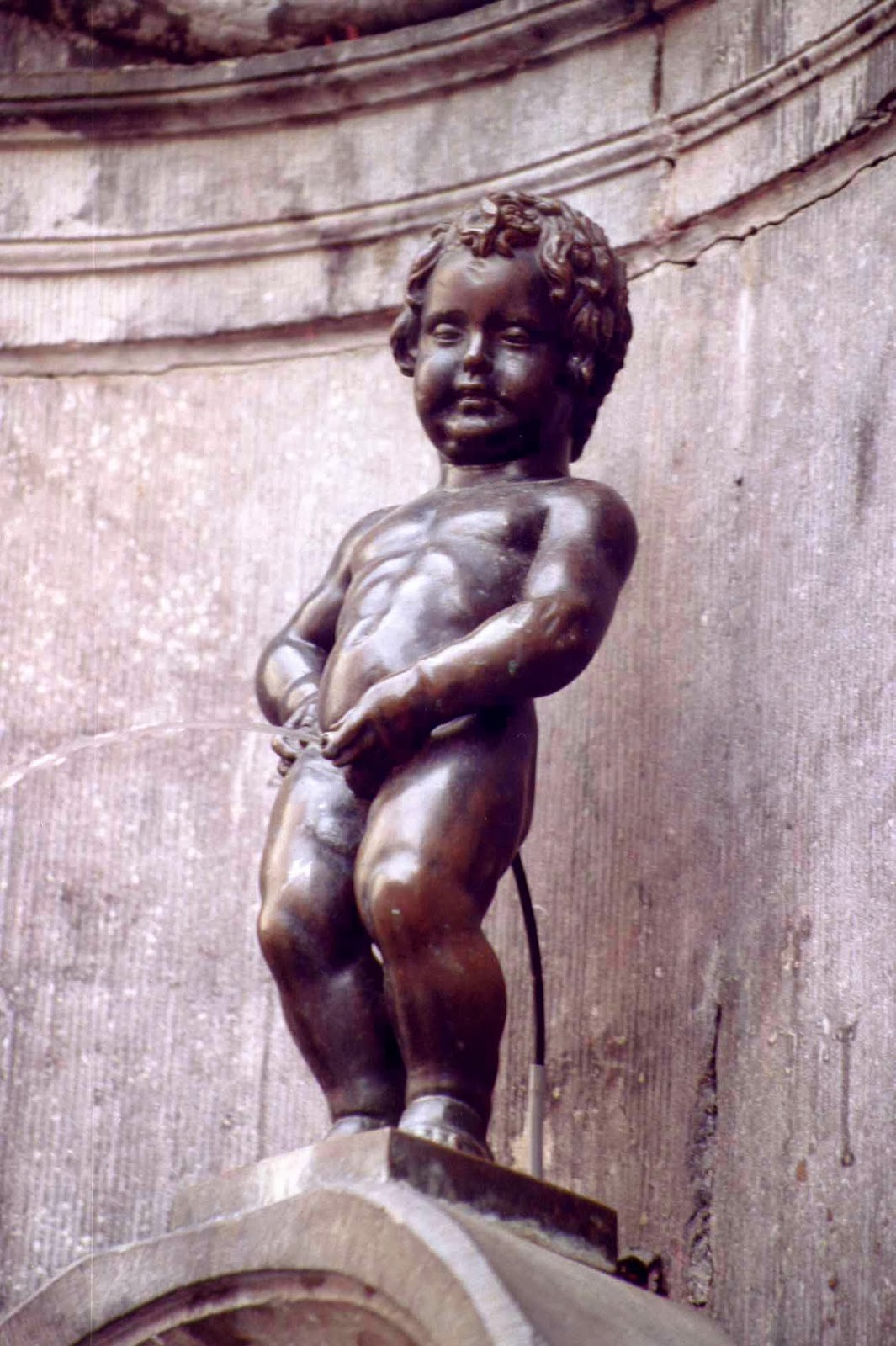
thumbtonosery" (FW p. 253) that Joyce's book represents is the Manneken Pis statue and fountain in Brussels which the
Wake makes frequent reference to. The statue depicts a small boy, a "
wee mee mannikin" (FW p. 576), continually pissing with a grin on his face. One can see why Joyce took a liking to this statue; in his greatest work he virtually obliterated language, the very foundation of all respectable reasonable rational adult structures, to rubble and took a piss on the ashes.