Showing posts with label book review. Show all posts

Sunday, December 21, 2025

A Few Notable Books on Joyce and His Afterlives

Dust jacket art from James Joyce: A Life by Gabrielle Carey.


A big new book related to Joyce was published this year and was received well among the critics and fans alike. The book is actually the story of Joyce's most famous biographer, it's called Ellmann's Joyce: The Biography of a Masterpiece and Its Maker (2025) written by Zachary Leader, who has previously written literary biographies of Saul Bellow and Kingsley Amis. Leader's study of how Richard Ellmann's 1959 biography of Joyce set the standard for greatness in the form of literary biography was recently praised in reviews such as this one from Seamus Perry in the London Review of Books (you can read some interesting letters in reply to that review, too). I will check out Leader's book at some point. Reading Ellmann's big 960-page cinderblock years ago was pivotal for me in my initial pursuit of learning more about Joyce's life. Since then I've read several other biographies of Joyce. I really liked Gordon Bowker's James Joyce: A New Biography (2011), a very detailed walkthrough of Joyce's itinerant life, I found it useful in some of my recent writings and research.

Among the shorter biographies of Joyce (under 200 pages) I'd like to recommend a few that I read in the past year:

James Joyce: Critical Lives Series (Reaktion Books, 2006) by Andrew Gibson 

A very rewarding and informative read. The author Andrew Gibson, who also wrote the book Joyce's Revenge (2002), delivers a fresh approach to documenting Joyce's life which emphasizes the Irishness of Joyce's entire project. This entry in the "Critical Lives" series starts off by stating that the indispensable efforts of scholars like Ellmann, with his gigantic collection of biographical details, and Hugh Kenner with his showcase of the vast multiverse of international, infinitely theoretical Joyce, have taken our knowledge of Joyce extremely far, but Gibson positions his approach by declaring those prior works of Joycean scholarship had not adequately emphasized the why of Joyce's mission nor how entirely Ireland-focused his artistic project was. What if Joyce's whole mission was based on celebrating his home city and fulfilling the destiny of the traditional exiled Irish monk crafting one intricate labyrinthine codex after another? Gibson emphasizes that while Joyce has become a global phenomenon celebrated for aspects of universal inclusivity and coexistence of many ideas, approaches, backgrounds, etc, his work can also be said to always "everywhere be addressing Irish themes and Irish questions." (p. 16) I found myself agreeing with Gibson's assertions and arguments. As I've said before, in my experience nothing sheds more light on Joyce's major works than visiting and learning about Ireland. 

What I really appreciated (and what makes me very intrigued to read more of Andrew Gibson's work) was his insightful attention to the nuances and complexities of Joyce's relationship to his home country during the last few decades of his life. Those years (mid-1910s to the late 1930s), Joyce's most productive stretch as a writer, coincided with violent and highly significant events in the history of Ireland and the Irish War for Independence, and Joyce remained an exile from his home country until his death. The question of Joyce's politics is complex, as Gibson notes, because while he seemed to harbor the hopes of a united independent Ireland free of British rule, he was not exactly a supporter of the Irish nationalist movement of the time, and tended to stray away from their extremes. There is a far more detailed and clearly explained analysis of the concurrence of the birth of the Irish Free State (1922-1937) and Joyce's literary career in Gibson's book. You should read it. It's as informed and fresh of a take on the biography of Joyce as you can find anywhere, packed into an approachable short volume. 


James Joyce: A Life (Penguin, 1999) by Edna O'Brien 

This biography of Joyce from the Irish novelist Edna O'Brien is substantive and well-written. Edna O'Brien was first inspired to be a writer when she initially encountered Joyce's work. In her take on Joyce's biography, she seems to have a knack for capturing the humanity of Joyce the person. She seemed to get him. In this short book she covers the main highlights of Joyce's life seemingly without leaving much out, while also touching on many of the figures in Joyce's circle who were important catalysts in bringing his creations to the public (especially women like Sylvia Beach, Harriet Weaver, Maria Jolas, etc). But what stood out to me about this book was how O'Brien touches on certain intimate details that reveal much. Little things like how, in the depths of his blindness and eye troubles, Joyce would identify guests to his home by their voice. Or how in love he was with his wife Nora, a country girl from the west of Ireland, like Edna O'Brien was. If you wanted to read a concise, entertaining biography of Joyce which covers the main points without getting too bogged down in history, politics, or interpretive theories, this thoughtful portrait from an Irish novelist would be a safe bet. 


James Joyce: A Life (Arden, 2023) by Gabrielle Carey 

This artistic, poetic, whimsical walkthrough of Joyce's life is a very entertaining and enjoyable book in a slim volume. A perfect example of why it is useful to have different approaches to the task of documenting the life of an artist like Joyce. The art of biography is like the art of translation, you can take the basic structure and key details then run with it in a creative way, kinda like doing a cover of a song. This author, Gabrielle Carey, hosted a Finnegans Wake reading group in Australia for many years (Carey passed away in 2023), so she writes from the perspective of one who has been deeply engaged with Joyce's quirkiest text while incorporating the perspectives of others. It's a fun book, with plenty of detail despite being fairly short (140 pgs), including some facts and details you won't find in the books mentioned above (for example, she talks about the medicinal effects of reading Finnegans Wake, and notes the TikTok trend that was going around of people talking about reading Finnegans Wake helping them with mental health struggles). Short chapters, no chunky paragraphs, terse sentences, often quoting from Joyce's texts or his letters without getting too caught up in the details of citations, the book takes a "bower bird approach" as the author describes it. It's a very worthwhile and fun read.


***

A couple other books I've been reading which I haven't finished yet, but which deserve to be mentioned here. I've been focusing on biographical studies of Joyce's life, these other books are in the realm of Joyce's afterlives.

Straight Outta Dublin: James Joyce and Robert Anton Wilson (2025) by Eric Wagner & R. Michael Johnson

This book examines the influence of the works of Joyce on the work of the Robert Anton Wilson, especially focusing on Finnegans Wake. The author Eric Wagner has been hosting Finnegans Wake reading groups for many years and has previously written a guide to the works of Robert Anton Wilson. Here, in a fragmented and digressive approach drawing from a wide array of disciplines, Wagner indulges in in-depth discussions of the Wake, drawing on the insights of John Bishop, Hugh Kenner, Joseph Campbell, while also venturing into other modernists like Ezra Pound and T.S. Eliot, and thinkers like Alfred Korzybski and Wilhelm Reich. In the latter half of the book, R. Michael Johnson (otherwise known as the OG, author of a great substack) provides a detailed survey of the Joyce elements that appear across all of RAW's books.  


Chapel Perilous: The Life & Thought Crimes of Robert Anton Wilson (2024) by Gabriel Kennedy

A perfect supplement to the above is this recent biography of Robert Anton Wilson, going through the interesting and at times harrowing life of the countercultural author. From a young man in Brooklyn during the jazz era in the 1950s, to being involved in Civil Rights protests as a teenager, working odd jobs before trying to be a full-time writer and raise a family. I like that the book even had a list of RAW's known addresses in the back, including his multi-year sojourn in Dublin in the footsteps of Joyce, and then his later years in Santa Cruz where for many years he hosted a Finnegans Wake reading group. 


***

As a bonus, here's one more notable book I've just started reading but haven't gotten very far with yet. It's a unique text called Peripatet (2019) by Grant Maierhofer, with typographical experiments in the vein of Quentin Fiore's work on Marshall McLuhan's books. A deliberately weird and obscure, very intriguing book, it is on one level a document of the author's exploration of Finnegans Wake. As Maierhofer has written, "I read Finnegans Wake... as an ode to forms, forms explored by Joyce himself and referenced throughout the text; forms shattered and rendered useless to traditional interpretive means by intuitive, heartily experimental—almost spiritually so—pages of linguistic forest fires simultaneously enacting and subverting their own interpretation... "
You can read more about the author's approach to reading Finnegans Wake here.

Here's a look inside Peripatet:


*

Have you read any of these books yet? What did you think? Let me know in in the comments. 

Thursday, July 6, 2023

Reviews of Five (Mostly) Recent Books on Joyce, Ulysses, and Finnegans Wake

Consuming Joyce: 100 Years of Ulysses in Ireland (2022) by John McCourt

Last year in June, I was in Dublin for the James Joyce Symposium at Trinity College where I presented a paper. That was my third trip to Dublin in a span of nine months, prior to which I'd never been to Ireland before. The city was bustling for the centennial celebration of Ulysses, which first appeared in 1922. On Bloomsday, June 16th, after attending some panels at Trinity, I wandered around the city and watched locals in the pubs genuinely thrilled for Bloomsday like they were celebrating a local sports team's victory. Dublin was lit and I had a great time hanging with friends throughout the symposium. 
I acquired a few new books during that trip, including this recently published study by John McCourt detailing the reception and impact of Ulysses in Ireland over the last century. Once I started reading Consuming Joyce, I couldn't put it down. I completed it in one long reading session on the flight back to the US. McCourt's approachable yet academically rigorous study goes decade-by-decade showing how Ireland's initially intense hostility against Joyce (and his devoted readers) evolved into hoisting Joyce up on a pedestal as a national hero.
    As an American in Ireland soaking in and savoring the local connections from Joyce's texts, one thing I found especially compelling in Consuming Joyce was the early hostility from the Irish against American readers of Joyce's work and how much that changed over the century. McCourt's book is peppered with quotes from Irish critics and commentators who, in the initial few decades after Ulysses appeared in 1922, relished the opportunity to trash Joyce's American readership. One example (from a review of Stuart Gilbert's guide to Ulysses which appeared in 1930) delivered Joyce some backhanded praise while needling the Americans who love his work: "Joyce is constantly pulling the long Homeric bow in order to astonish the uninitiated; and he has succeeded to some extent, especially with the Americans, where classical learning is not very widely cultivated." (pg. 60) 
    Joyce's old frenemy from Dublin, Oliver Gogarty (immortalized as Buck Mulligan in Ulysses), published an editorial in a Dallas, Texas newspaper in the year 1950 mocking the "Joyce fetish" of Americans, remarking that they all belong in kindergarten, and concluded, "This is a moment in the history of art where cross-word puzzles, detective stories and distortions take the place of literature and beauty. And when we consider that America is the original home of smoke signals, the popularity of Joyce here can be explained." (pg. 110)
    In 1965, an article in the Irish Times mocked "the Joyce posers (or symposers)" and complained that Joyce would be rolling his grave if he'd known what an enthusiastic international readership he'd attained: 
'The bould Jamsie Joyce was writing for Irishmen and for nobody else. I wish the Americans would learn that simple fact. They would be happier if they did.' Joyce would be 'vastly annoyed if he had the gift of clairvoyance to foresee that his books would take on the veneration which is accorded the Talmud. Joyce is now a money-spinner for Dublin hoteliers and if he revolves in his Zurich grave I shall not be very much surprised.' (p. 169)
McCourt's book is filled with quotes like this. The impression I get was that the trajectory of Joyce's reception in Ireland began as disgust and hatred at his portrayal of his fellow countrymen, followed by a sort of nationalist covetousness which disdained foreign admirers hijacking their hero, until the widespread attitude suddenly flipped in the 1980s after the centennial of Joyce's birth. Ireland as a country had changed drastically from its tumultuous revolutionary period in the first couple decades of the 20th century, to its era of repressive Catholicism and strident nationalism, and now strived to become a cultural and economic force on the global stage. McCourt's tracing of these changes alongside the reception of Joyce makes for an insightful recent history of Ireland. The once-reviled Joyce had become central to Ireland's ambitions as a nation: "The post-nationalistic, anti-Catholic, pro-European (but more crucially pro-capital) Ireland of the 1990s—proudly the world's most global economy—found the perfect symbol in Joyce, who had earlier rejected so many of the pieties that the country was now finally beginning to question and demolish." (pg. 210)
While it is an academic study packed with information and footnotes on every page, Consuming Joyce is also an engaging read and I learned much from it. The book mostly shies away from direct engagement with Joyce's texts themselves, mainly focusing on the Irish reception of Ulysses and Finnegans Wake over the years. Also included in here is a fascinating and informative history of the development of the "Joyce industry" including the stories of how places like the Joyce Tower in Sandycove and the Joyce Center on North Great Georges Street became the Joyce museums they are today, as well as background on the origins of the annual international Joyce Symposium. I've attended several of these symposia over the last decade and it was eye-opening to learn how these events began with hostility from the locals until eventually the widespread ostracism of Joyce and his readership evolved into hero-worship, accepting and celebrating Joyce as a leading source of tourism in Ireland, all leading up to the grand celebrations of Ulysses at 100. McCourt skillfully captures the details of how this all came to be. Towards the end, he also surveys the vast landscape of Joyce criticism and scholarship to have appeared over the decades pointing to some of the open frontiers of untapped research. (McCourt is noticeably dismissive of the John Kidd side of the "Joyce wars" and adopts the party line of Joyce academics in accepting the Gabler edition of Ulysses.) Historical nuggets of interest to Joyceans abound in this study, the context provided will be useful to any Joyce reader, and I expect I'll be drawing more anecdotes from Consuming Joyce for blog posts in the near future.


*   *   *

The Book About Everything: Eighteen Artists, Writers and Thinkers on James Joyce's Ulysses (2022) ed. by Declan Kiberd, Enrico Terrinoni, & Catharine Wilson

Another book I acquired in Dublin on its publication day on Bloomsday 2022 (at The Winding Stair bookshop on Ormond Quay a few steps away from the Ha'penny Bridge), this is a colorful collection of reflections on Joyce's art from eighteen different contributors from diverse backgrounds. There's some intriguing stuff in here like an Irish Times newspaper correspondent discussing the newsroom scenes of the Aeolus chapter of Ulysses, a Michelin-starred chef from Dublin digesting the lunch-time episode of Lestrygonians, and a Palestinian-born Jewish Irish sociologist insightfully examining the political implications springing from the Nestor episode. Despite eighteen different voices with vastly different approaches to discussing a complicated novel, the prose throughout this book is refreshingly easy to consume, the collection feels well-edited and stands among the best recently published Joyce books for the general reader. 
Even though I thought a few of the chapters deviated too far from the topic, where authors hardly touched on the Ulysses episode they were assigned, or abandoned Ulysses to instead surf around the infinite multiverse of Finnegans Wake, there were also some absolute gems to be found in here. Eric A. Lewis, co-host of the tipsyturvy Ulysses podcast, presents a superb examination of the Ithaca episode arguing that it turns the reader into a surveillance agent gathering intelligence on Leopold Bloom. It's gotta be the most insightful and unique piece of Ulysses criticism I've read in a while. Another standout was Dublin-born novelist Joseph O'Connor's essay on Sirens, captivating for its rich prose and local context. Additionally, Jhumpa Lahiri's wide-ranging analysis of the meaning behind the flittering bat in the Nausicaa episode left a lasting impression, prompting me to seek out more of Lahiri's work. While this collection may not always offer groundbreaking new readings for the seasoned Joycean, it offers a wealth of great material celebrating the author and his work from a multitude of angles.


*   *   * 


James Joyce in Context (2014) ed. by John McCourt

This batch of 32 essays from different Joyce scholars on various topics related to reading Joyce is a dense academic tome. Unlike the previous book above, the authors here don't attempt to get too creative in their prose style, so I would not consider this an engaging or especially enjoyable read. But as a reference text for various topics related to Joyce, it proves helpful. Personally, I picked this up because I wanted to fill in some gaps in my understanding of Joyce, especially some missing contexts that became apparent during a few trips I took to Ireland. Thus, for instance, I appreciated the essay in this collection about post-colonial Joyce by Gregory Castle. I was curious to know more about Joyce's complicated and seemingly contrarian views about Irish politics since, for example, he maintained his British citizenship all his life, never opting for an Irish passport after Ireland gained its independence. There are no easy answers to these questions, but I do think the reader is provided some helpful perspective in trying to understand, Castle puts it, "that Joyce's nationalism takes the form of a transnationalism in which an anti-nationalist position enters into a dialectical relation with pro-nationalist sentiments." (p. 108) Similarly, Brian G. Caraher's essay on Irish and European politics looks at Joyce's political writings from his younger days and sees an affinity towards socialism—Joyce even attended a meeting of the Italian Socialist Party in Rome in October 1906—but the author, making reference to the book James Joyce and the Question of History by James Fairhall, concludes:
Joyce's cultural politics may share in the broad outlines of a general disillusionment consequent upon the betrayals of international socialism in the early years of the twentieth century. Nevertheless, in Fairhall's persuasive reading, 'however we try to define his ambivalent, elusive politics,' Joyce 'was in any event not a passive esthete, but a literary revolutionist for whom writing represented the supreme political act. (p. 290)
These essays attempt to summarize in a limited space the existing scholarship on certain topics. Another very complex subject that was well-explained here is the postmodernist study of Joyce, the semiotic viewpoint of thinkers like Umberto Eco and Jacques Derrida. I also found the chapter chronologically going into detail about the composition and publishing history of each of Joyce's major works to be a useful and accessible refresher with some new info added too. This volume is a good resource for undergrad or grad students studying Joyce, though hardly a top pick for a general reader interested in the subject.


*   *   *


Beating the Bounds: Excess and Restraint in Joyce's Later Works (2023) by Roy Benjamin


Roy Benjamin teaches English at Borough of Manhattan Community College and has published many articles on Joyce, mostly focused on specific themes and patterns in Finnegans Wake. Among his published articles is a fascinating exploration of the role of axial precession myths in the Wake, a paper whose insights I was inspired to write about at length on this blog several years ago. The publication of a new book-length work by Prof. Benjamin, one of the more prolific and seasoned scholars of Finnegans Wake alive today, is a valuable addition to the canon of Joyce criticism. The new book Beating the Bounds: Excess and Restraint in Joyce's Later Works is published as part of the Florida James Joyce Series (edited by Sebastian D.G. Knowles) printed by the University Press of Florida (side note: ain't it ironic that the state of Florida, of all places, has an academic book production system churning out fascinating scholarly studies of James Joyce? For real though, the series has produced some great books but they need to do something about the exorbitant list prices). 
    Benjamin's Beating the Bounds book presents a wide-ranging exploration of the role of boundaries and limits in Joyce's writing, showing how Joyce had a Jesuit penchant for structured systems organized by boundaries but also insisted on shattering any notion of limits. Beating the Bounds shows Joyce's tendency toward transgressing boundaries in several different aspects of his work. I describe this as a wide-ranging study because, while the book is laser-focused on the subject of creating boundaries and breaking them, Benjamin identifies this pattern across several disciplines; there are chapters on Joyce's treatment of these themes in philosophy, Irish politics, mathematics, aesthetics, ecology, gender studies, and scientific cosmology—while enlisting ideas and quotes from an eclectic array of thinkers like Camile Paglia, Ken Wilber, Marshall McLuhan, Jacques Derrida, Slavoj Zizek, Ludwig Wittgenstein, and Friedrich Nietzsche. The approach Benjamin takes in his examination is to crack open specific lines and phrases from Finnegans Wake, using Roland McHugh's annotations, Encyclopedia Britannica and the Oxford English Dictionary, while revealing connections and correspondences to illustrate the repeated dialectic of boundary making-and-breaking. To read of this dialectic playing out thru the realms of ecology in "the mountain and river system" of the Wake or the cosmologies of a bounded or an infinitely boundless universe, all through the freighted language of the Wake is an enlightening experience even if requiring close attention to understand. Benjamin's explications allude not only to the roster of thinkers listed above, but frequently touch on classics like Greek myth, the Bible, and Shakespeare. No doubt, the material is dense, not unlike reading John Bishop's study, Joyce's Book of the Dark—the pages of Beating the Bounds are built of paragraphs weaving in quotes from across the Wake, while annotating the portmanteaus. I'm usually hoping for new perspectives or new notes on specific lines from Joyce's text and Benjamin's book delivers plenty of that. It doesn't always make for easy reading, but also Beating the Bounds successfully avoids bogging down the reader in the analytical jargon of academic theories, managing to thread a needle in presenting a wide-scoped view of a specific subject found evident in abundance all across the Wake.


*   *   *

James Joyce's Mandala (2023) by Colm O'Shea

Stuart Gilbert's 1930 guide to Ulysses has been criticized for reading too much eastern mysticism into his analysis of Ulysses, even though Joyce himself was supposedly feeding Gilbert information and overseeing his writeup. Joseph Campbell helped to bring the work of Joyce to a wider audience of readers (myself included) with his explication of Joyce finding ample elements from Buddhist and Hindu myths. One of Campbell's vital influences was the German scholar of Indian religions, Heinrich Zimmer. One of Zimmer's books on the study of Maya in Hindu mythology was discovered in the personal library of James Joyce with Joyce's annotations and markings indicating he'd been reading it with interest. This was the trimmed-down library Joyce kept after all the relocations, from his final years in Paris, these were the books he considered important. 
Colm O'Shea's brilliant study of the eastern mystical elements glowing at the heart of Joyce's work begins with the foundation of the notable volumes in Joyce's Paris library. Besides the Zimmer book on Maya there was also a collection of Tolstoy's essays in which Joyce had underlined some striking passages in the essay "Religion and Morality" including these lines: "What is the meaning of my momentary, uncertain and unstable existence amid this eternal, firmly defined and unending universe? … The essence of every religion consists solely in the answer to the question, 'Why do I live, and what is the meaning of my relation to the infinite universe around me?" (O'Shea, p. 2)
Creating frequently compelling comparisons between the meanings involved in the "psychic architecture" of mandalas and Finnegans Wake, O'Shea presents his research in a clear and approachable writing style. James Joyce's Mandala is not only an in-depth study of mandala symbolism in Finnegans Wake, it also provides the reader a fascinating overview of the function of the mandala in eastern religions and meditative practices. The mandala is shown by O'Shea to embody an attempted response to the deep question posed by Tolstoy, "what is the meaning of my relation to the infinite universe around me?" The mandala can be considered a map of psychic states and structures, but it's also seen as a blueprint for the architecture of the universe, centered on a cosmic axis. 
    The chapters of James Joyce's Mandala examine some of the "mandalic motifs" featured in the Wake including the quincunx, the squared circle, and the sphere-cube palace/city structure. The latter structural motif evolves as a more complex version of the world-tree or world-mountain mythic image prominent in eastern myths and prominent in the Wake, as well. Making frequent use of the 1892 study Architecture, Mysticism, and Myth by the English architectural historian William Lethaby, O'Shea identifies intriguing connections with Finnegans Wake, a multi-layered universe which centers around a Chapelizod pub. Parallels are drawn between the three-dimensional versions of a mandala like a stupa or a pagoda and the architectural elements featured in the Wake, where the world-axis is represented as a building which is also a shrine, a tomb or a gate. (There's some correspondence in this part with my comparison of the Wake's portal into the bardo realm with the gopuram entrance to a Hindu temple.)
    O'Shea builds a compelling argument, even providing a whole chapter in the beginning of his book going point-by-point comparing each episode of Dubliners with the structure of the samsaric wheel, conveying the depths of Joyce early interest in eastern mysticism from his earliest writing days (the younger Joyce published a review of a book about Buddhism). One of the more notable links suggested in O'Shea's analysis is the comparison of the two main schools of Buddhism, Hinayana and Mahayana, with the different ways readers might approach Finnegans Wake. The main modes of Buddhism are "river vessels" after all (yana in Sanskrit means "ferry-boat" or "raft"), and the Wake is a book with a river flowing throughout the entire text. O'Shea argues that the Hinayana critic of the Wake imagines they could absorb all the existent critical and scholarly material and eventually reach a meaningful understanding of the text, or enlightenment. While the Mahayana critic of the Wake accepts that the journey from confusion to comprehension never really ends, never reaches a final conclusion. The journey is the point.
    The bulk of the book examines the meanings and uses of the mandala in Buddhism, Hinduism, and psychology while showing the presence and resonance of these in the text and structure of the Wake. Some of these links have been touched on by critics before (a springboard for the book is the explicit assertion that the Wake is a mandala made by Clive Hart in Structure and Motif in Finnegans Wake, published in 1962) but O'Shea's study adds immensely to this discussion. The chapters detailing mandalic representations in the Wake yield rich insights. Along the way, O'Shea uncovers noteworthy gems from Joyce's earlier writings like Stephen Hero, Portrait, Ulysses, and Dubliners. I would not hesitate to describe this book as an essential work of Wake criticism (which makes it unfortunate the list price is ridiculously high). Alongside the Wake-as-mandala theories shared, what really draws the reader into this book is O'Shea's engagement with the question of whether Joyce was descending into a psychotic break while writing his final book. At the end of the book O'Shea devotes an entire chapter to this issue.
    In the introduction he states that, "Artistic genius in a work shouldn't obscure possible evidence that it comes from a sense of personal suffering; conversely, signs of psychological 'malfunction' behind the origins of an artifact do not negate the aesthetic, psychological, or spiritual insight rendered within." (p. 22, O'Shea)

    Later on in the last chapter, O'Shea returns to this question:

The Wake bears uncanny similarity to schizophrenic speech. I'm not pointing this out to claim… that Joyce was a latent psychotic and so we should dismiss his work. I think the truth is more interesting: the Wake-as-mandala is a creative defense from psychosis; its construction is a response to the dark night that descends on spiritual refugees. … Joyce's Wake can be read as both a locus of that sickness–a focus lens for obsessional self-reflexivity—and its own unique method of dealing with that sickness: Joyce's act of writing it was his creative therapy. (p. 174-175)

    That conclusion resonates with his earlier description of the different schools of Buddhism: "Intellectual vehicles, such as the various Buddhist schools of thought, that float in the samsaric flood are, non-dually, part of that flood but also aim to save the refugee from it." (p. 140)
    Overall, this a stimulating and thorough analysis of an interesting correspondence which other authors have sometimes alluded to but never before delineated with such depth. O'Shea's book brings new light to some passages of the Wake, it also provides convincing arguments about the structure of the text as a whole, and hardly shies away from some of the thornier questions of Joyce's sanity, all while providing the reader an approachable overview of some of the key tenets of Buddhist and Hindu philosophy.  

Sunday, February 3, 2019

McLuhan's Jolting Thunders plus Links: the Real Prankquean, RadioMOLI, Joyceans in Mexico & more

Happy (belated) Birthday, James Joyce!

Recently I finished reading Eric McLuhan's extraordinary work of scholarship, The Role of Thunder in Finnegans Wake, after having thumbed through it for about five years. An extremely rich, thoroughly detailed, original and astute analysis, it's not always easy reading but its insights are manifold. It ranks up there with Joyce's Book of the Dark by John Bishop and Wake Rites by George Cinclair Gibson among the best analytical Wake studies I've ever read. Eric McLuhan, son of the famous Canadian media philosopher and Wakean Herbert Marshall McLuhan, takes his father's theory on the meaning of the Wake's ten thunderwords (1,001 letters in all) and explores it in thorough detail for the reader, breaking down the elements of each thunderword to their most discreet etymological units, examining the hundreds of polylingual resonances therein, proving how each successive thunderword piles on the themes of its predecessors and encapsulates the themes of the section of the text where it appears while also signaling a shift into a new technological age.

McLuhan's The Role of Thunder in FW opened up many portals for me. I'm sure you'll be seeing references to it pop up in my upcoming posts here and hopefully I can write a full review of my experience with the text sometime soon. For now, I just want to touch on one of the core aspects of McLuhan's study that left an impact on me and which resonates with the name I chose for this blog, "Finnegans, Wake!" McLuhan's book focuses on the Wake as being part of the tradition of Menippean satire, a form of Cynic parody which aims to jolt the reader into a renewed, heightened awareness of how their senses have been numbed, leading to a clarified perception. Finnegans Wake performs this action by putting daytime rational language to sleep, "otherwise the 'conscious levels' would obtrude upon or obliterate all the others." (McLuhan, p. 30) We are all somnambulantly wandering thru the conscious surface of our hyper-rational language, stuck in the world that cut-and-dry system of words and meanings creates for us. Joyce instead turns language into a wild circus, throwing every verbal trick imaginable into the mix and demanding that we not merely look at the words on the page but speak them aloud, awakening the auditory sense and adding new dimensions to our experience of words. Every part of the Wake is a pun, including the title. The name of the main character, Earwicker, carries many meanings, I often think of it as "ear-waker" awakening the ear. McLuhan points out that the German ihre Wecker means "alarm clock." The Wake's thunderwords contain its densest concentration of these forces.

The Wake enacts the aim of the ancient Cynic philosophers who sought to shake humans into an awareness of their dull adherence to systems of learning, leaving them stuck in a state of numbness. McLuhan points out:

The Cynics' constantly reiterated message stressed three things:
  • To the great and powerful, remember you're human.
  • To the proud, remember you're mortal.
  • To the rest, discard all your pretences and illusions.  (McLuhan, p. 7)

McLuhan also quotes Eugene Kirk who describes the core characteristics of Menippean satires, essentially describing the nature of Finnegans Wake:
"The chief mark of Menippean style was unconventional diction. Neologisms, portmanteau words, macaronics, preciosity, coarse vulgarity, catalogues, bombast, mixed languages, and protracted sentences were typical of the genre, sometimes appearing all together in the same work. In outward structure, Menippean satire was a medley---usually a medley of alternating prose and verse, sometimes a jumble of flagrantly digressive narrative, or again a potpourri of tales, songs, dialogues, orations, letters, lists, and other brief forms, mixed together." (McLuhan, p. 8) 
Key in all of this is the combination of low satire and highbrow learning, as McLuhan writes, "never so serious as when at riot of play, combining low sham with profound learning and the trite and trivial with the quadrivial. ... It can quickly be seen that every technique in the descriptive catalogue aims at the same jolt or sudden flash of awareness by irrationally flinging the reader from one situation or mental posture to another." (p. 8)

A main source of ridicule in all of this is the intellectual fraud, the theorizing intellectuals who think they've got it all figured out. This resonated with me as I've noticed more and more how irritated I am by the pedantry and pompousness of overly rational or scientific thinkers. As the Wake says, "Latin me that, my trinity scholard"! (FW p. 211) Finnegans Wake is kryptonite to people with that mindstate. Of course the western scientific tradition is immensely valuable, but to be so locked into that framework as to think the nature of reality consists of only what has been verified in peer-reviewed scientific research is, to me, a form of madness. McLuhan talks about the Menippean/Cynic approach as intending to wake the reader up using the Book of the Word in order to allow them to actually study the Book of the World. It can't all be explained away in theories and conclusions. McLuhan writes:

Menippean satirists simply deploy the one text, the written book, to cleanse the Augean stables of their readers' sensibilities, and then set the reader to work on the other text, the Book of the World: in all, an intensely grammatical enterprise, and no less so because they do it with language. Of these two books, one, the satire, is an entirely human production, while the other, the world, has been remade and re-uttered by man in and by his own speech and technologies and culture. Civilized man is so enveloped by his own artefacts and technological whims that he has forgotten himself, has lost the ability to perceive and read them as 'signatures' or signs, has become subject to them and spends his days ignorant that he lives in a wild fairyland of his own making. Restoring awareness is a Herculean labour. (p. 10-11, emphasis mine)
One last thing I want to mention here is McLuhan's discussion about the Letter at the center of the Wake as being a red herring. Joyce confounds and frustrates the reader looking for a literal meaning for the Letter and its importance, making us focus instead on the linguistic games used to obscure our pursuit of meaning.

Menippists often take a perverse delight in frustrating readers who try to educe 'right' meanings or coherent narratives from their work: techniques range from putting the preface late in the work, to jumbling the order of chapters or inserting blank pages as chapters... to instructing the reader to write the next few lines or paragraphs, etc. Joyce manages it in a more literary manner, by letting the very style of the Wake float a dozen levels of meaning simultaneously in every passage; so there is not one point of view at a time but many. Again, this ploy will keep the reader from becoming rigid, that is, from adopting a single fixed perspective on the text or the experience, and demands that the reader sustain maximal flexibility of response...
'Our subject is not so much the letter's content, as how that content becomes obscured, and how we are urged to embark on what is tantamount to an archaeological investigation so as to piece its meaning together. This task is carefully made impossible by the Wake itself,' remarks Philip Herring (Joyce's Uncertainty Principle, 200). In true Menippean fashion, the fun and the play is the point, not the interpretation of the content; or rather the real meaning is the effect that the book has on the reader. (McLuhan, p. 301-302)
I'll spare you any more of my scattered responses to McLuhan's book for now. I was sad to learn that Eric McLuhan passed away last year on May 18, 2018 at the age of 76. Now I wish I'd have taken the opportunity to get in touch with the man to discuss his richly fascinating perspective on Finnegans Wake, Menippean satire, and technology when he was alive.

Check out the post "Remembering Eric McLuhan" over at the excellent "McLuhan Galaxy" blog to learn more about his life and career. Also go read this piece by Eric McLuhan's son Andrew in remembrance of his father.

You might also dig this this interesting piece by Robert Guffey in "Paranoia Magazine" that touches on McLuhan's theories on the thunders, Joyce's technological insights, and other adventures in thought.


*   *   *

LINKS:


RadioMOLI is now live! 
The Museum of Literature Ireland (MOLI) has launched a 24/7 digital radio broadcast featuring discussions, interviews, radio plays, documentaries and more. Listen to it HERE. I have it on in the background right now, they are currently playing an audiobook version of A Portrait of the Artist as a Young Man. The radio program launched last night for Joyce's birthday, kicking off with the famous recording of Joyce reciting the end of the Anna Livia Plurabelle episode and they even played a rendition of the "Ballad of Persee O'Reilly" from Finnegans Wake.


RTE "The History Show" discusses the legendary piratess Grace O'Malley
This RTE program featured a terrific segment on the history of the legendary pirate queen Grace O'Malley, the real life figure satirized in Joyce's fiery Prankquean character (discussed in my last post). Listen to the 27 January episode to hear the segment.


How Joyce gave Guinness a new slogan
Over at his always interesting "Swerve of Shore" blog Peter Chrisp details how Joyce provided Guinness beer with a new slogan in a passage from Finnegans Wake while touching on Joyce's penchant for devising new ideas for advertising.


Joyceans in Mexico City
The next James Joyce Symposium will take place this June in Mexico City. "Joyce Without Borders" is now accepting proposals for papers. I'm currently working on mine. The theme and location of this event promises something special. I've been to a few of these conferences now and they're like Disneyland for bibliophiles. Very much looking forward to it!


New online FW reading group "Blotty Words"
Carol Wade has been creating truly stunning paintings of pages from Finnegans Wake for a while now with her "Art of the Wake" project. Now she has launched an online FW reading group called "Blotty Words" which is being run thru this Facebook page.


Save Sweny's!
Sweny's Pharmacy, one of the locations featured in Ulysses (where Bloom buys Molly some lemon soap) is in trouble as the surrounding neighborhood has experienced extreme gentrification and rising rents. The rent for Sweny's, which has been in the same spot since the 1850s, doubled in the past year. A cultural landmark that features daily readings of Joyce and hosts Bloomsday celebrations every year, they are asking for support to help them stay open. You can go HERE to pledge as little as $1 per month thru Patreon to help this landmark of Joyceana stay alive.


Finnegans Wake-End, May 3rd-5th in Dublin
"Waywords & Meansigns" mastermind Derek Pyle and documentary filmmaker Gavan Kennedy will be participating in a weekend celebration hosted by the James Joyce Centre in Dublin in honor of the 80th anniversary of the publication of Finnegans Wake which was officially released to the world on May 4th, 1939. Read more about this event HERE.


Finnegans Wake at 80
Another big event scheduled to celebrate the 80th anniversary of Joyce's masterwork will be this three-day symposium at Trinity College in Dublin, scheduled for April 11-13. Lectures and panels will focus on encouraging "a synthesis of thematic and formal approaches to the Wake through genetic approaches, that is, to look at its stylistic and linguistic complexity through the prism of the notes and manuscripts on which it was written during the period 1922–1939." Read more about this symposium HERE.

Saturday, November 1, 2014

Book Review (Part 4 of 4): Joyce's Book of the Dark by John Bishop


"For too long were the stars studied and man's insides neglected. An eclipse of the sun could be predicted many centuries before anyone knew which way the blood circulated in our own bodies."
- James Joyce 

The eighth chapter of Finnegans Wake is perhaps its most famous section. Known for containing the names of over a thousand of the world’s rivers embedded in its prose, the chapter is devoted to the mother goddess archetype in Joyce’s mythology, the river-woman Anna Livia Plurabelle, “angin mother of injons… the dearest little moma ever you saw” (FW p. 207). In Joyce’s numerology the number 8 is associated with the female, the feminine life-renewing energy, perhaps because 8 is the symbol of infinity ∞ upright. In Ulysses, the 18th chapter is dedicated to Molly Bloom's final soliloquy consisting of 8 long sentences, and her birthday is on September 8th (also the birthday of the Virgin Mary). The centrality of the female in his final work is hinted at right from the opening word of Finnegans Wake, “riverrun” which contains 8 letters.

James Joyce considered the Anna Livia Plurabelle (ALP) chapter to be the showpiece for his entire book. It was his pride and joy, the chapter upon which he was “prepared to stake everything." While the public and his own supporters were questioning the merit (and sanity) of the early published fragments from his Work in Progress, Joyce declared in a letter to his patron “either [ALP] is something, or I am an imbecile in my judgment of language.” Fellow Irishman James Stephens agreed, declaring it to be “the greatest prose ever written by a man.”

Joyce went through seventeen different revisions of the chapter during the Wake’s creation, constantly weaving new river names and foreign words into its pun-laden network, while exhausting himself into a “nervous collapse,” as he told Ezra Pound, from the thousands of hours he worked on it.

The chapter opens with the text forming a triangular shape, the delta symbol ∆ of ALP:

O
tell me all about
Anna Livia! I want to hear all
about Anna Livia. Well, you know Anna Livia? Yes, of course,
we all know Anna Livia. Tell me all. Tell me now. (FW p. 196) 

The ALP chapter consists entirely of a dialogue between two washerwomen scrubbing clothes on opposites sides of a river while chattering and gossiping to each other about ALP and her husband. All throughout the chapter, the inquisitive washerwoman (later referred to as “Queer Mrs Quickenough” FW p. 620) excitedly begs her opposite (“odd Miss Doddpebble” FW p. 620) to divulge more about Anna Livia: “Onon! Onon! tell me more. Tell me every tiny teign. I want to know every single ingul” (FW p. 201). As the chapter comes to a close, night begins to fall, the river widens and rushes more loudly, and the two women can no longer hear each other over the “hitherandthithering waters of. Night!” (FW p. 216).

A beautiful audio recording from 1929 captures Joyce reciting the closing pages of ALP with a playful and theatrical brogue, giving us our one single glimpse at how he intended his enigmatic work to sound. It’s noticeably mellifluous and musical, with Joyce rolling his r's and lilting the vernacular between the two chattering washerwomen.

John Bishop acknowledges that this flowing sonority is the most frequently praised feature of the chapter, but as with the rest of the Wake though, there is so much more to this poetic prose than its "sounddance" (FW p. 378). Initiating the need to explore deeper into the sediments of ALP, Bishop admits: “Not many readers, however, are likely to struggle through very many pages of prose so torturous as the Wake’s simply because, though they may not mean anything, they sound nice.” It is this often overlooked meaning that Bishop endeavors to elucidate.

For the ultimate crescendo of his unique and fascinating analysis of the Wake, Bishop devotes the final chapter of his Book of the Dark study to an investigative plunge into the “riverpool” (FW p. 17) of Anna Livia. With Joyce putting so much emphasis and hard work into his showpiece chapter, Bishop surmises, “we might make the chapter something of a test case of the book as a whole.” Similarly, while there are so many great insights throughout Bishop's Book of the Dark, its final chapter is so rich, enlightening, original and compelling that it could in fact stand as a “test case” for Bishop’s book as a whole. So, to conclude this lengthy summary of Bishop’s delightful and dense book, we shall take a close look into this last chapter, which he entitled "A Riverbabble Primer."

Emphatically putting the final flourishing touches on his fascinating and well-argued thesis that Finnegans Wake represents a rendering of the sleeping state of one man, Bishop takes a microscope to the vivacious streams of the ALP chapter to confirm his theory. He finds ALP’s massive network of rivers is undulating with the sound and pace of a pulse. In short, Bishop argues that the riverwoman Anna Livia Plurabelle represents the watery bloodflow heard pumping inside the sleeper’s body throughout the night.

This accounts for the overall back-and-forth dialogue structure as well as the recurrent rhythm of twos found “ufer and ufer” (FW p.214) again, echoing the binary sounds heard in “the pulse of our slumber” (FW p. 428). The sleeping mind absorbs and amplifies these sounds, unconsciously creating the dream association of flowing rivers until the sleeper becomes immersed in a “watery world” (FW p. 452).

Bishop extends this thread of logic further until we envision the sleeper lying in "foetal sleep" (FW p. 563) with the sounds of pulsing bloodflow triggering reminiscence of and regression to the prenatal bliss of "whome sweetwhome" (FW p. 138) when he was united with the body of his mother or “himother” (FW p. 187). Two hearts beating as one, “uniter of U.M.I. hearts…in that united I.R.U. stade” (FW p. 446).

Of course this is a very radical and unique idea, unlike any interpretation of ALP any Wake scholar has put forth before. It's also fun to ponder and Bishop, a scholar with about as much knowledge about Finnegans Wake as anyone else in the world (he’s been reading it for over 40 years and wrote the introduction to the Penguin edition), presents a most compelling case with his often spellbinding wizardry of exegesis.

Tuesday, February 11, 2014

Book Review (Part 3 of 4): Joyce's Book of the Dark by John Bishop

"(Stoop) if you are abcedminded, to this claybook, what curios of signs (please stoop) in this allaphbed! Can you rede (since We and Thou had it out already) its world?" 
- Finnegans Wake, pg. 18
After the resolute reader has made it through the first 300 dense pages of Joyce's Book of the Dark, its author provides us with a brief respite in the form of an entertaining chapter-long primer on how to read Finnegans Wake. This chapter, entitled "'Litters': On Reading Finnegans Wake," also prepares the reader for the forthcoming exegetical finale, the climax of this enormous study (which we will discuss in Part 4).

FW structure (by Laszlo Moholy-Nagy)
Bishop begins with an apologia for the style of writing he's employed thus far in the book in which words, quotes, and snippets from all over Finnegans Wake are taken and utilized throughout his own prose, often out of context. For instance, in one Bishop sentence he might use three completely unrelated quotes from Joyce's book to build his point. He argues that the Wake itself endorses this kind of reading, pointing to the enigmatic nightbook's references to the ancient practice of Virgilian fortune-telling (Sortes Virgilianae) in which a reader opens the works of Virgil at random ("volve the virgil page and view" FW p. 270) and then interprets the lines as referring to their own life at that moment, a practice of divination very much like using the I Ching. The same tactic works with the Wake. As Allen B. Ruch puts it, "Finnegans Wake seems uncannily alive, as if it's aware you're reading it." Indeed, the Wake can be seen as a Western version of the I Ching which is also known as the Book of Changes---the key symbol of the Wake is a river. Just as Heraclitus wrote that you can never step into the same river twice, it's often said of the Wake that it's a different book each time you read it, as its riverine text is "moving and changing every part of the time." (FW p. 118) (Philosopher Robert Anton Wilson, who was known to randomly flip open the Wake and riff on it during stand-up routines, has an essay discussing in detail the parallels between the Wake and the I Ching in his book Coincidance.)
I Ching diagram

The Wake itself is also explicit in "indicating that the words which follow may be taken in any order desired" (FW p. 121) because, unlike a novel with a sequential and orderly plot, Joyce's circular book might be said to have no beginning or ending and is composed in an alphabet soup of "expolodotonate[d]" (FW p. 353) English, a giant scrapheap of words and letters that have been "blown to Adams" (FW p. 313) or "litterish fragments" (FW p. 66).

The experimental American composer (and noted I Ching devotee) John Cage displayed the idiosyncrasies and strange pleasures that may derive from this type of approach to the Wake in his essay (read aloud here in a gem of a video) "Writing for the Second Time through Finnegans Wake" in which he constructs mesostic poems from dug up Wake words.

Marshall McLuhan was known to keep a specially customized copy of the Wake so as to similarly explore the potentials of piecing together its lexical elements like a child playing with Legos:
The Wake was McLuhan's vade mecum. In later years he kept one copy unbound, with each page pasted onto a sleeve of 3-ring paper. The stack stood in an accessible spot just outside the door of his office. McLuhan was forever plucking fresh pages like a gambler toying with oversized cards. He liked to snap the pages into new configurations, up, down, across, and read the phrases in a kaleidoscopic collage, much as Joyce himself had written them. (Source)
For Bishop, the Wake's frequent allusions to its own brand of "pure chingchong idiotism with any way words all in one soluble" (FW p. 299) are signals to the reader that this type of free associative reading is not only suggested but required if one is to grasp Finnegans Wake. Breaking down a passage from the Wake's opening pages, Bishop details how our hero's fall into sleep brings with it the collapse of every conceivable standing structure; ladders, buildings, trees, etc. but also rational, readable structures too. Bishop frequently adopts particular Wake phrases to return to over and over again to hammer home his theoretical points---in this case, he advises that we must be like Finnegan who "stottered from the latter" (FW p. 6) or tottered and fell from the ladder, except we must be prepared to totter or fall from the letter, the normal rational language of letters. Thus, Bishop concludes:
Together, all these elements are stating obliquely what is everywhere evident in Finnegans Wake anyway: that the language of the book, like the language of dreams and like language autonomically disrupted by the stutter, will operate in a manner unpredictably different from that in which rational language operates. As a reconstruction of the night, Finnegans Wake is "freely masoned" (FW p. 552), "freewritten" (FW p. 280), and structured "in the broadest way immarginable" (FW p. 4) by free associations.
Continuing his impressive interpretative plundering of Wake passages, Bishop takes us through the first paragraph of the Shem the Penman chapter (FW p. 169) which describes, in an exaggerated and absurd parody, the author Joyce:
Shem is as short for Shemus as Jem is joky for Jacob. A few toughnecks are still getatable who pretend that aboriginally he was of respectable stemming (he was an outlex between the lines of Ragonar Blaubarb and Horrild Hairwire and an inlaw to Capt. the Hon. and Rev. Mr Bbyrdwood de Trop Blogg was among his most distant connections) but every honest to goodness man in the land of the space of today knows that his back life will not stand being written about in black and white. Putting truth and untruth together a shot may be made at what this hybrid actually was like to look at. (FW p. 169)
Bishop shows us that in order to understand the Wake's author and the text itself we must read "between the lines" and pursue "distant connections" in our free associative reading because the life of Shem ("an outlex" who is outside the laws---Latin lex---of reason), just like the material of dreams and sleep, "will not stand being written about in black and white", thus it cannot be conceived merely by reading the words on the page. The text of Finnegans Wake is "superscribed and subpencilled" (FW p. 66) so its meaning must be sought above, below, and beyond merely the printed words, just as we would interpret a dream by reading past its bizarre surface material, as Bishop declares:
The greatest obstacle to our comprehension of Finnegans Wake since its publication has surely been a failure on the part of the readers to believe that Joyce really meant what he said when he spoke of the book as a "reconstruction of the nocturnal life" and an "imitation of the dream-state"; and as a consequence, readers have perhaps too easily exercised on the text an unyielding literalism bent on finding a kind of meaning in every way antithetical to the kind of meaning purveyed in dreams... What it really requires of its reader is the ability to pursue "distant connections" and, in doing so, to leap all over the place.
The actual words and material of the Wake available to be absorbed and assimilated by the literate mind conceals hidden, buried, invisible meanings. In other words, "the speechform is a mere sorrogate" (FW p. 149). The physical pages are "packen paper" (FW p. 356 [German Packenpapier, "wrapping paper"]) that must be dug through to discover what lies beneath the surface. The Wake's 5th chapter, which describes the nature of the book itself and its puzzling style, uses the metaphor of a mysterious buried manuscript that's been dug up out of garbage heap by a pecking hen. This exhumed document with its "writing thithaways end to end and turning, turning and end to end hithways writing and with lines of litters slittering up and louds of latters slettering down" (FW p. 114) is pored over by various expert scholars and scientists trying to decipher its "changeably meaning vocable scriptsigns." (FW p. 118) This process of digging and deciphering is a key recurring theme in the Wake and a perfect metaphor for the experience of reading it.
 
Everything about the Wake, in both the macro and microcosm, is essentially a puzzle or a riddle. It describes itself in this sense as a "nightmaze" (FW p. 411), a "jigsaw puzzle" (FW p. 210), a "beautiful crossmess parzel" (FW p. 619 [Christmas parcel + crossword puzzle]), a "cryptogram" (FW p. 261), or "holocryptogram" (FW p. 546) and challenges us "to salve life's robulous rebus" (FW p. 12[a rebus is a pictogram puzzle]). Bishop attests that if you perform Virgilian sortilege and open the book at random, you're bound to come upon a riddle of some sort: "Every word, every phrase, every paragraph, and every story of Finnegans Wake requires the same kind of solution as a riddle does. And this includes the English."

As anyone who's ever participated in a Finnegans Wake reading group knows, trying to solve the riddles on each page is where all the fun lies. Parsing through a single page with a group, you'd be amazed how many things other people will find that you would've never caught on your own. The group approach gives you the feeling that you're all tasked with interpreting the elements of one very long and complicated dream, the dream of HCE or "Here Comes Everybody." Bishop suggests that if you've broken out in laughter in the process of solving these dream-riddles then you are on the right track:
…dreams operate exactly as riddles do, not simply in the wholly intuitive process by which they are untangled, but in the kind of understanding they yield. The successful interpretation of a dream results not primarily in an intellectual understanding, but in an illuminating "click" that wakes up the dreamer in the middle of his own life. And just as the analysis of a dream produces a sudden recognition, just as the solution of a good riddle generates a ripple of mirth, so a good "reading [of the] Evening World” (FW p. 28) works to liberate “everyone’s repressed laughter” (FW p. 190), whose release is a sign that the book has been read rightly: in risu veritas, as Joyce remarked of the Wake (Latin “in laughter there is truth”).
As we dig into the unconscious mind of HCE and try to interpret its many puns and riddles, we are also confronted constantly with forms of child's play, fairy tales, and nursery rhymes. It is this aspect of the Wake that Bishop explores in his book's penultimate chapter, called "The Nursing Mirror." It is considered a forgone conclusion in modern scientific and psychoanalytic circles that dreams and sleep entail a regression to the infantile state. On this subject, Bishop refers to Freud's Interpretation of Dreams which states: "Dreaming is a piece of infantile mental life that has been superseded" and "to our surprise, we find the child and the child's impulses still living on in the dream." Passing into a deep unconscious snooze, the Wake's hero returns to "first infancy" (FW p. 22) and becomes "an overgrown babeling" (FW p. 6). Our immersion into this night world consequently turns us into children as well since, as Bishop describes it, "Joyce puts his reader into a position roughly analogous to that of a child encountering an unknown language for a first time."

It is a childlike curiosity and abandonment of authoritative literal reading that will provide the most rewarding experience for a Wake reader. The aforementioned exhumed document representing the Wake itself is described as being "folded with cunning, sealed with crime, uptied by a harlot, undone by a child" (FW p. 94). Despite the novel's highbrow literary reputation, Bishop proclaims "one must become a child again if one is to read the Wake."

The buried "childhide" (FW p. 483 [childhood that is hidden]) unearthed in the playful, joyous, humorous Wake represents a crumbling of the old man institutions of rational, literalistic language and its supposed "awethorrorty" (FW p. 516 [notice the presence of "horror"]). "The old man on his ars" (FW p. 514) supine and sleeping gives way to the child inside coming alive with no regard for grownup daytime rules and rational structures. The Wake celebrates this child inside all of us, "The child we all love to place our hope in for ever" (FW p. 621).

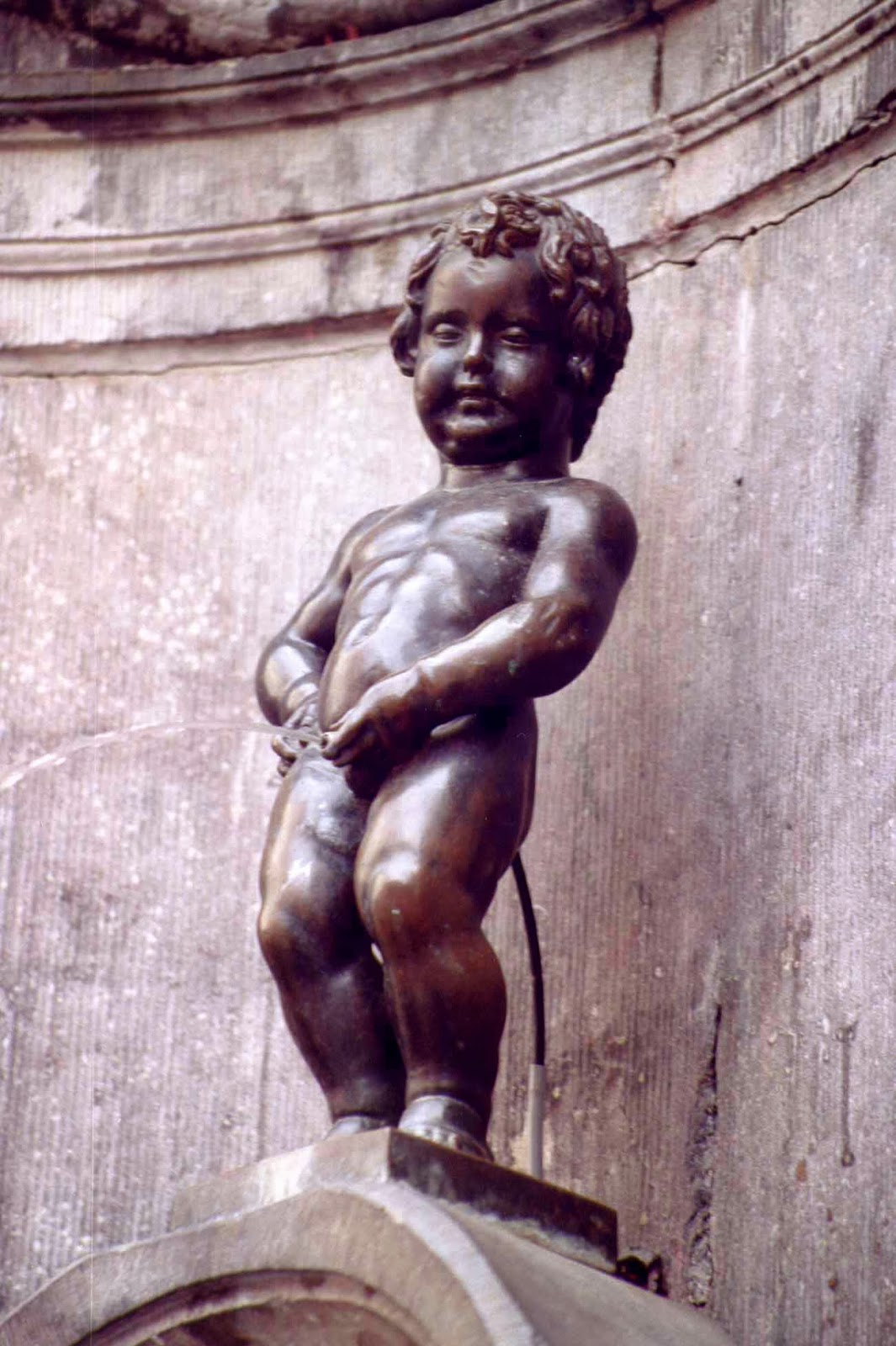
At the heart of the Wake, at the end of one of its densest chapters (Book II, chapter 2 "Night Lessons") the children have begun to take over power from their parents as the old era closes and a new one begins. The children tease their parents in a letter sending "our best youlldied greedings to Pep and Memmy and the old folkers below and beyant" (FW p. 308) while also inscribing doodles in the margins, including an apparent thumb-to-nose image. But the most eminent and comical symbol of this playful "thumbtonosery" (FW p. 253) that Joyce's book represents is the Manneken Pis statue and fountain in Brussels which the Wake makes frequent reference to. The statue depicts a small boy, a "wee mee mannikin" (FW p. 576), continually pissing with a grin on his face. One can see why Joyce took a liking to this statue; in his greatest work he virtually obliterated language, the very foundation of all respectable reasonable rational adult structures, to rubble and took a piss on the ashes.

Wednesday, January 8, 2014

Book Review (PART 2 of 4): Joyce's Book of the Dark by John Bishop

"In fact, under the closed eyes of the inspectors the traits featuring the chiaroscuro coalesce, their contrarieties eliminated, in one stable somebody" 
- Finnegans Wake, pg. 107

As one progresses along through Joyce’s Book of the Dark, the analysis grows deeper and more thorough (as well as dense and slightly more difficult to read) while the rewards of Bishop’s deep investigations become more exciting. At the heart of the text lies the chapter entitled “Meoptics,” the second-longest chapter in the book, in which Bishop comprehensively discusses the visual aspect of Finnegans Wake. Of course, since it’s a book of the dark in which we share in the experience of a main character who is asleep, the chapter begins by driving home the point that there is rarely anything actually visible in the Wake except pitch-black darkness, hence the hundreds upon hundreds of references to darkness, blackness, and every other kind of murkiness all throughout “the lingerous longerous book of the dark” (FW p. 251).

Occasionally, though, visual dreams do occur inside the head of our dreaming hero. “And Dub did glow that night” (FW p. 329). But if the phenomenon of vision entails light bouncing off of objects and then reflecting back to the retina, we are led to wonder how anyone can have visual dreams with their eyes shut. Thus begins a highly fascinating inquiry by Bishop into the optics of one who has their eyes closed. The word “meoptics” (FW p. 139) suggests “my optics” and “myopia” or nearsightedness and Bishop discovers that our sleeper’s eyes are awakened by phosphorescent (“fusefiressence” FW p. 378) flashes on the insides of his eyelids which remain closed in “blepharospasmockical suppressions” (FW p. 515, Greek blepharon means “eyelid”), and “his eyelids are painted” (FW p. 248) with “his own length of rainbow” (FW p. 79) which seems to emanate from inside the body.

In a dark room with eyes closed, the eyeballs are suddenly somehow lit up to form visual dreams which the eyes view across the inside surface of the eyelids like a movie screen. Bishop elaborates: “because the shimmer falling over all surfaces of the world perceived in dreams is created out of the eye’s flesh and cast forth in a semblance of the real, HCE’s ‘eyebulbs’ (FW p. 531) might be understood to create light---‘fleshed light’ (FW p. 222)---like ‘glowworms,’ ‘fireflies,’ ‘lightning bugs,’ and other forms of life that radiate out of living tissue.” As his own flesh flashes forth florescent streams of light, the sleeper confuses them for meteors or “falling angles” (FW p. 21) or lightning bolts or “starshootings” (FW p. 22) and his “gropesarching eyes” (FW p. 167), groping and searching, try to capture these elusive glowing flickers.

Continuing his inquiry into the visual dreams taking place inside the Wake, Bishop engages in one of his rare discussions of the secondary characters in the book, the children Shem, Shaun and Issy. Alluding to the chapters of the Wake known as “The First and Second Watches of Shaun” (the first 2 chapters of Book III), he notes how “the dreamed image of Shaun” lights up the sleeper’s eyes and becomes visible---“now, fix on the little fellow in my eye” (FW p. 486). Known as “Shaun the Postman” he also carries letters and thus literacy and daytime reality, signaling the awakening of the dreamer’s ego. He is associated with space, visible space, and his “spatiality” (FW p. 172) is to bring forth forms of visible space to be “seene” ([scene] FW p. 52). Bishop also notes that Shaun is “as much a figure through whom we see things as a figure whom we see” which is why extended portions of the Wake are actually narrated by Shaun. This all makes sense when you consider the location of the Shaun chapters toward the end of the book when the night is reaching its conclusion and the sleeper will soon wake up to daylight.

With this perspective of the Shaun character in mind, Bishop also sheds new light on the chapter known as “The Mime of Mick, Nick, and the Maggies” (Book II Chapter 1). What seems to be going on in this chapter, according to most Wake commentaries, is a children’s game in which Shem and Shaun have to try to guess the color of Issy’s underwear, leading to a conflict between the two brothers. The chapter is in the form of a stage play, a pantomime filled with rainbows and references to the word heliotrope (which literally means "moving toward the sun"). For Bishop, the entire thing plays out inside the body of the sleeper and he explains the frequent references to heliotrope as having to do with the movement of the “unknown sunseeker” (FW p. 110), the sleeping body of HCE, floating “toward sunrise, resurrection, and the wakened discovery of sunlit vision" as nighttime progresses toward morning.

In this chapter-long vignette, Shem and Shaun take on the roles of Mick and Nick or the Archangel Michael and Old Nick (nickname for Lucifer/Satan), representing the powers of Light and Darkness battling it out inside the eyes of the sleeper. Associated with visual space and daytime reality, the Shaun/Mick figure attempts to awaken the dreamer to light (Joyce sometimes spells Shaun as “showm” or “shone”) and recapture his grasp on reality. Shem/Nick is the force of darkness or deep sleep trying to subdue the dreamer back into blacked-out sleep and the unconscious realm with its “shameful” repressed material. Bishop sees this as the struggle “which structures any dream, during which a variable force impinging on the ‘tropped head’---pain, desire, a sensory disturbance---seeks to return the ego toward wakefulness… while a concurrently acting counterforce [which Freud calls] ‘the universal, invariably present and unchanging wish to sleep,’ dissolves all such ‘upsits’ ([upsets] FW p. 127).”

As for the mysterious Issy character, always one of the toughest elements of the Wake to pin down, Bishop sees her as the ideal beauty who “drifts through the Wake in the guises of so many female models, movie stars, actresses” always inviting the envious eyes of the sleeper inside of whose eyelids her apparition floats like a “skysign of soft advertisement” (FW p. 4). Appearing surrounded by “rainbow girls” she seems to be the sleeper’s associative interpretation of bright rainbow phosphenes ("truetoflesh colours" FW p. 481) flashing on the retina causing HCE’s “Envyeyes” (FW p. 235) to try “to catch… by the calour of brideness” (FW p. 223) these tenuous clouds. Symbolizing two aspects of HCE himself, Shem and Shaun tussle with each other as the “shameful” devilish Shem tries to guess the color of Issy’s drawers while the watchful eye of Shaun steps in to censor him and send him back down into the dark unconscious. Complicated as this "rainborne pamtomomiom" ([rainbow pantomime/pandemonium] FW p. 285) all may sound, for Bishop this entire entanglement embodies the situation inside the closed eyes of the Wake’s sleeping hero.


Of course, there is so much more to his interpretation than my cursory summary suggests, and the visible colors/rainbow theme of Finnegans Wake is one that’s rich enough to write an entire book about. Joyce, who suffered from countless eye diseases and endured about a dozen ghastly eye surgeries during his writing career, was keenly interested in the mechanics of vision and explicitly attested to the Wake’s elaborate “theory of colours” in letters to friends. Bishop’s “Meoptics” chapter unpacks a wealth of information about the color spectrum and Helmholtzian optics found to be present in the “acheseyeld” ([exiled] FW p. 148) Irishman’s magnum opus. Bishop even uncovers a mass network of blinking/eyelid references within this book of forty winks, leading to an examination of “those lashbetasselled lids” (FW p. 474) which, he explains, developed on the bodies of animals living outside of water so they could refresh their eyes with saltwater or “meye eyesalt” (FW p. 484). I assure you, Bishop goes much further in his attempt to “define the hydraulics of common salt” (FW p. 256) in the Wake’s sleeping hero but we’ve covered enough about the eyes, let’s move on to the ears, which any reader of the Wake knows are the most important. “Ear! Ear! Not ay! Eye! Eye! For I’m at the heart of it” (FW p. 409).

*   *   *

“In sleep our senses are dormant, except the sense of hearing, which is always awake, since you can’t close your ears. So any sound that comes to our ears during sleep is turned into a dream.” – James Joyce

When commissioned to create a portrait of Joyce in 1929 to be included with the publication of a section from the as-yet-unfinished Wake, Romanian artist Constantin Brancusi came up with a disarmingly simple illustration featuring a large spiral. This symbol could be representative of many things (and indeed spirals are ubiquitous in Finnegans Wake) but I prefer to picture it as a symbol for the ear. The auditory realm is vast in its scope, allowing one to hear all around them, but the wide world of sounds swirls its way into the inner ear like water whirlpooling down a drain.

In his study of the Wake’s auditory dynamics (the chapter entitled “Earwickerwork”), Bishop maintains that the “sound sense” (FW p. 109) of Joyce’s book is its most crucial component. He mentions fellow Joyce scholar Adaline Glasheen’s suggestion that a  reader should try to count how many times the word “ear” appears in the text as well as other auditory words like “hear” and “listen” and “sound.” With the help of the online search engine FWEET (Finnegans Wake Extensible Elucidation Treasury), I found those words appear almost 300 times in the 628 page book and that’s not counting the words like “Bullsear!” (FW p. 9) and foreign words such as the ubiquitous “oreilles” (“ears” in French) and other ear ciphers.

The ears of the sleeping body at the center of Finnegans Wake never fall asleep, thus the hero’s central nickname “Earwicker” which derives from the Anglo-Saxon Euerwaar or “Ever-Waker” and designates a watchman.  All of the sounds in his surroundings leak into his head as “Acoustic Disturbance” (FW p. 71) and find their way into his dreams. These sounds include his own body’s snoring, the beating of his heart, the grumbling of his stomach (“all the vitalmines is beginning to sozzle and chew and the hormonies to clingleclangle” FW p. 456), farts, grinding teeth, and perhaps sleepily mumbling to himself “imeffible tries at speech unasyllabled” (FW p. 183). Outside sounds like cars, trains, singing birds, and even a rooster crowing “Cocorico!” (FW p. 584) proliferate towards the end of the book when morning approaches, confirming (according to Bishop) the work’s overall chronological structure of one single night experienced by “one stable somebody” (FW p. 107) as opposed to the “universal dream of some disembodied global everyman as some Wake critics have attested.”

Indeed, Bishop’s textual analysis diverts sharply from the general consensus of Wakean criticism at times but he always backs up his imaginative arguments thoroughly and convincingly. This was particularly the case with his piecing apart of the pages which open Book II, chapter 3 of the Wake. This is perhaps the most difficult and dense chapter in Finnegans Wake, but the opening seems to be describing a very complex and powerful radio, “as modern as tomorrow afternoon… equipped with supershielded umbrella antennas” (FW p. 309) inside Earwicker’s pub. At least that’s how it had always been interpreted. I had always loved this image since it was one of the many examples in the Wake of technology that hadn’t been invented yet. Bishop sees things differently though, and the results of his detective work appear to be impeccable.


He begins his virtuoso exegesis of the radio passage by emphasizing the most worthwhile approach to interpreting the Wake: “rather than reading it linearly and literally, we interpret it as we might interpret a dream, by eliciting from the absurd murk a network of overlapping and associatively interpenetrating structures.” Digging into the murk of this ostensibly electronic passage he uncovers that “this harmonic condenser enginium” (FW p. 310) not only conceals the appearance of the sleeping body of HCE at all times but specifically alludes to his head (“enginium” = Latin ingenium or “mental power”) described as having “a howdrocephalous enlargement” (FW p. 310) (Greek kephale means “head” and the medical term hydrocephalus means “water on the brain”). Concurrently, he finds embedded throughout the passage all the anatomical parts of the ear, leaving the Wake reader agape for not realizing all along that what we are dealing with here is just a very dense and radio-analogy-filled description of “the lubberendth of his otological life.” (FW p. 310)


Alongside a diagram of the inner ear, Bishop includes all of the ear anatomy terms like “hummer, enville, and cstorrap” ([hammer, anvil, and stirrup] FW p. 310), “routs of Corthy” ([rods of Corti] FW p. 310), and “tympan” ([tympanum] FW p. 310) which are found to be lurking all over this Wake passage we once thought was describing a radio device. This leads him to declare that “Earwicker, as a recurrent ‘character’ in the Wake, is constituted essentially of two vast, vigilant, and radarlike ears with a large and hydrocephalus head wedged vacantly somewhere in between.”


HCE’s “pricking up ears… picking up airs from th’other over th’ether” (FW p. 452) don’t simply perceive sound, though, they also interpret as they listen, for even while asleep his mind can’t help but activate its predisposition for making what Bishop calls “audiophonic associations” no matter how absurd they may be. As Bishop explains, “Like all of his body, HCE’s ears are humanly made and organized, wired by parents and the authority of literacy.” So the sounds that his “vast, vigilant, radarlike ears” absorb then enter into a massive knotted web of phonetics (what the Wake calls “funantics” FW p. 450), a matrix of words and language which reach back through connections and meanings beyond HCE’s conscious mind, recalling again the aforementioned etymological archaeology of Vico. For Bishop concludes his line of thought thusly:
If a reading of [Vico’s] The New Science shows HCE lying at the evolved end of a diachronic language whose roots lie unrecapturably buried in the unconsciousness of prehistory, immersion in the Wake’s ‘funantics’ complementarily shows Earwicker lying at the center of an immense phonological tangle whose totality is language as a synchronic structure.
Concluding his study of the Wake’s “otological life” (FW p. 310) and “funantics” (FW p. 450), Bishop more or less advises the reader who wishes to engage this notoriously difficult and “superliterate” text to become like HCE and merely listen, letting the breeze of mixed sounds wash over you, drawing up sparks of association, memory, emotion here and there inside one’s radiohead. As hard as this may be, the Wake reader must try to give up the natural inclination to make rational sense out of everything and “abandon the monied and privileged reflex of literacy in order to attain to ‘dummyship’ and become as good an illiterate as HCE.” Or as Finnegans Wake itself states: “What can’t be coded can be decorded if an ear aye seize what no eye ere grieved for.” (FW p. 482)

Monday, January 6, 2014

Book Review (PART 1 of 4): Joyce's Book of the Dark by John Bishop


"Sleep, where in the waste is the wisdom?" - Finnegans Wake, p. 114


Since first discovering John Bishop's monumental book about 4 years ago, I've been disappointed about how little discussion there is about it on the internet. Now that I've finally gotten around to reading it (twice), I'd like to change that here.

Joyce's Book of the Dark is a masterpiece of literary criticism while at the same time an eye-opening scholarly consideration of sleep. Bishop begins with the provocative premise that Finnegans Wake is, at all times, a record of what goes on inside the body and mind of one sleeping person (that is, not just dreams, but even the extended mysterious dreamless periods) and proceeds to build upon that argument almost ad nauseam, deploying snippets from the text of the Wake relentlessly through twelve progressively groundbreaking chapters concluding with a most brilliant and original theory of what the flowing female character Anna Livia Plurabelle really represents in the book.

One of the most fascinating things about Finnegans Wake is that you can study it through any particular lense and construct a pretty good argument that the whole book is all about, for instance, fly fishing---as a funny New York Times piece explored once. There's a whole series of books on Kabbalah in Finnegans Wake; George Cinclair Gibson wrote a well-received book Wake Rites arguing that the ancient rituals of Tara underlie the whole thing; Benjamin Boysen's humongous new study of Joyce declares it's all about love; Marshall McLuhan posited it is “about the electric retribalization of the West” via technology and, following McLuhan, Donald Theall considered it a kind of hybrid literary-electronic-hypertext device. The Wake undoubtedly has a special verbal Rorschach quality to it, inviting endless interpretation, which is one of the reasons why it's so rewarding to read with a group.

Bishop's sleeping body argument is by no means a radical one, though. While Joyce offered few clues about his Work in Progress over the 17 years of its composition and died shortly after its publication without getting to explain much about it, he did certainly make it clear as day in his letters and conversations with friends that this book of his was to be about the night, a "reconstruction of the nocturnal life" and "an imitation of the dream-state." This is part of what makes Bishop's thesis so compelling. Many readers consider Joyce's Book of the Dark to be the finest analysis of Finnegans Wake that's ever been written and I have to agree. Building a gigantic scholarly mountain of material on top of his rather simple thesis, Bishop's text is definitely the most extensive treatment of the Wake thus far; with 385 pages plus 80 pages of footnotes (which are filled with enough enlightening material to form a small book on their own), it's about as wide as a coffee table book and is peppered with geographical maps, etymological charts, diagrams, and illustrations to convey his theories. He writes with an engaging, humorous though densely informative style while incessantly weaving in quotes taken from all over the Wake. This lends his argument an increasingly convincing credence but also forces the reader to slowly parse through passages since, essentially, you're oftentimes reading a collage of various Finnegans Wake snippets.


While Joyce’s most famous work Ulysses maintains a reputation for being impenetrable and puzzling, it's also sprung forth a pretty substantial library of exegeses which make quite clear the book's intentions and intricately constructed mechanisms. With an evolving, erudite and increasingly odd writing style, Ulysses tells the story of Leopold Bloom, a rather ordinary modern human being during a single day in Dublin, zooming closely into his inner experience and the way in which his mind and body interact with the world around him.  While Ulysses is often associated with the stream of consciousness technique, Finnegans Wake, on the other hand, is essentially an account of the "stream of unconsciousness" as its hero drifts off into sleep. Ulysses follows one single day, and the Wake one single night. In the latter, though, all rationality, reason, relativity, spacetime and other daytime mental structures collapse and crumble along with the conscious mind. This is, as Bishop argues, part of the meaning behind Finnegan's fall on the first page, "The fall... of a once wallstrait oldparr" which is "retaled early in bed" (FW p. 3).

With the fall into sleep, there is also a fall inwards of our sensory perception, the world of objects disappears and we fully inhabit the world of our own bodies, in which all dreams take place. Everyone and everything we experience during our dreams is in fact ourselves (Bishop makes liberal use of Freud's Interpretation of Dreams to support this). The same goes for Finnegans Wake, in which a sleeping body underlies every scene, character, and event. As Bishop writes, "All things at the Wake start here, 'in the flesh.'"

Early on in the text, Bishop introduces a thought experiment that he frequently returns to:
Suppose that we charged ourselves with the task of providing in chronological order a detailed account of everything that occurred to us not last night (such an account would be far too sketchy to be useful) but in the first half hour of last night's sleep; or better yet, suppose that we fall asleep tonight intent on preserving for liberal study in the morning a detailed memory of the first half hour of sleep. ... What we are likely to recall... is a gap of obscurity far more stupefying than anything Joyce ever wrote.
Alluding to the etymological source of the word "bed" which derives from a root referring to a dug up spot of turf (think "flower bed"), and quoting from various sources such as Schopenhauer who said "there is no radical difference between sleep and death," Bishop explains the numerous references in the Wake to a corpse---"the presence (of a curpse)" (FW p. 224)---as an intertwining of sleep and death. The sleeper in the Wake is, after all, "tropped head" (FW p. 34) and "Dead to the World" (FW p. 105), completely unconscious of himself as an entity with a name, address, personal history, etc. He no longer possesses an identity or has a body. He simply is a body.


Following this logic, Bishop makes a good case for the main character's recurring initials of HCE standing for hoc corpus est or "this is the body," a Latin phrase from the consecration of the Roman Catholic Mass. The HCE initials take on thousands of different permutations and varieties throughout the book, but while the Wake refers "to him by all the licknames in the litany" (FW p. 234) he is ultimately a corpse (German Leichnam "corpse"), "he's rehearsing somewan's funeral" (FW p. 477), "in beautific repose, upon the silence of the dead" (FW p. 452). Elaborating on his initial thought experiment, Bishop concludes:
These considerations will enable us to begin filling in the vast "blank memory" we all have of the night by allowing us to see that what must take place in parts of sleep void of dreams is the body itself, which has to be there in the "Real Absence" (FW p. 536) of everything else for one "to be continued." ... Since the content of our "knock[ed] out" hero's "tropped head" here is largely "his own body" (FW p. 185)... what is ultimately being represented is less a dream than the fertile ground of dreams ... Finnegans Wake, in other words, is a representation of a human body. This is only what we might expect of a work entitled the Wake, where, as at all wakes, the body is the life of the party. 
This all comes from the chapter on “The Identity of the Dreamer” in which Bishop also ponders the daytime identity, the real regular human being who is the star of the show, lying asleep at the Wake. As Joyce filled his book with references to a giant garbage dump or rubbish heap, Bishop sees this as referring to the “chaotic trash heap of mnemonic bric-a-brac, scraps, trivia, personal memories, and particles of information gathered from such places as the Encyclopedia Britannica and Dublin’s papers and lore.” Sifting through the repeated elements within these scraps, one gathers that “our hero seems to be an older Protestant male, of Scandinavian lineage, connected with the pubkeeping business somewhere in the neighborhood of Chapelizod, who has a wife, a daughter, and two sons… What emerges from an examination of the details is the sense of someone as singularly unsingular as Leopold Bloom.”

Therefore, just as Joyce lifted a drab Dubliner in Bloom up to the lofty heights of a mythological Everyman in Ulysses, Bishop finds that the sleeping figure through whom all of Finnegans Wake emerges is a regular 50-something year old pubkeeper, a perfectly normal guy, or as the Wake so humorously describes him: “One of the two or three forefivest fellows a bloke could in holiday crowd encounter” (FW p. 596), “somebody mentioned by name in his telephone directory” (FW p. 118).

Whereas Bloom was a man with a very creative, intelligent, and inquiring mind, always trying to come up with new advertising ideas and pondering the scientific explanations behind natural events, Bishop postulates that Joyce chose a middle-aged Protestant publican to be the source of the lively cosmic and colorful circus of history that is Finnegans Wake to emphasize the dormant energies lying within all of us always. “What he is unconscious of is precisely his own potential, and the possibility that life could be so much more.”

This is where the ideas of Italian philosopher Giambattista Vico and their major influence on Joyce become so important. It is through his study of Vico that Joyce developed the perspective of the human body containing the entire history of the species within it. As Joyce’s friend Frank Budgen once wrote:
We carry around within us in the unvisited yet populous recesses of our minds signatures of a past infinitely more remote. From the dawn of life to the moment in which we live all experience is written in the structure and function of our bodies---all is preserved in the depths of our memories. This is the unknown country into which we are led when we begin to read [Finnegans Wake].
Since there is an unbroken link of life (as Joyce wrote in Ulysses “The cords of all link back, strandentwining cable of all flesh”) from the earliest humans all the way down the line of history and ancestry to yourself as you are right now, your body contains all of that history within it. Our bodies weren’t instructed how to evolve in the womb from a one-celled organism into a human being, nor do we consciously move our bodies to digest our food or circulate our blood. This important information is all contained within the unconscious wisdom of the biological system. It’s all within our DNA. And this is what Finnegans Wake explores as it depicts the night, when the conscious mind dissolves into the body. 

*   *   *

Einstein raised an amused eyebrow. "Jeem," he said, "you look into words like a biologist looking down a microscope. I begin to believe you really meant all those paradoxes you were reciting last night, about the content of mind being nothing but words."
"The history of consciousness is a history of words," Joyce said immediately.

-  Robert Anton Wilson,  Masks of the Illuminati, p. 229
A recent issue of New Scientist magazine (Sept 7-13, 2013) featured a cover story about how linguists now say “it is possible to excavate thousands of years of human history from the words we speak.” Unfortunately, there is no mention of 18th century Italian philosopher/historian Giambattista Vico who pioneered this idea in his book The New Science (a strange omission considering the synchronicity between their titles). In one of the more enlightening chapters of Joyce’s Book of the Dark, Bishop thoroughly describes Vico’s special brand of verbal archeology and takes us through its major role in Joyce’s conception of the style of Finnegans Wake and even draws interesting parallels between the Wake and The New Science.

It is generally recognized by Wake critics that Vico’s work, The New Science, strongly influenced Joyce but, as Bishop strongly contends, they don’t even come close to recognizing the magnitude of that influence. Every study of the Wake simply repeats the same facts: that the whole text, split up into its 4 books, is structured around Vico’s idea of a cyclical history (“vicous cicles” FW p. 134) with 4 repeating stages and that references to these 4 stages reoccur throughout. While this is certainly true, it doesn't begin to touch upon the importance of The New Science which, Bishop argues, Joyce conceived “as an intellectual foundation that would underlie Finnegans Wake as the Odyssey had Ulysses.”


Vico’s work is essentially an attempt to reconstruct how the rational, enlightened mind of modern man grew out of the beastly animal lifestyle of cavemen, who Joyce calls “our family furbear[s]” (FW p. 132) or forebears. This is an important endeavor as, while we’ve built layers and layers of reason atop our irrational aboriginal mind over the centuries, these irrational foundations still underlie and influence our current state. Predating Freud, Vico invents his own version of depth psychology to burrow into the ancient sources of the human mind to its original infantile state out of which language and civilization eventually grew. While Freud was focused on the influence of one’s parents in striving to cure irrational disturbances within the psyche, Vico’s perspective is that all of history weighs down upon us. As Bishop explains:
The individual cannot purge himself of neurotic unhappiness by rethinking familial past alone, because his parents are largely innocent transmitters of a language and an ideology determined by a history that transcends them and himself both. Fully to understand the irrationalities understructuring his mind, he has to exorcise his parents’ parents, and his parents’ parents’ parents, and [quoting Vico] the ‘first men, stupid, insensate, and horrible beasts,’ who laid down the foundations of human civil life and consciousness.
This partially explains why Joyce frequently rejected the influence of modern psychoanalysis, once declaring “my imagination grows when I read Vico as it doesn’t when I read Freud of Jung.” Bishop points to a strong Vico influence in all of Joyce’s work, even accounting for the complete re-writing of his first novel which began as Stephen Hero and turned into A Portrait of the Artist as a Young Man with a detectable Viconian perspective as the prose depicts Stephen’s mind growing from childish talk toward refined, intellectual language. Vico sees the aboriginal human mind as equivalent to the mind of a small child and it is out of childish babble that “articulate language began to develop by way of onomatopoeia, through which we still find children happily expressing themselves.” (A later chapter in Bishop’s book, “The Nursing Mirror”, explores the playful childishness of the Wake and begins by quoting Freud who wrote, “dreams simply make us into children once more in our thoughts and our feelings” and concludes with Bishop declaring “one must become a child again if one is to read the Wake.”)

Examining the historical development of consciousness through language, Vico’s New Science posits that language begins with the body. This is the first key etymological principle espoused in his book, “Words are carried over from bodies and the properties of bodies to signify the institutions of the mind and spirit.” Hence we use the word “head” for the top or beginning of something, refer to the “eye” of a needle, “mouth” for any opening, “teeth” of a comb or rake, “hands” of a clock, etc. (Bishop even points to the root of the word “language” which derives from Latin lingua or tongue.) These origins are present in all of our language if we consider the deepest etymological roots of words, as Bishop displays with massive two-page charts showing the various networks of words that grew from one common original root.

Vico’s next two etymological principles highlight how important his work truly was for Joyce in creating the Wake, which he called his “history of the world.” The second principle holds that “the internal social history of a people is implicitly preserved in and transmitted through its language, and that all words carry a subliminal record of an entire past: etymology, in short, is also a form of history, or verbal archaeology.” Studying the origins of words and common roots between certain words begins to shed light on the dynamics of the earliest social groupings, the original families and their developing hierarchies. This of course calls to mind the one family of Finnegans Wake which seems to lie behind all characters in human history, their tensions evident in phrases like “The family umbroglia” (FW p. 284) and “family histrionic” (FW p. 230). 

The third of Vico’s etymological principles states that the etymology of language “can reveal not only the internal social formation of a people, but also the international forces that transformed that people through trade, war, migration, colonization” and “miscegenations on miscegenations” (FW p. 18). When nations collide, their cultures and languages collide as well. This is especially true of the English language since their empire expanded to the far reaches of the globe, pillaging other nations while splicing in pieces of their language. As the Wake has it, “our social something bowls along bumpily, experiencing a jolting series of prearranged disappointments, down the long lane of… generations, more generations, and still more generations.” (FW p. 107)

Since it is language that structures our consciousness and creates our reality, we carry all of this history within us. This vast history is what Joyce draws forth through the unconscious mind of HCE. Bishop notes that the Wake “treats its central figure as the raddled blur of millions of persons, most of whom are completely absent from the consciousness that they unconsciously helped to shape. ‘As a singleminded supercrowd’ (FW p. 42), our hero is ‘more mob than man’ (FW p. 261).” The endless gamut of historical figures that pop up on every page of the Wake are there because, in a strange way, they are present in the unconscious (timeless and spaceless) sleeping mind of this humdrum middleaged pubkeeper as having contributed to it. Bishop comes to this incisive conclusion:
HCE’s personality, then, is defined not only by family and contemporaries, but by people as remote in history as Christ and Constantine and Attila. These people are members of his personality: they arise in his ‘nightlife’ not simply in composite structures that obliquely capture his identity, but as parts of him, by virtue of having made parts of his consciousness possible. Thousands of people from the past and from all nations crowd into HCE’s dream to constitute the mind beneath his mind. In the individually dreaming body they establish a thickly entwined human community whose evolution in history has vitally formed the ground of his wakeful life. His ego or ‘I…be the massproduct of teamwork.’ (FW p. 546)


PARTS
2
3
4