Showing posts with label Dublin. Show all posts

Saturday, March 7, 2026

"So This is Dyoublong?" Living Inside the World of the Wake, Part 3

Continuing my American-spectator-in-Ireland, wandering psychogeographical exploration of Finnegans Wake and relevant sites, jumping around the map of Dublin and the Emerald Isle, recalling my time staying there a few years back.

In part two I mentioned that the earliest settlement of Dublin involved two adjacent towns, Dubh Linn, and Atha Cliath. Having recently done a close reading of the Nightlessons chapter (II.2) of the Wake where the bicircular diagram appears, I've become convinced the diagram is, on one level, a reference to the doublin' bi-circular dual-town Dublin origins, a map of ancient Dublin. See more about this here and here


"Vieus Von DVbLIn" (FW 293)

vieux = old Dublin

{Views of Dublin} 


(circle diagram as map of old Dublin )


"Vieus Von DVbLIn"  (FW 293.13)
early-Viking Dublin  
{if interpreting this line as a chronogram the roman numerals V+V+D+V+L+I add up to 566 which is half of the Wake's recurrent 1132, also indicating Dublin circa 566 AD, the Viking era}

Dublin as a town began with the Norse Vikings who invaded and set up a settlement at Dubh Linn. There were already small Gaelic settlements in the area around the Liffey estuary. Atha Cliath was the adjacent settlement where the wickerwork bridge crossed the river Liffey. The name Dubh Linn is old Irish. The Vikings rendered it in old Norse as Dyflin or Dyfflin, which pops up in Finnegans Wake a few times as "in Dyfflinarsky" (13.22) and "in Dyfflinsborg" (582.21). 

The river now known as the River Poddle used to form a pool or a confluence of waters where it met the Liffey River, this pool was known as Dubh Linn which means Black Pool. This body of water historically fed into a protective moat around Dublin Castle. In present day, there is a subterranean network of rivers formed by the confluence of these waters, which runs underneath Dublin Castle. 


                                                        "mind the poddle!" FW 208.30 

See the River Dodder in FW. The Dodder River, Poddle River and the Grand Canal are the remnants of this confluence. "Polycarp pool, the pool of Innalavia" FW 600.04

After this confluence pool was closed off by established embankments of artificial development, the area now known as Temple Bar would frequently breach the sea-walls and flood. This overflowing of the riverbanks seems to be what's taking place when the formatting of the text mutates in the middle of Nightlessons II.2, when the left & right marginal notes disappear and the middle column of text overtakes or floods the page (FW 287-292) and becomes "Floods Area" on FW 289.28.

Besides the modern-day remnants of this confluence of waters in underground networks of rivers, there was also a relatively recent (2018) discovery of a 13th century columnar tower uncovered in an underground excavation near the River Liffey, it's called Isolde's Tower. Read more about Isolde's Tower here.

Joyce in a 1924 letter to Harriet Weaver describing his latest work: "Some of the words at the beginning are hybrid Danish-English. Dublin is a city founded by Vikings." The Norse Vikings had established the city but then after the Anglo-Norman invasion of the 12th century led by Strongbow "from bank of call to echobank, by dint of strongbow" (FW 547.31), the Norse community was pushed out to the north side of the river. The Norse community went "from bank of call to echobank" from one riverbank to the other, settling in the northwest of city center an area that became known as the Town of Ostmen (meaning Eastmen) and later Ostmannstown, today called Oxmantown. Variations on this neighborhood Oxmantown appear throughout FW. "Olaf's on the rise and Ivor's on the lift and Sitric's place's between them" (FW 12.31-32). According to Fweet, these three streets named after Vikings are Olaf Road, Ivar Street, and Sitric Place, all near one another in the northbank side of Dublin. 

Joyce had spent the first decade of his life living in the south side of Dublin, in Bray, and then in Blackrock, but around when he was 11 years old Joyce's father began facing financial issues, and the family moved to the north side of the river in 1893. They lived in Drumcondra ("Draumcondra's Dreamcountry" FW 293) and later on North Richmond Street which is not only used a setting for the story "Araby" and is mentioned by Stephen in Ulysses, it also appears in FW in a list of Joyce's past addresses, "12 Norse Richmound" on FW 420. Many sites on the north side of the Liffey are noteworthy for Joyce research. The James Joyce Center is on North Great George St. where they preserve the door of the building that once stood at number 7 Eccles St, the home of Leopold Bloom in Ulysses. The house at 7 Eccles St was where Joyce's friend once lived, it is also on the north side of town but that whole block has been turned into a hospital, actually it's the same hospital Bloom mentions in Ulysses: "The Mater Misericordiae. Eccles street. My house down there." Years later the Mater Misericordiae hospital expanded and swallowed up the Bloom house. (Read more about visiting Joyce's Dublin addresses in this Guardian piece.)

One afternoon when I was staying in Dublin, I explored the north side, and walked around the Stoneybatter neighborhood on the outskirts of the east entrance to Phoenix Park. Stoneybatter the name means Stony Road, as this area used to be a rocky thoroughfare leading from the countryside into the city. Stoneybatter today is a diverse neighborhood with a substantial Brazilian population. I was at a Brazilian cafe in Stoneybatter once when I ate delicious pão de queijo. Encountered numerous street art murals around Stoneybatter, a place that appears in FW as: 
"stoney badder" FW 242.23
"Staneybatter" FW 291.11
"stony battered" FW 553.29


In Ulysses, the "Cyclops" episode opens:
"I was just passing the time of day … at the corner of Arbour hill there and be damned but a bloody sweep came along and he near drove his gear into my eye. I turned around to let him have the weight of my tongue when who should I see dodging along Stony Batter only Joe Hynes."
When I was in Stoneybatter, I walked along Arbour Hill Road, a street which also pops up in FW a few times. In FW there are multiple allusions to an old site in Arbour Hill Rd area known as Scaldbrother's Hole, it was the hiding place of a notorious thief, Scaldbrother, who would plunder victims and then escape into a subterranean network of caves he knew how to navigate well enough to evade capture. Scald, from the Norse word for poet. See more here, and Glasheen's Third Census of FW mentions:
Scaldbrother—Mm Staples [Hugh Staples, scholar] says that a curious subterranean building in Oxmantown (part of Dublin) is named "Scaldbrother's Hole" after a notorious thief who inhabited it. Scald is a Scandinavian poet. 223.19.
[More here.]

...walking further west along Arbour Hill Road the road makes a ninety-degree turn and curves to the south towards the Liffey ("backtowards motherwaters" FW 84.30). If you continue on that road southward you will come to a park which today contains the Anna Livia statue, formerly located on the Liffey itself but moved to this small park perched over a pond. Locals call it "the floozy in the jacuzzi." When I went to see the Anna Livia statue there were three Irish gents snugly seated together on a bench, enjoying a smoke. Just a park in Dublin with a statue of a river goddess from Joyce's night-novel and a trio of Dublin guys being dudes. 

                (Floozie in the jacuzzi and the three Irishmen.)

Then I was walking westward along Parkgate Street towards Phoenix Park…. Joyce makes specific mention, in Ulysses and FW, of the Phoenix Park murderers having their last drink at a pub on Parkgate Street. Also, located on Parkgate Street is the Nancy Hands pub, named for the first female pub owner in Dublin and in Ireland (link). The Nancy Hands pub is mentioned several times in Finnegans Wake. I enjoyed a pint there one afternoon, and I appreciated the atmosphere of the old place, it felt cozy and historic, and the pub was filled with families, grandparents, grandkids, generations gathering together there for lunch and pints. Just next door to the Nancy Hands pub I noticed a sign for a realtor named Finnegan Menton. A nice little coincidence to see the signs of the Nancy Hands beer garden featured in Finnegans Wake adjacent to a local Irish Finnegan's sign, but this is Finnegans World. 
(Read more about this pub at Peter Chrisp's blog.)

Nancy Hands pub and Finnegan sign.


The pub chapter of FW (II.3) ends with a sailing off of a ship, "So sailed the stout ship Nansy Hans. From Liff away." (FW 382.27) Walking out of the Nancy Hands pub you would turn right and walk westward to go over to the entrance to Phoenix Park. There's a hotel right near the entrance, Phoenix Park Hotel, which isn't specifically mentioned in the Wake but felt significant because the book centers around an inn or hotel, which is also a pub. "Finn's Hotel Fiord" (330.24) More about that shortly.

A passage on FW 564 describes the entrance to Phoenix Park:

Finn his park has been much the admiration of all the stranger ones, grekish and romanos, who arrive to here. The straight road down the centre (see relief map) bisexes the park which is said to be the largest of his kind in the world. On the right prominence confronts you the handsome vinesregent's lodge while, turning to the other supreme piece of cheeks, exactly opposite, you are confounded by the equally handsome chief sacristary's residence. Around is a little amiably tufted and man is cheered when he bewonders through the boskage how the nature in all frisko is enlivened by gentlemen's seats. FW 564.08-17

Sign at entrance to Phoenix Park.


A short walk on the "straight road down the centre" entrance of the park leads to the Wellington Monument, the "Zenith Part" (FW 494.13) of the Wake and Phoenix Park. The Wellington Monument is a central recurrent motif in FW, starting from the "Willingdone Museyroom" section where the Wellington Monument has an underground museum beneath it, full of artifacts from Wellington's defeat of Napoleon in the Battle of Waterloo. To search for an underground Waterloo museum at the Wellington Monument, though, would be like asking if there's a basement in the Alamo. It's just a Wakean dream conflation from Joyce's mind of the obelisk in Phoenix Park standing as a phallic imperial monument to the Irish-born Duke of Wellington, combined with the diorama hilltop museum outside Brussels where Joyce as a tourist had visited the site of the Battle of Waterloo. 

Wellington Monument (Phoenix Park)


The Willingdone monument in real life was interesting to behold, the four sides each featured  their own weathered copper frieze depicting battles, and the sides of the shaft of the obelisk itself featured, in faintly visible faded golden lettering, the names of battles from Wellington's career. There you see the "Pyrenees" and "Monkaseer" etc. One of the friezes displays the scene from the Battle of Waterloo.  

Waterloo frieze on Wellington Monument.


On the Wellington monument in FW, the Joyce scholar Andrew Gibson writes:
The monument was not just a tribute to the 'Iron Duke'. It was also an assertion of British imperial triumph within the Irish capital. Here [in FW], however, Wellington's name functions as a vortex attracting miscellaneous allusions to warfare with which he had no connection [...]. Part of the comic point is to deface the references to Wellington's actual victories that adorn the monument itself.
(
p. 162, James Joyce Critical Lives
That Joyce defaces the Wellington Monument throughout the many allusions in FW is a helpful point. And there are so many references to it, starting with the Willingdone Museyroom scene but then appearing over and over in so many mutating forms. Toward the end of the book, the monument is invoked in a mix of Sanskrit language (perhaps a postcolonial response to British imperialism in India?) with "vellumtomes muniment, Arans Duhkha" (FW 595.22). Can't neglect to also mention the sexual shame aspect, the erotic undercurrent of many of the references to the phallic "Zenith Part" (FW 494.13) in Phoenix Park. In the Wake "the sphinxish pairc" FW 324.07 becomes an Edenic riddle, where some shameful event of a sexual nature is rumored to have occurred. My Dublin guide did mention to me that even nowadays the local Irish teenagers meet in the park for furtive encounters since the Catholic families tend to be pretty tight-knit and uptight households. Gotta find a place to fulfill those desires. Phoenix Park is huge, easy to get lost in. There are many deer in Phoenix Park, it's a vast green space spanning many miles. Phoenix Park is more than double the size of Central Park in Manhattan. It's like a dense dark forest at night, you could see why a primal Wakean scene is a mysterious dream encounter in the park at night. 

A couple of Finnegans Wake-connected pubs flank the outer edges of the park, the most significant one being the Mullingar House in the village of Chapelizod. Joyce's father John Stanislaus Joyce had frequented the Mullingar House when he once worked as a clerk nearby. Lucia Joyce wrote to Frank Budgen in 1933 confirming the central location in Finnegans Wake when she mentioned that, "The principal bistro he [James Joyce] says is the Mullingar Inn" of which the main character is the landlord, HCE the innkeeper. The principal bistro, great phrase. There was a bowling green in the backyard of the Mullingar Inn where Joyce's father John Joyce once had a moment of glory, according to the scholar John Gordon (blog): "His prowess as a bowler, on show on the bowling green in the inn's back yard, was noted in a June 20, 1876 item in The Irish Times." 


I visited the pub now called the Mullingar House in Chapelizod once and enjoyed a pint. It's a 20-minute ride on the bus from Dublin city center. Mullingar House is decidedly not a tourist spot, it's a pub frequented by locals. It wasn't crowded when I was there, and even though there are multiple commemorations of the place's significance to Joyce and Finnegans Wake, there was no indication any person cared much about the connection. You can see, though, a placard above the front entrance touts it as "Home of All Characters and Elements in James Joyce's novel Finnegans Wake." I can't help but wonder if there's some reference there to the recurring initials HCE from the Wake in that phrase "Home of all Characters and Elements."


Joyce plaque in Mullingar House pub.


As I mentioned, the pub hugs the edge of Phoenix Park. Looking at the map I noticed there is a prehistoric dolmen, a megalithic burial site, located in Phoenix Park spatially in the vicinity of the Mullingar House pub (less than 1,000 feet or 300 meters away). A line from FW mentions "Finmark's Howe" (FW 553) where howe is a tumulus or prehistoric burial mound. Many megaliths and tombs appear in the Wake. Whatever significance the Mullingar House may have initially had for Joyce in his life is perhaps less important at this point. For him to have centered the wide Wakean universe on that place, the literary weight it holds now from its placement at the heart of such a phantasmagorical hypertextual construction of thermonuclear poetry as the Wake, that alone gives it immense weight and shadow significance, more than eight decades after the book's publication. Joyce's final novel is sometimes said (by its most ardent acolytes) to contain everything in the universe, therefore that sign above the entrance really says it all, "Home of All Characters and Elements in James Joyce's novel Finnegans Wake." That place is a fulcrum of the universe. (More info on Mullingar pub here and here.)

Across the park to the north, on the opposite side of Phoenix Park in the Castleknock neighborhood there is an old turnstile gateway in the stone wall of the park leading directly to a beer garden at an old tavern called the Hole in the Wall. This pub appears in Finnegans Wake, too. It's another pub for the locals, not a touristy spot. It sits outside the city center in the local streets. This place has also been known as the Black Horse Tavern in the past and it too was even called Nancy Hands pub at one point. I examined an old photo of this place in a prior post on the significance of the portal in the Wake's symbology. The wall and the gate next to the tavern are all very much the same today as they were more than a century ago. (See more about this pub at my post "Beyond the Portal".)


"A glass of Danu U'Dunnell's foamous olde Dobbelin ayle." (FW 7)
Wake pubs:
-Nancy Hands (Stoneybatter)
-Hole in the Wall (Castleknock)
-Mullingar Inn (Chapelizod) [center of the whole thingamagog]

The Mullingar pub might be the principal bistro but the Wake also conflates all these pubs. When the lines on the opening page mention "their upturnpikepointandplace is at the knock out in the park" that seems to conflate Castleknock and Chapelizod, both places with pubs along the park edges, and both have an "upturnpikepointandplace"---whereas the Chapelizod pub is next to a turnpike road, the Castleknock pub has a turnstile gate. The pubs stand in for each other and for all pubs. Joyce does the same with hotels in FW, where Finn's Hotel could be the principal inn, but it's conflated with other Dublin hotels, "the unguest hostel in Saint Scholarland." (FW 135.19) Just as Dublin is conflated with and becomes a double for all cities in the world. 


*   *   *

As I've mentioned before, Dublin in the Wake is not just the setting for a story, it's much more than that. I'm not sure there's any other piece of literature which celebrates a city in so much depth and detail as this (including Ulysses), not just in a descriptive way, the names of Dublin locales form the fabric of the text. Once you learn the names of places you'll notice they are embedded on every page like gravel on a street.

A particularly rich example is the section known as Haveth Childers Everywhere (FW 532-554) where the main character HCE, the master builder, speaking in the first-person, describes the designing and constructing of Dublin. What stands out "from lacksleap up to liffsloup" (FW 547) is not just the lack of sleep in "lacksleap" it's also referring to going from Leixlip (west of Dublin) over to the Liffey's Loopline Bridge (train bridge, which is still there). When HCE mentions how he "ranked rothgardes round wrathmindsers" (FW 541) that invokes the districts of Rathgar and Rathmine in the south part of Dublin.

Another line here is worth venturing into for a moment: 
"I richmounded the rainelag in my bathtub of roundwood" (FW 542)
That's Richmond Hill in Rathmines, and Ranelagh another district in the south part of Dublin city, and then Roundwood which is a village in County Wicklow just outside of Dublin where there is a reservoir ("bathtub of roundwood"). I went out to Roundwood once for a short stay, it's in a beautiful green valley in the region of Glendalough, with scenes of mountains and valleys that were carved in the glacial period. The green hills are wavy and serene. 

Glendalough
"In yonder valley, too, stays mountain sprite." FW 564.26


Roundwood is the name of the village, Glendalough is the valley, and the reservoir itself is called the Vartry. All of these places are named repeatedly in Finnegans Wake. Vartry water and the Roundwood reservoir are also invoked in Ulysses
on his expressed desire for some beverage to drink Mr Bloom in view of the hour it was and there being no pump of Vartry water available for their ablutions let alone drinking purposes

            [from Eumaeus chapter]

            ... 

Did it flow? Yes. From Roundwood reservoir in county Wicklow… 
[from Ithaca chapter]

Driving through the area I also noted the name of the Sugarloaf Mountains which also appear in Ulysses and in FW: "would ondulate her shookerloft hat" (FW 243.28)


*   *   *


Let's circle back into County Dublin proper… 

On a trip back in June 2022, I was staying at the Royal Marine Hotel in the neighborhood of Dun Laoghaire, right on the coast overlooking Dublin Bay with Howth Head looming on the horizon. This is a historic hotel, and yes it is mentioned in the Wake as "ye olde marine hotel" (FW 30.16).

One stop away on the DART train headed south from Dun Laoghaire will take you to Sandycove, where the Joyce Tower and museum is located. I visited the Joyce Tower, otherwise known as Martello Tower number 11, in late June of 2022. I was actually there visiting the tower at the same time as the Joyce blogger Peter Chrisp and his wife and we all hung out for an afternoon.

Sandycove, Dublin


I was amazed with the Sandycove Martello Tower. A resonant space, it felt like a giant stone seashell echoing the nearby roaring waves of the scenic rocky seacoast, a poignant Joycean shrine. Ideal omphalos for Ulysses. What stood out to me being inside the tower space where Joyce, and his friends Gogarty and Trench would've stayed for a few historic nights in September of 1904, was the realization that Joyce stayed there because he was otherwise basically homeless, but then he had fled in fear after Gogarty fired a shot from a revolver near his head when he was sleeping. Being in that resonant echoey interior of the stone tower space it was noticeable how that revolver blast must've scared the living shit out of the young Joyce. I could feel that there.

The stone sea shell fort by the sea also contains a library of Joyce-related books and a collection of artifacts. Included in that batch of materials was a letter Joyce wrote to Gogarty in the summer of 1904 and signed "Stephen Dedalus." I remember one of the things that struck me among the artifacts was a trunk that had belonged to Joyce. It seemed like that thing must've been important for the itinerant author, lugging around notes, scraps, vital books, papers, notebooks in trunkfuls, in a trusty archive, like this was his version of the internet. This was his version of Dropbox or a data storage cloud. A portable storehouse of his important stuff, which he must've lugged around in his many travels and different homes. Joyce once wrote a letter to a friend asking him to retrieve a briefcase filled with notes and ship it to him: "In this briefcase I have lodged the written symbols of the languid sparks which flashed at times across my soul." (see p. 277 of Selected Letters, ed. Ellmann)

You can see the trunk at the Joyce Tower's excellent website here: https://joycetower.ie/collection/artefacts/jtaa_0085-james-joyces-cabin-trunk-c 

                                                                Credit to JoyceTower.ie


Joyce's wallet is there too. I like that custom crafted symbol of the golden triangle with the initials JJ in the middle. Pretty incredible to see.


credit to JoyceTower.ie


Also in the Joyce tower, among many interesting documents and artifacts encased in glass there was a piece of paper with Joyce's handwritten drafts for lines in FW, an original manuscript. Check it out:


All of these lines ended up in the final text of Finnegans Wake. You can see Joyce was drafting out lines, words, different versions of a passage on a piece of stationery from Shakespeare and Co. The paper is undated (just says "May") but this would've been when he was drafting the Shaun chapters so it was likely May of 1924 in Paris. Looking at Joyce's letters I think I confirmed: June 1924 in a letter to Harriet Weaver, Joyce quotes these lines in a letter sent from Victoria Palace Hotel where Joyce was living at the time (V.P.H. the cryptic letters are mentioned multiple times in FW, it must've been a place where Joyce was especially productive in his working on the Wake).

Here's what Joyce wrote on the sheet and where this material ended up in the published book: 

"with half a glance of Irish friskey from under
the shag of his parallel brows"
(appears on FW 470.32-33)

"my soamheis brother" (FW 452.22)
[you can practically see Joyce chewing on and crafting this phrase---so-am-he-is brother while making a pun on Siamese twins, he mentions this in 27 June 1924 letter to HSW]

"amstophere" (FW 452.01)

"walk while you have the night for morn, light breakfast bringer, morroweth whereon every past shall full fost sleep" (FW 473.23-4) [these are the closing lines of book III.2]


*   *   *

I have moved to Dublin to have it out with you,
majestic Shade, You whom I read so well
so many years ago,
did I read your lesson right? did I see through
your phases to the real? your heaven, your hell
did I enquire properly into?
- John Berryman, Dream Songs #312

These lines quoted from the poet John Berryman from his Dream Songs are often interpreted by critics to be about Yeats. On the other hand, this is likely regarding Joyce, as the esteemed Joyce scholar Katherine Ebury has written an insightful article detailing the many Joyce references in the Dream Songs and Berryman's deep interest in Joyce, including when the poet embarked on his own voyage to Dublin where he paid a visit to the Joyce Tower in Sandycove, bringing along a photographer who captured the scene (see the article for pics and more info). 

The spectator in Dublin encounters not one Martello Tower but several along the coast, like stone sentinels. They are all numbered. See Martello towers in greater Dublin area. An old, mossy, medieval sentinel tower stands on the island off of Howth called Ireland's Eye. I was really struck by the appearance of that tower on Ireland's Eye, especially as glimpsed from the Howth Castle area.

That one on Ireland's Eye is designated Martello tower number 3 North. Built in 1803 or 1804 to ward off Napoleonic invasion. Beyond the famous Joyce tower at Sandycove in the south, further down the coast is the Martello Ten tower in Dalkey. Owned by a friend and supporter of this blog, Martello Ten is an incredible historical site, I once had the privilege of getting to spend a few days there. The Joyce Sandycove tower is visible from atop Martello Ten. The Sandycove tower is the omphalos naval point in Ulysses, and I've now come to think of the Martello Ten in Dalkey as Wake Tower, dedicated to Joyce's even grander ode to Dublin and Ireland. 

From the Martello Ten in Dalkey you can see out across the water to Dalkey Island which also has a Martello tower looking back, along with the ruins of an old monastery, a glimpse across centuries. The Dalkey Island tower is Martello Tower number 9. I don't often see Dalkey Island mentioned as must-visit spot on a tour of Dublin, but it's definitely one of my favorite places I encountered. The little island has wild goats, and you're provided with a fantastic view of the Vico Road across the water.

Martello Tower on Dalkey Island.


*   *   *

"Treetown Castle under Lynne. Rivapool? Hod a brieck on it! But its piers eerie, its span spooky, its toll but a till, its parapets all peripateting." (FW 266.04)
    
"Eblinn" (FW 264.15)
 
"A phantom city"   (FW 264.19)


"Libnud" (FW 600.11)

*   *   *


"Each day, and each hour of the day, he thought of Ireland."
- Philippe Soupault describing his friend Joyce 

In part 2, I had been trying to figure out why Joyce stayed away from Ireland for so long, never returning again after the summer of 1912, and yet constantly thinking about, writing about, talking about Ireland, seemingly. 

And now I realize more and more that he could not go back, he would absolutely have been in danger if he went back. See my post about Evil Days and the friends of Joyce's who were killed during the violence of the Irish War for Independence. After 1922 and the establishment of the Irish Free State, Joyce still wouldn't go back to Ireland because he felt under threat for the scandalousness of his famous book Ulysses and how it depicted Ireland, maybe the nationalists might've considered him not loyal enough to the cause. On top of that, it was in 1922 when Nora brought the children to Ireland and they got caught in a cross-fire shootout. 

A letter from Joyce to T.S. Eliot (the publisher of Finnegans Wake in the UK) recounts that violent incident of 1922 and serves as a good coda to this exploration of Joyce and his connection to Dublin. 

JJ letter to TS Eliot Jan 1, 1932
I have been through a bad time telephoning and wiring to Dublin about my father. To my great grief he died on Tuesday. He had an intense love for me and it adds to my grief and remorse that I did not go to Dublin to see him for so many years. I kept him constantly under the illusion that I would come and was always in correspondence with him but an instinct which I believed in held me back from going, much as I longed to. Dubliners was banned there in 1912 on the advice of a person who was assuring me at the time of his great friendship. When my wife and children went there in 1922, against my wish, they had to flee for their lives, lying flat on the floor of a railway carriage while rival parties shot at each other across their heads [...] I did not feel myself safe and my wife and son opposed my going.


More than 90 years after that letter was written, I'm grateful for the safe and welcoming city that Dublin is today and for the time I got to spend there exploring the city's rich culture and history and the endless elements and connections with Joyce's art and life. 


*

To be continued, beyond Dyoublong... 

Sunday, February 15, 2026

"Evil Days": Joyce and State Violence

(pic source: By WD Hogan, Public Domain)

The figure pictured above was a member of the Royal Irish Constabulary (R.I.C.) Auxiliary forces, a paramilitary unit sent into Ireland in 1920 as a counter-insurgency force to brutalize, intimidate, and murder Irish people. They brutally murdered one of Joyce's friends. The Royal Irish Constabulary (R.I.C.), their Auxiliary forces and the so-called Black and Tans are often conflated in historical accounts, and they all appear frequently in the pages of Finnegans Wake in various forms. These were notoriously violent, heavily armed militia troops, jaded WW1 veterans hired as constables to terrorize the Irish. The Black and Tans seem much like I.C.E. in the United States today. Poorly trained recruits from the army, even their attire unseemly, whereas ICE agents wear masks and plain-clothes gear, the Black and Tans got their nickname due to their makeshift attire, since the R.I.C. had a shortage of uniforms, these recruits wore black tunics and khaki pants. They were often recruited out of jails, the more psychotic and violent, the better. The RIC, their Auxiliary troops, and the Black and Tans creep up throughout Finnegans Wake, here are just a few examples:

Saw his black and tan man-o'-war. FW 46.14

          Blech and tin soldies FW 563.31 

          mulattomilitiaman FW 354.10

la garde auxiliaire  FW 471.30

         Mr Black Atkins and you tanapanny troopertwos FW 588.18 

R.I.C. Lipmasks  FW 221.27 

          R.U.C's liaison officer    FW 529.27

his exution with all the fluors of sparse in the royal Irish vocabulary FW 86.01


The Black and Tans were notorious for taking revenge on civilians, such as when they fired on a crowd at a football game in Croke Park in Dublin on Nov 21, 1920, fourteen people were killed including three children, it became known as Bloody Sunday. The shooting was reprisal for the IRA (Irish Republican Army) having assassinated several British intelligence agents and RIC officers that same morning. Bloody Sunday and the Croke Park massacre appear in FW, "Kroukaparka" (FW 176.33) and "croakpartridge" (FW 301.30), and "that surprisingly bludgeony Unity Sunday." (FW 176.20)

With the state-sponsored murders of two Americans by lawless ICE and Border Patrol agents earlier this year, and with my continuing reading and research of Joyce, this stuff has been on my mind lately. Two of Joyce's schoolmates were executed by British forces in Ireland during the Irish War for Independence (sometimes referred to as the "Black and Tan War").

One of Joyce's school friends was named George Clancy, he appears in Portrait as Davin, later he became the mayor of Limerick. He was the mayor when one night, the Black and Tans dragged him out of bed and summarily executed him in front of his family. This was in 1921. Joyce was remembering the shock of this almost 15 years later, in a letter to his son Giorgio 4 Feb 1935 he mentions "my poor friend George Clancy (Davin in Portrait). ... He was afterward Mayor of Limerick and was dragged out of bed by the Black and Tans in the night and shot in the presence of his wife." (Letters 1, Gilbert, p. 357) Read more about George Clancy and the Black and Tans.

Joyce's old friend Francis Sheehy-Skeffington was trying to be a peacemaker during the riots and looting that was occurring in the immediate aftermath of the Easter Rising of 1916. In the midst of the chaos, Skeffington was arrested by the British military, taken to the Portobello barracks, and summarily executed by a firing squad. He was still breathing after the first round so they shot him again. They placed his body in a sack and buried him in the yard of the Portobello barracks and never informed his family who went around Dublin searching for him. This unjust killing eventually led to criminal charges of the commanding officer who would plead insanity as a defense. 

Francis Sheehy-Skeffington (who put his wife's surname in front of his own) was a pacifist, feminist, vegetarian hippie with a beard. Joyce called him "Hairy Jaysus." A relentless activist, militant in spirit but anti-militarist in practice, Skeffington for much of his life was fiercely outspoken about the threat of British military force in Ireland. He also advocated for women's rights and equality, Joyce wrote him into Portrait as the character MacCann, and in Stephen Hero, he's introduced as "a serious young feminist." Joyce and Skeffington had collaborated to publish essays together in their university days, when Joyce wrote "The Day of the Rabblement."

A few interesting notes on Skeffington can be found in the annotations to FW: for example, Francis Skeffington had noted in his diary in 1903 that Joyce and others performed a charade of kaleidoscope as a collide-escape or "A collideorscape!" (FW 143.28) Seems the forces of state violence in Ireland in the first decades of the 20th century led some of its residents to collide or escape, and Skeffington collided while Joyce escaped. 

Skeffington had given to Joyce the nickname Joacax because he was always a jokester. A version of this nickname appears on FW 433: "Words taken in triumph... from the sufferant pen of our jocosus inkerman militant of the reed behind the ear." Jocosus Inkerman Militant = the initials JIM identify Jim Joyce.

Writing to Mary Kettle (maiden name Sheehy, she was married to Joyce's friend Thomas Kettle who also died in the war, and also appears in FW), who was the sister-in-law of Mr. Francis Sheehy-Skeffington, in Sept 1916 after his friend was murdered, Joyce wrote:

I am grieved to hear that so many misfortunes have fallen on your family in these evil days. - Joyce (Letters 1, p. 96)

Skeffington wrote a novel called In Dark and Evil Days and, as noted by scholar Greg Winston, Joyce in his letter honored his friend with an allusion to the title of his book, "in these evil days." Skeffington's book was considered politically radical and it was seized by British soldiers when they violently forced their way into his house after he was murdered. The book was published posthumously. 

Lots more information about all of this is available from the insightful book Joyce and Militarism (2012) by Greg Winston, see below:


*   *   *


"Dope in Canorian words we've made. Spish from the Doc."

This line appears as a footnote on FW 287 and I've never seen much about it in the various sources of annotations. But it interests me for a few reasons. The use of the word "dope" is pretty dope considering this book was published in 1939. The footnote is attached to the word "preteriti" in a paragraph of Latin, the word "preterite" is frequently used by Thomas Pynchon in Gravity's Rainbow to refer to the marginalized masses. Here on FW 287 it's meant to call the attention of a crowd of listeners, to listen to a "Speech from the Dock" or "Spish from the Doc"---a reference to the last words spoken by Irish rebel Robert Emmet, who was executed by the British in 1803 after a failed uprising. 

A quote from the end of Emmet's "Speech from the Dock":

"Let my character and my motives repose in obscurity and peace, till other times and other men can do them justice."


*   *   *


A marginal note on FW 306:

Enter the Cop and How.
Secures gubernant urbis terrorem.


The Latin translates to: axes govern the terror of the city. (Secures is the plural of securis, a hatchet or axe with sharp blade.) These are the axes carried by Lictors in Roman times---they carried the bundle of fasces with an axe, this is a reference to fascism, and a fascist police state. In "Ask Lictor Hackett" (FW 197.06) for example, Joyce compacted axe, hatchet, and the Lictor guardians carrying the ceremonial axe of authority. The bundled fasces with the axe represent the origins of Fascist symbolism. 

Look at the below pic of the Roman lictor, guardian of the Roman magistrates, holding the fasces with an axe, symbolizing rule by force. 


*   *   *

In the midst of the battle/war chapter of the Wake, somebody calls the other a Fascist:
"Fadgest-fudgist!" (FW 323.23)

Later on in that same chapter we read:

"We insurrectioned and... 
before he could tell pullyirragun to parrylewis, I shuttm" (FW 352)

The pic at the top of this post with the R.I.C. auxiliary soldier holding a big gun, that's a Lewis machine gun, likely alluded to in this line, and it could also mean to invoke the name of Percy Wyndham Lewis, an opponent of Joyce who appears as an antagonist in FW.


*   *   *

In the aftermath of the Easter Rising, while Joyce was living in exile in Zurich, a French news journal wrote to him requesting that he write an article about the tumultuous historical events going on in his home country. Joyce replied in the summer of 1918, declining the request.  

I'm translating from his 5 August 1918 letter written in French (see Letters 1, p. 118), in which Joyce replied that he didn't write articles anymore, he was instead devoted to crafting his humble art ("ma pauvre invention"):
the problem of my race is so complex that one needs all the means of a flexible art to sketch it—without ever resolving it....  I am constrained to express it through the scenes and characters of my own humble art.

Saturday, December 21, 2024

"So This is Dyoublong?" Living Inside the World of the Wake, Part 2

Dalkey Island, southeast of Dublin 


I was on an extended stay in Dublin a few years ago and found myself in a shared space somewhere out in Leopardstown on the outskirts of the city. The Leopardstown horse racing course is mentioned multiple times in Finnegans Wake and is still active to this day. No leopards are found in the area, though, the name was a modification of Leperstown, as it used to be called, because that's where the city had once quarantined its leprous citizens. In the Wake it appears as "Leperstower" (FW 237) and "Leperstown" (FW 462). It comes up in a classroom scene in A Portrait of the Artist as a Young Man when a student is missing during roll call and someone blurts out, "Try Leopardstown!"

No matter where I went, whether all the way out in Leopardstown or in the heart of the city, every time I looked up something nearby it seemed there was mention of it in the Wake. It's hard to overstate how much one feels embedded in the Wake due to the places and place names one encounters in that city. At one point I relocated to the city center and, looking on the map, I notice across the street from my hotel was a funeral parlor by the name of Fanagan. This was on Aungier Street, central Dublin. Sounded familiar, so I looked for it in Finnegans Wake and, sure enough, Fanagan's funeral parlor is punned on several times in the book. They've been in business in the same location since the year 1819. You will find "Fanagan's weak yat his still's going strang" (FW 276.22) among other appearances, "and all the fun I had in that fanagan's week." (FW 351) That's Dublin, the center of Wake world. The text of Joyce's encyclopedic 1939 novel is so wide open it seems to encompass everything that's ever been or will be, yet it all revolves around the reliable center anchor that is Dublin and environs. A real place on a map. The same Dublin I was staying in, strolling through, the same street as present-day Fanagan's undertakers fashioning their own wakes for Finnegans for the last two hundred years. 

Being in Dublin means being at a crossroads of mulitverses, a centerpoint of alternate realities, the axis of a mandala where worlds intersect and converge. Joyce scholar Struther B. Purdy wrote an article for the JJQ entitled, "Is There a Multiverse in Finnegans Wake, and Does That Make It a Religious Book?" In that piece, Purdy argued that Joyce's linguistic manipulations and the unmooring of space/time leads to words creating alternate worlds:

Past and present are coterminous because they are different places. Different places and different times coexist; words make worlds. Worlds are therefore a) plural and b) as unlimited in number as are words. "Budlim" (FW 337.26) is not Dublin distorted phonologically to add to the description of the earth's Dublin but a Dublin-like city in another Ireland, possibly the eerieland/"Ereland" of FW 264.31. The "battle of the Boyne" is locatable as the battle of that name in 1690, while the "bettlle of the bawll" is a shadow battle in a different world. (FW 114.36, 337.34).

Further multiplying the shadow worlds of "Dublin-like" cities in Joyce's "Errorland" (FW 62) or "Aaarlund" (FW69) hovering next to and intersecting with earth's Dublin are the various names for Dublin that proliferate throughout Finnegans Wake. Wander the city, take the bus, or ride the train around Dublin, and you'll frequently encounter the Irish names for places (signs and announcements include both the English and Irish language) especially Baile Atha Cliath, the city's Irish name, which translates to Town of the Ford of Hurdles. Hurdles are basketwork, (hence "at Wickerworks" FW 289) which was used as a ford or bridge to cross the river. In the Wake it appears as "fordofhurdlestown" (203.07). Seeing the words Baile Atha Cliath pop up so often around town always harkens back to the Wake where variations of "Baulacleeva" (FW 134) and "Bauliaughacleeagh" (FW 310) inundate the page, "the deep drowner Athacleeath." (FW 539). In the Dublin of the pre-Viking invasions era, there actually were two settlements along the Liffey named Atha Cliath (hurdle ford) and Dubh Linn (black pool). The two names are now interchangeable. Dear dirty Dublin or "Dix Dearthy Dungbin" (FW 370) the center of the Joycean universe, it is astounding when you consider how devotedly Joyce's books focus on Dublin.

*   *   *

All of Joyce's major published works focus on Dublin and when I was there I was wondering, why did this talented author devote all of his energies to document this place, its neighborhoods and characters and histories? And why did he stay away from Ireland for so long? And, especially, exactly when was it that Joyce had last set foot on the streets of Dublin?

Even after his young and defiant departure from the emerald isle with Nora Barnacle in 1904, Joyce made a few trips back to Ireland, first in 1909 and again in 1912. Never again after that. Biographers note that he stayed away for fear he might be attacked in the street, thinking of an incident that happened to Parnell where an assailant threw quicklime powder in his eyes. Nora and the kids got caught in a crossfire in Galway on a visit once. The period of the Irish Revolution was extremely violent, and nationalists not only might accuse Joyce of not sufficiently supporting their cause, in those days they were likely to be angered by Joyce's depictions of the Irish.

Whether reading Joyce's books or walking the streets of Dublin, the emphasis on psychogeographies leads me to be interested in recalling the facts of when was the last time Joyce was physically present in the country he wrote so much about. Here are some details on the last visits James Joyce made to Ireland:

  • July 1909 the exile returns to Dublin for the first time since he left with Nora in 1904. Joyce arrived by ship into Kingstown Pier (now Dun Laoghaire, same pier from which they had disembarked). First thing he spotted on getting off the ship was Oliver Gogarty's fat back, and he avoided his old nemesis. James and his son Giorgio took the train into the city center and were welcomed by his father and sisters at Westland Row Station (present day Pearse station). This was the trip when Joyce bumped into a friend, Cosgrove, who said he'd taken long walks with Nora after dark when they were first dating. Joyce fell into despair, went over to 7 Eccles Street (in north Dublin) to be consoled by his friend Byrne. These events became integral to Joyce's conception of his novel, Ulysses. On that same trip, Joyce met with his nemesis Gogarty for one final tense encounter. Gogarty would soon be transformed by Joyce's pen into Buck Mulligan, the arrogant foil to Stephen Dedalus in Ulysses. By the time Joyce left Dublin with his son in September 1909, he felt sick of the place. 
  • But he would return shortly thereafter, on 21 October 1909. This time he stayed for more than two months. This time it was a very awkward departure when he left Nora in Trieste. He was heading into Dublin for a business venture, looking to find a good location for the new cinema he was helping to put together, the first of its kind in Ireland. He settled on 45 Mary Street, not far from busy Sackville Street (present day O'Connell Street). On this trip, he was also meeting with publisher George Roberts trying to get his first book Dubliners published. During this trip he "went to Finn's Hotel, visited Nora's old bedroom and wept. After dining there, he sat at the table and wrote to her, sobbing as he did so." (Bowker, p. 189) Joyce and his business partners went up to Belfast looking for more sites to build a cinema. The Volta was opened on Mary Street in Dublin in December. During this long time away from his young wife, Joyce and Nora exchanged naughty letters. Seems he had become so aroused, he couldn't resist going to visit the brothels in Nighttown. There's an implication that he might've caught a venereal disease at this point. He confessed this to Nora who stopped sending letters to him for a while after.
  • July 1912, Joyce rushed off to Dublin with Giorgio to meet Nora and Lucia. Bowker pg. 200-201 details how Nora brought Lucia to Ireland to meet her family in Galway in 1912. They also went east where the Dublin Joyces met the girls at Westland Row station on July 8. That's when John Joyce broke down in tears at the sight of Lucia, feeling sad that he'd become disconnected from his favorite son. James Joyce in Trieste was troubled with jealousy, grew anxious over not hearing from Nora, became sad because she stayed at Finn's Hotel without even mentioning to him that it was where they first met. So he borrowed money from friends and rushed off to Dublin from Italy with Giorgio on July 12. Upon arrival, they stayed at 17 Richmond Place with his brother Charlie and family. Of this visit, Bowker writes: 

Joyce was anxious to refresh his memory of the city which he had made the centre-point of his creative imagination. There were places to revisit and fragments of gossip to be gleaned from every encounter, every visit to a bar, every edition of a Dublin newspaper. (p. 201) 

After more difficulties with the printers and publishers over the publishing of Dubliners, Joyce wrote the broadside "Gas from a Burner" attacking those who refused to publish his works for fear of upsetting the Ireland of the time under British rule and Catholic control. He took a ship back to Trieste, never to return to Ireland again. Soon thereafter he started writing Ulysses

Decades later, in 1941 when Joyce and his family managed to escape Nazi-occupied France to enter into Switzerland, an Irishman named Sean Lester greeted them. Lester, the last Secretary-General of the League of Nations, records Joyce's answer when Lester asked him why he did not go home to Ireland: "I am attached to it daily and nightly like an umbilical cord."
(see more here)


*   *   *

"And Dub did glow that night" FW 329.14

The city today has a population that keeps growing, worsening a severe housing shortage. Dublin has become an international tech hub, home to headquarters of Google, Facebook, Microsoft, Verizon, &c. The many colorful lights gleam at night from ultra-modern architecture along the quays of the “efferfreshpainted livy” (FW 452), the effervescent ever-fresh-painted Liffey. Modernized as it has become, the city still constantly summons connections to Joyce's 1939 novel. Of course, the same applies for Ulysses, that book by itself generates substantial tourism to Dublin. As I mentioned in a previous post, I got to walk around the city during the Ulysses centennial on Bloomsday 2022 and really get a feel for the local pride around that book (John McCourt's recent book Consuming Joyce: 100 Years of Ulysses in Ireland gives a great account of the shift in Ireland's attitude toward Joyce). 

I'm taking you through some of my experiences exploring sites relevant to Joyce's work, especially Finnegans Wake. I had been reading the book for at least a decade before I ever set foot in Dublin. When you gain even a passing familiarity with districts in Dublin, a shockingly significant portion of the text starts to become recognizable. I think it is likely true that nothing could better prepare someone to read Finnegans Wake than to visit Dublin and learn about the city. I don't mean to promote the place, although I do love it there. It's just that the Wake is obsessed with Dublin to the point of absurdity, at one point when the opaque book offers a moment of clarity, for instance, it turns into a commercial promoting the city:

This seat of our city it is of all sides pleasant, comfortable and wholesome. If you would traverse hills, they are not far off. If champain land, it lieth of all parts. If you be delited with fresh water, the famous river, called of Ptolemy the Libnia Labia, runneth fast by. If you will take the view of the sea, it is at hand. Give heed! (FW 540.03-08)

I think it is fair to say the text of the Wake contains even more information about Dublin than Ulysses does. Dublin serves as the setting for Ulysses and it is as thoroughly described as could be. In the Wake, though, Dublin becomes the entire texture of the language. Dublin is the subject, object and predicate. City district names blend, morph, and become verbs. To the extent there are characters in the Wake they are on some level representative of aspects of the environment, the father connected with Howth Head, the mother is the River Liffey, the daughter is a cloud, for example.


        (clouds over Dublin)

Everything in the entire history of this place across varying scales of time all coexists on the same plane in the Wake. Dublin becomes a crossroads of multiverses where time folds into and becomes part of space. You notice there is so much history embedded everywhere around Dublin, and how the text of the Wake seems to embody this landscape, its earth layers filled with centuries of history. There is a Timefulness to the place. This is a term coined by the geologist Marcia Bjornerud to describe spaces containing a palpable presence of deep history. As she explains: "I see that the events of the past are still present… This impression is a glimpse not of timelessness but timefulness, an acute consciousness of how the world is made by–indeed made of–time." (p. 127 Saving Time, Jenny Odell) I thought of this when I saw a Martello Tower or when I saw Howth Castle or the rocky cliffs in Dalkey or the promontory in Bray or the rugged coastline at Greystones. Joyce in the Wake captures the essence of this observation in the phrase "this timecoloured place" (FW 29.20). 

A more expansive example of this timefulness quality of Dublin is provided by Joyce when Stephen is walking along Sandymount Strand in the "Proteus" episode of Ulysses and he has this vision of being among the vikings: 

   Galleys of the Lochlanns ran here to beach, in quest of prey, their bloodbeaked prows riding low on a molten pewter surf. Dane vikings, torcs of tomahawks aglitter on their breasts when Malachi wore the collar of gold. A school of turlehide whales stranded in hot noon, spouting, hobbling in the shallows. Then from the starving cagework city a horde of jerkined dwarfs, my people, with flayers’ knives, running, scaling, hacking in green blubbery whalemeat. Famine, plague and slaughters. Their blood is in me, their lusts my waves. I moved among them on the frozen Liffey, that I, a changeling, among the spluttering resin fires. I spoke to no-one: none to me.


"Famine, plague, and slaughters" marked the years of the brutal Viking invasions of Dublin. What Stephen describes are not only scenes of bloody wars in Scandinavian Dublin but also visions of hordes of locals feeding off beached whale carcasses "hacking in green blubbery whalemeat," and this cluster of images comes up again in the first chapter of the Wake as the reader is guided along on a tour of Dublin. 

Men like to ants or emmets wondern upon a groot hwide Whallfisk which lay in a Runnel. Blubby wares upat Ublanium. (FW 13)

Men feeding off "a groot hwide Whallfisk" whale laying in a runnel or a river channel. And the last part is not just the blubber wares of whale meat but the bloody wars at Eblana, another name Joyce uses for Dublin. (Eblana was the name given by Ptolemy in early maps of the Dublin area.) The bloody wars in Dublin becomes a motif repeated again a few more times in the ensuing paragraphs, while also giving the various names for Dublin. 

Blubby wares upat Ublanium.

Blurry works at Hurdlesford.

Bloody wars in Ballyaughacleeaghbally.

Blotty words for Dublin.
(FW 13-14)

I think what is being captured in the varying names for Dublin being stacked this way is showing the changes across time due to the bloody wars and blurry works. But, again, in the Wake all of these historical eras and events are ongoing and coterminous with each other, all active in the same space. 

In the last post, I was describing visions of Dublin, seeing the ink and paper of Finnegans Wake merging with the sewage, rainwaters, roots and soil of the city. I was thinking of the letter in the book, on one level representing the Wake itself, buried deep under the city, taking root in the inner terrain of Dublin. Interlocking with the city innards, like an artery, soaking in the detritus of the city, draining down to the Liffey. Blackpool. Dubh Linn. 

what was beforeaboots a land of nods, inspite of all the bloot, all the braim, all the brawn, all the brile, that was shod, that were shat, that was shuk all the while, for our massangrey if mosshungry people, the at Wickerworks, still hold ford to their healing (FW pg 288) 


*   *   *

If to be able to read Ulysses it is advisable to relate the movements of the characters to a map of Dublin… in Finnegans Wake it is the text itself that, in a sustained embodiment of modern creativity, becomes the map, the pilot's book, the topographical pattern, the metaphoric grid, the model and the structure capable of projecting the image of the world onto a screen, on a two-dimensional page…   

(Carla Vaglio Marengo, "Mapping the Unknown, Charting the Immarginable, Fathoming the Void: Space, Exploration and Cartography in Finnegans Wake", from Joyce Studies in Italy, 2022)


There is a circularity to the geography of Dublin as it's presented in the Wake. It starts with a sentence that cycles around town starting from Adam and Eve's Church, going along the swerve of shore, out to Vico Road in Dalkey, and then "by a commodious vicus of recirculation" cycling around out to Howth Castle. The drilling down into the history embedded in the layers of the landscape I mentioned above seems like a centripetal spiralling down into the vertical depths of "Shuvlin, Old Hoeland." (FW 359.24-26) The "Nightlessons" chapter (II.2) has a bunch of geographical aspects to it, the lessons studied by the children involve the geography of Dublin. It seems the Euclidean overlapping circles diagram on FW p. 293 has a geographical interpretation to it, maybe that is what the directions are providing in the second paragraph of that chapter (on pg 260), where the reader is given an itinerary through the city, we circle "wheel, to where. Long Livius Lane, mid Mezzofanti Mall, diagonising Lavatery Square, up Tycho Brache Crescent" (FW 260) and so on.

A few pages prior there is a passage with a geographical survey of the city: "where G.P.O. is zentrum and D.U.T.C. are radients write down by the frequency of the scores and crores of your refractions the valuations in the pice of dingyings on N.C.R. and S.C.R." (FW 256.29-32) This denotes the GPO, or General Post Office, on O'Connell Street as the center ("zentrum") of the city, with radii "radients" branching out via the DUTC (Dublin United Tram Company) pathways, and then the "N.C.R." and "S.C.R." are the North Circular Road and South Circular Road. When you stare at the map of Dublin with this in mind, looking at the rounded roads along the north and south you could see how the city might be considered a circular or oval oblong shape, as Joyce calls the city elsewhere in the Wake, "D'Oblong." (FW 266.06) This spatial geomapping has some historical accuracy, as described in Roy Benjamin's book Beating the Bounds (2023), the North and South Circular Roads were originally designed to be the boundaries of the city. 

Just as the historical events of the place are not abstract or in the past but actively occurring alongside each other, the city of Dublin doesn't just exist as a static entity in the Wake, it's constantly in motion taking formation as the streets branch out from the river in the heart of the city forming like veins carrying the lifeblood of the community. When Joyce had sent his patron Harriet Weaver a draft section of the Anna Livia chapter including his annotations shedding light on what was going on in the passage, he explained one of the lines this way: "All this is to give the idea of the growth of Dublin, branching out into one street after another." The branching streets and the tracks of the trams and trains venture out from the heart of the city to the suburbs and back. This is the same network described at the opening of the "Aeolus" chapter of Ulysses with the headline blaring "In the Heart of the Hibernian Metropolis" followed by details of the same radii lines of the Dublin United Tram Company expanding outward from the GPO in the center of the city.

The detailed geomapping with the GPO serving as the centerpoint becomes even more outlandish elsewhere in II.2 when the focus is on the suburb of Chapelizod, to the west of city center, the place where the Mullingar Inn pub is located. This pub is considered to be the location of all the events of Finnegans Wake, with the pub owner and his family asleep upstairs and, according to some interpretations, dreaming all of what we're reading in the book. In a passage on pg. 265 the distance from the Mullingar pub to the GPO is given as "only two millium two humbered and eighty thausig nine humbered and sixty radiolumin lines to the wustworts of a Finntown's generous poet's office." (FW 265.25-28) Naming the GPO "generous poet's office" is fantastic, bravo Joyce, but breaking down the distance into "radiolumin lines" is truly mindboggling. McHugh's notes say that there are 2,280,960 twelfths of an inch in three miles (the distance between the GPO and the Mullingar pub). But "radiolumin lines" conjures not only the radius, but also rays (radius) of light (lumin) which gets into all kinds of physics ideas about lightspeed as a measurement. Too much for me to comprehend right now, but we will come back to the landmark Mullingar pub later on.


*   *   *
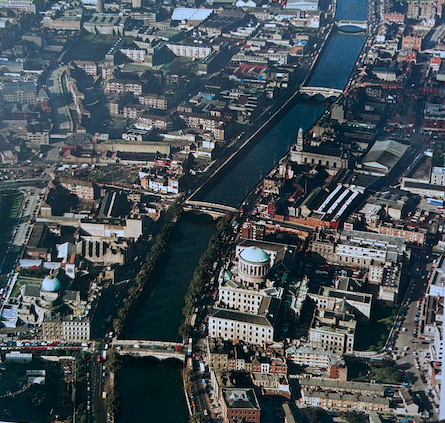

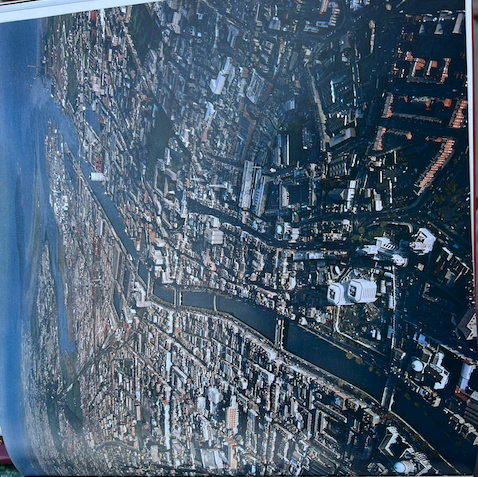
 Centering ourselves at the General Post Office on O'Connell Street, nearby there is the pointed Dublin Spire structure, the city's focal point and a memorial of the site of Nelson's Pillar which once stood there before it was blown up in 1966. If you started from there and walked a few blocks up to Henry Street and turn left, walk a bit and you'll be on Mary Street, a busy shopping area, and you will pass by 45 Mary Street which was the site of the Volta Theater, the first cinema in Dublin, which Joyce had helped arrange on one of his final visits to Ireland. 

From there if you turn left and walk back down toward the river you'll come upon Bachelor's Walk along the north quay of the Liffey—this street is mentioned on pg 214 of the Wake, a part you can listen to Joyce himself reading aloud in a recording, "of a manzinahurries off Bachelor's Walk." From Bachelor's Walk you can cross onto Ha'Penny Bridge to walk across the Liffey onto the south side of the river. This bridge was originally called "Wellington's Iron Bridge" and it appears this way on FW 286.11, with the capitalization and no distortions. On one of my stays in Dublin I was in lodgings right on Bachelor's Walk and got to walk across Wellington's Iron Bridge every day. Here's the view from the bridge after crossing to the southside, where you can see Merchant's Arch, a spot featured in Ulysses.
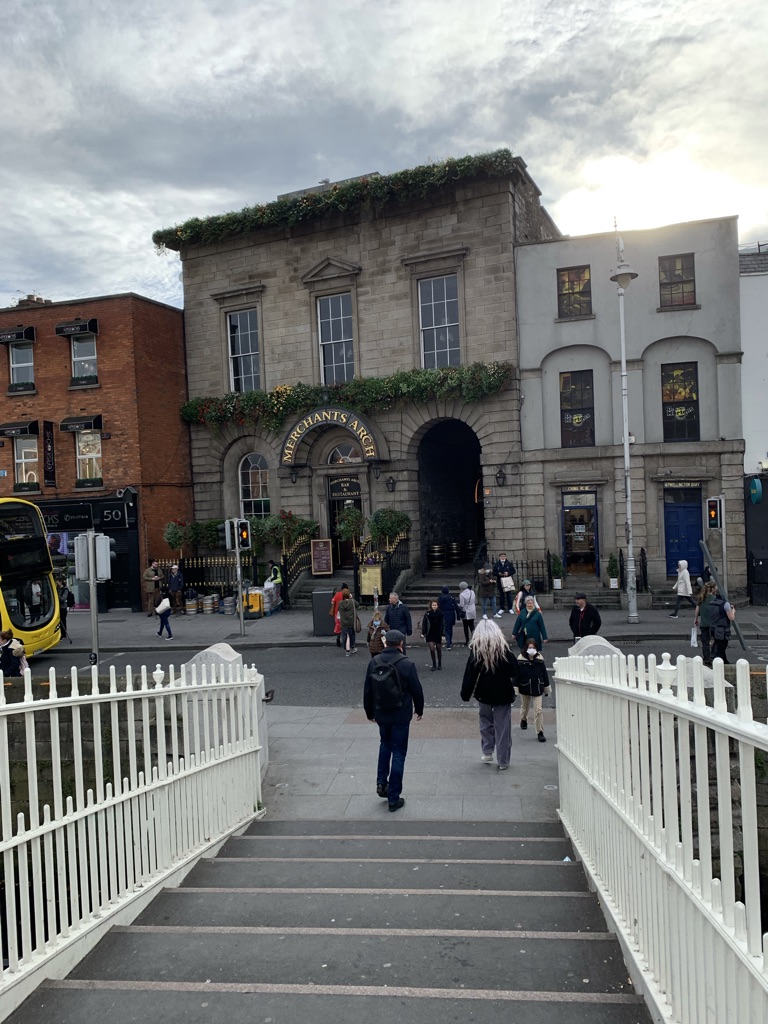

Merchant's Arch from Wellington's Iron Bridge (aka Hapenny Bridge)


Once you cross the bridge you can walk thru the archway, this area used to be filled with bookshops, described in the scene where Bloom is observed scanning books in Ulysses:  "They went up the steps and under Merchants’ arch. A darkbacked figure scanned books on the hawker’s cart." Walk under the archway, go a few blocks then turn left and you'll be heading toward Trinity College. In June 2022, I had the honor of presenting a paper in an auditorium at Trinity for the centennial Joyce conference. It was an incredible moment in my life. I spoke on the morning of Bloomsday. Just outside of Trinity if you walk down Nassau Street you will encounter Finn's Hotel, the site where James and Nora Joyce first met. Finn's Hotel is considered by some scholars to be Joyce's original title for Finnegans Wake. Walk around the corner and you'll find Sweny's Pharmacy and down the street from there is present-day Pearse train station, which used to be Westland Row station which comes up in Ulysses and which Joyce himself had arrived at in one of his last visits to Dublin.

When walking down Nassau Street you can also turn right and go down Dawson Street, and there you will find the historic Hodges Figgis bookstore. This place has been in operation for over 200 years (albeit including moving locations), it is one of the oldest bookshops in the world. It pops up in Ulysses and in Finnegans Wake. It's a fantastic bookstore, a great place to browse for hours. I can tell you that they've got an impressively deep collection of Joyce books. I was there eyeing their several shelves of Joyceana and, can you imagine what it must've felt like when I discovered they had a book on the shelf which named me in the index? I'm not kidding. The book is called James Joyce and the Arts (part of the European Joyce Studies series) and there's an essay in there by Derek Pyle which mentioned THIS BLOG in a footnote. I was in the heart of Dublin, in a bookstore that appears in Ulysses and the Wake, and found my name in a footnote in a Joyce book. Achievement unlocked, life goal accomplished. 

*   *   *

The inspiration for the thoughts I'm sharing here I originally conceived while standing atop Killiney Hill observing the landscape around Dublin, the rolling green Wicklow Mountains in the distance, and I was envisioning how the hills would look in the night in centuries past when, in the words of the Wake, "There were fires on every bald hill in holy Ireland that night" (FW 501). I've been curious about that phrase "holy Ireland" and it doesn't seem to be common, then I saw the same phrase used in a book by the American poet Susan Howe, The Quarry, which mentions "reciting secret languages of holy Ireland." Susan Howe is the daughter of Mary Manning Howe, an author and playwright who was born and raised in Dublin. She was a close friend of Samuel Beckett, and as a playwright she adapted Finnegans Wake to the stage. (see here)

Ireland is a famously evocative environment for writers. I'm focused on Joyce and the Wake here, but Ireland has a rich literary tradition beyond Joyce, and the country today continues to be very welcoming to writers. There are frequent articles about the literary mecca of Dublin, here's one example.

One of the first things that strikes me every time I arrive in Ireland is noticing the old stone walls covered in mossy mold from the sea air, soon as I see the mossy old stone I know where I am. This comes up in the Wake where "though he's mildewstaned he's mouldystoned" (FW 128.02) That moldy stonework and the sea air are part of the recipe for literary brainwork I associate with "holy Ireland."

A passage in Ulysses captures this mixture beautifully:

The air without is impregnated with raindew moisture, life essence celestial, glistening on Dublin stone there under starshiny coelum [Latin, "sky"]. God’s air, the Allfather’s air, scintillant circumambient cessile air. Breathe it deep into thee.

The aforementioned Susan Howe has a sister who is also a renowned poet, Fanny Howe. In her excellent book The Winter Sun, Fanny Howe writes of when she and her sister, both American born, first went back to their Irish mother's home country and encountered Dublin:

"Then we were herded into a bus and headed for Dublin where the clouds were much lower than they were in America. My sister and I gulped in the atmosphere of a new country; it entered our systems like a potion that suffuses the whole and would never leave either of us. It was our mother's body." (pg 30, The Winter Sun: Notes on a Vocation)

"Holy Ireland." "God's air, the Allfather's air," the atmosphere that was "[their] mother's body." To bring this "back to Howth Castle and Environs", the "scintillant circumambient cessile air" and the mossy stone that make up the poetic potion were noticeable in abundance when I went up to Howth one afternoon. I took the DART, Howth is the northmost stop. Howth feels like how I imagined Ireland would be before I ever visited the country. Howth was very green, chilly, cloudy, soggy wet, misty, lots of boats on the docks, and plenty of old stone structures covered in moss. The vibes feel very historical there. I went and checked out Howth Castle and environs. The piratess prankquean "grace o'malice" had trod this ground, ported at this peninsula. It was so interesting being there observing this real and historical space and considering how deeply it has been lodged into my brain as a mythic site, thanks to the legendary Grace O'Malley scene in the Wake. 

Grace O'Malley was a real person, a female pirate from Ireland who, according to legend, arrived at Howth Castle one night in the 16th century, hoping to stay for the night as it was customary in those days for the castle to keep its doors open to offer hospitality to visitors. After she was denied entry at the door, she kidnapped a child from the royal family. All of this is enacted in the language of a fairy tale in the Wake, where the prankquean "grace o'malice" poses riddles to the doorman and kidnaps two children. I found the experience of walking around Howth surreal, considering there's a street named after Grace O'Malley and you can walk up the Howth Castle door where the prankquean "made her wit foreninst the dour." (FW 21.16) Walking around the castle area it felt imbued with a spooky presence, this was a relic of half a millenia ago, the grounds were well trodden, the walls seemed to be alive. Look at the rotting and tree-rooted parapet in the second picture below, notice the timefulness, this was a space filled with time.
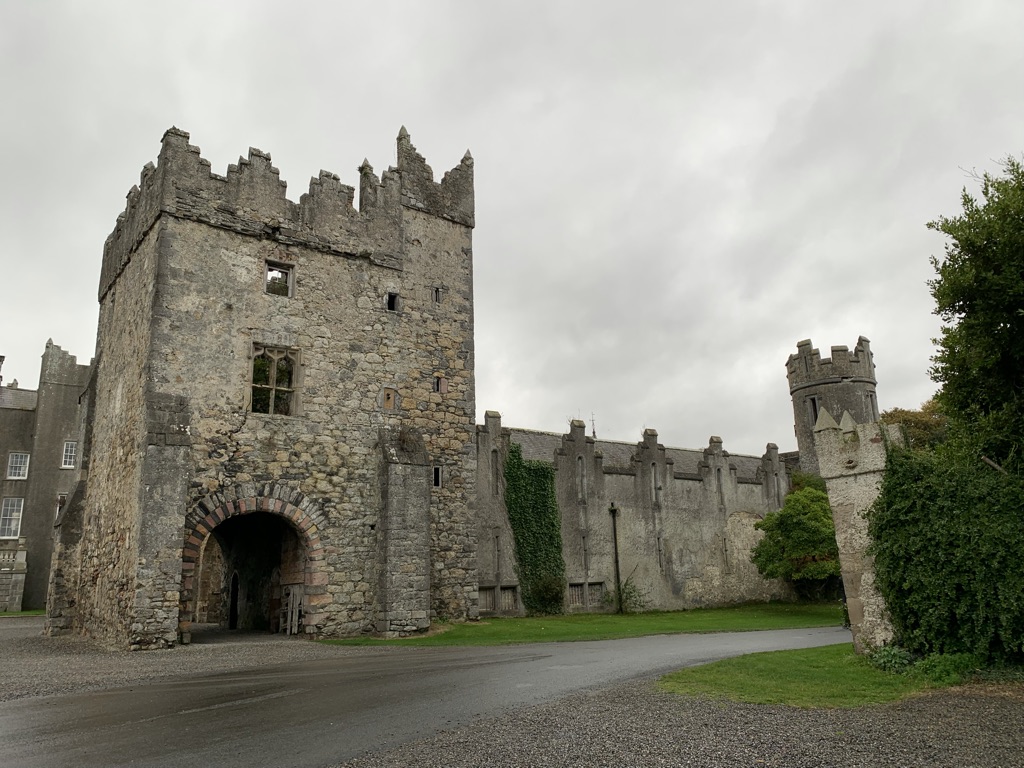

BACK TO HOWTH CASTLE AND ENVIRONS


*   *   *

In the year 1906, James Joyce was living in Rome, working long hours as a clerk at a bank, finding very little time to write, and he felt miserable. His biographer Gordon Bowker notes: "He wished himself far away–beside the sea at Bray…"
    Away from home only a couple years at that point, Joyce longed for the scene of his childhood home by the sea in Bray. Whereas Howth with its rocky promontory is the northernmost stop on the DART train in Dublin, at the opposite end the southernmost stop on the train is in the village of Bray which also has a jutting promontory. Joyce conflates the two places in the Wake, calling it "Brayhowth" (FW 448.18). The train station has a mural of Joyce. I got to spend a few days exploring Bray, a stony beach scene. There's a film studio there, one day as I was walking along the rocky beach I saw a camera crew doing a shoot.

Bray Head

Joyce spent years as a child living with his family in a house on Martello Terrace in Bray, right next to the sea. I got to see the house where Joyce lived from 1887-1891, it is extremely close to the beach. When the Joyces lived there the house would sometimes flood when the waves got especially rough. Being there and seeing how close it was to the shore, seeing the incredible view facing out from the front of the house, looking straight towards the big rocky green Bray Head, seeing the waves and the sea, I thought OF COURSE a future poet would've grown up here. 
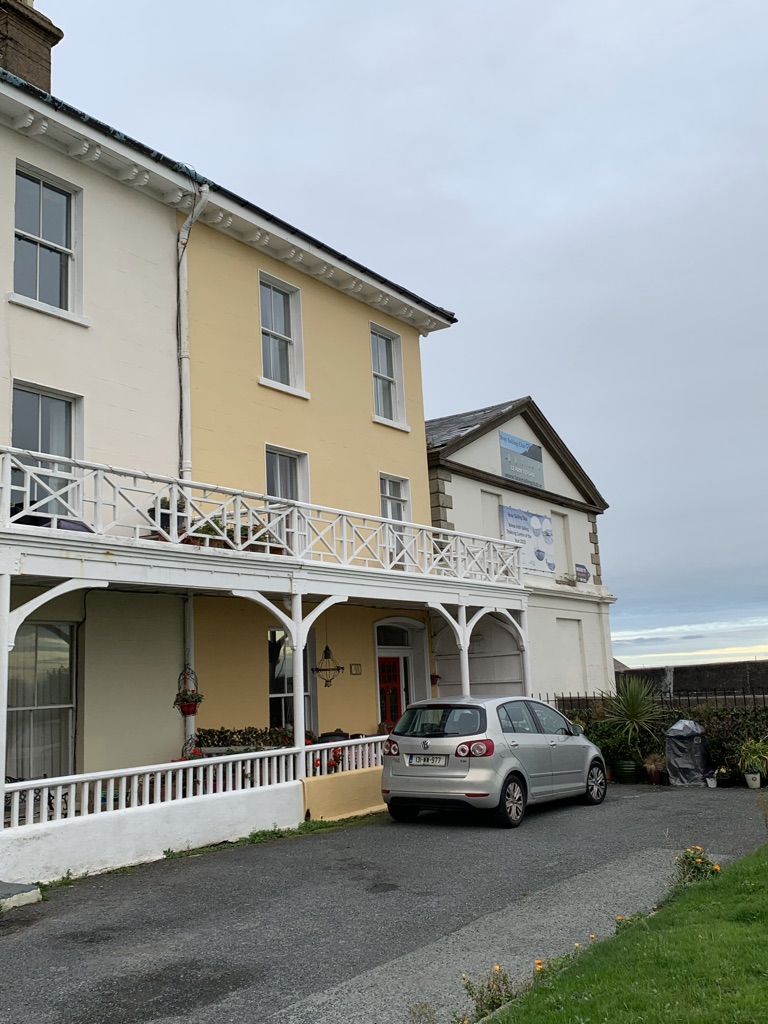

The Bowker biography of Joyce notes: "James would sometimes take [his brother] Stannie for walks along the beach. Living and walking beside the sea became a lifelong pleasure for him." (Bowker 28) This beach was also where Joyce acquired his fear of dogs, he and Stannie once threw rocks at a dog on the beach, it attacked them and bit a chunk out of Joyce's chin, supposedly the goatee he maintained as an adult was to hide the scar. This was also the house where the famous scene of the political fight over Parnell at the family Christmas dinner table that's depicted in A Portrait of the Artist as a Young Man would've taken place.
In 1935, Joyce's daughter Lucia went to stay in Ireland for a summer, and she stayed with some family members in Bray. She thought Bray Head looked like her father's profile (see Lucia Joyce, Schloss, pg. 343). In one of his letters, Joyce wrote to her suggesting she could take the train into Dublin city center to visit the GPO. 

*   *   *
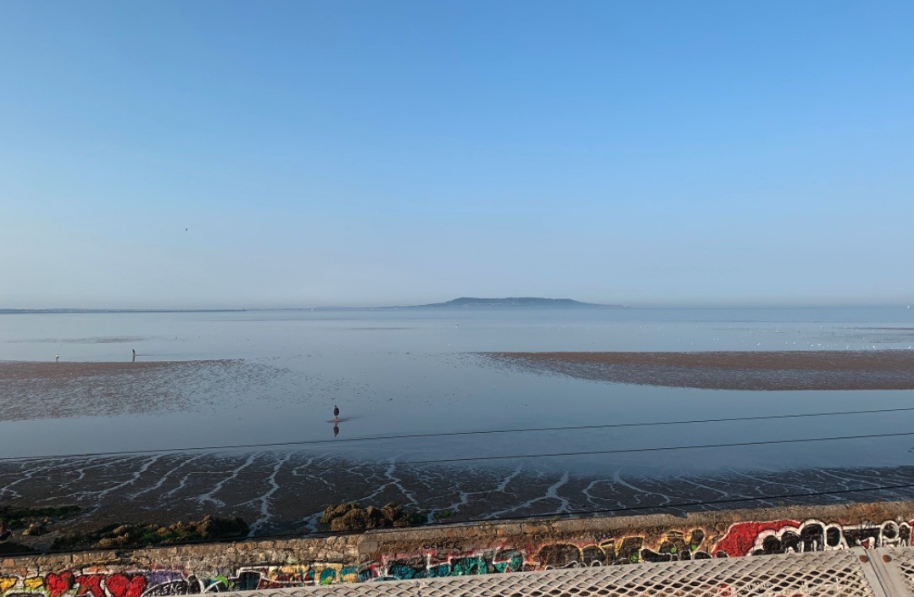
view from Blackrock

About midway between Howth and Bray along the coast is the neighborhood of Blackrock. When riding the train seeing the Irish names for the stops I was interested in the Irish name for Blackrock An Charraig Dhubh, because of the Dubh for black, same as Dubh Linn, for black pool. One night I had dinner at the beautiful home of some friends I'd met in a reading group at Sweny's. The view out their front window looking at the bay was picturesque, with Howth Head prominent on the horizon. When Joyce's family moved from the house by the sea in Bray up to a house in Blackrock, living closer to the city center of Dublin transformed the young Joyce's life. His father would take him around the city showing him sights and telling him stories, as Bowker in his Joyce biography explains:
Joyce was absorbing the intricate layout of the city he was to immortalize in literature... landmarks not just on the map of Joyce's Dublin but also on the map of his creative consciousness. And through those streets of that Victorian city, past shops, cafés, bars and newspaper offices, moved and jostled the Dubliners [who] would people his fictions. John sometimes joined in his son's sightseeing perambulations, regaling them with tales of Dublin life and characters and pointing out places of interest... It was a leisurely city with an air of languor, not subject to the dictates of business or industry. The sights, sounds, smells and texture of Dublin introduced James to a world he would transform into the focus and playground of his imagination. The spirit of the place would permeate his thoughts and writing, wherever he happened to be in the world, and would supply the dream-like setting for the great rumbustious Finnegans Wake. (Bowker, p. 42)
There's an interesting mention of Blackrock in Portrait of the Artist as well, with Joyce once again focused on the geo-mapping of the city:
Outside Blackrock, on the road that led to the mountains, stood a small whitewashed house in the garden of which grew many rosebushes... Both on the outward and on the homeward journey he measured distance by this landmark: and in his imagination he lived through a long train of adventures…
The image above is the view from the train stop at Blackrock. Often the mentions of Blackrock in Finnegans Wake are having to do with the Dalkey-Blackrock-Dunleary tramway, "Dullkey Downlairy and Bleakrooky tramaline" (FW 40.29-30) which I believe would have been essentially the same route as the present day DART train. 

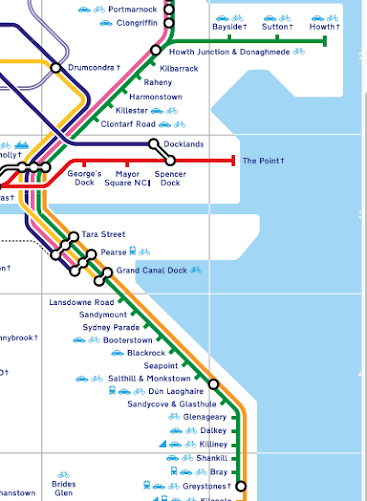
In fact, I found that virtually every single one of the present day DART train stations in Dublin are named in FW. Compare the following list (incl. FW page/line numbers) with the map below:


  • Howth            (too many to list)
  • Kilbarrack 315.28; 327.24
  • Raheny 17.13; 39.09; 129.24; 142.15; 204.18; 497.20
  • Harmonstown (see above, also nearby "Artane" appears twice)
  • Killester 427.01
  • Clontarf Road (too many to list)
  • Connolly (Amiens St) 443.15; 549.31
  • Tara Street (too many to list)
  • Pearse (Westland Row) 553.3
  • Grand Canal Dock several references to streets on Grand Canal
  • Sandymount 247.34; 323.02
  • Sydney Parade 60.27; 553.31
  • Booterstown 132.04; 235.36; 386.24; 390.03; 507.35; 582.33
  • Blackrock 40.30; 83.20; 294.22; 541.02; 582.32
  • Seapoint 129.24; 588.15; 594.34
  • Salthill and Monkstown 261.F04
  • Dun Laoghaire (too many to list)
  • Sandycove/Glasthule 321.08; 529.23
  • Glenageary 529.26
  • Dalkey (too many to list)
  • Killiney 295.F02; 431.21; 433.13
  • Bray 53.30; 313.31; 448.18; 522.30; 537.34; 624.32


*   *   *

Back toward the city center, I remember walking around the streets I'd often encounter the name Kimmage Outer seen on bus tags in the city. It's another thing recognizable from repeated appearances in the Wake, the name of a district in southwest Dublin, right near where Joyce was born.
    There's an odd and obscure pattern to the way Kimmage Outer (K.O.) appears encoded in the Finnegans Wake text, the clatter of noises in the soundwaves of the dreamworld sometimes catches the frequency of radio calls:

pg 13 "Dbln. W. K. O. O. Hear?"
pg 35 "pingping K.O. Sempatrick's Day and the fenian rising" 
pg 72 "ring up Kimmage Outer 17.67"
pg 275 "phone number 17:69 if you want to know"
pg 456: "O.K. Oh Kosmos! Ah Ireland! A.I."


*   *   *


To be continued in Phoenix Park ...