Showing posts with label how to read Finnegans Wake. Show all posts

Sunday, November 12, 2023

The Guardian/Observer Celebrates the Galaxy of Wake Reading Groups

Print edition of the UK Observer/The Guardian from Sunday Nov 12, 2023. Courtesy of Peter Chrisp.

The Sunday edition of The Guardian newspaper, The Observer, prominently featured an article about the Venice Finnegans Wake Reading Group having recently completed a full cycle of reading the text after 28 years. The media ecologist, Venice Wake group founder, and self-described "antiquarian ne'er-do-well" Gerry Fialka receives some great coverage here. And alongside descriptions of other Finnegans Wake reading groups led by renowned Joycean scholars Sam Slote in Dublin and Fritz Senn in Zurich, The Guardian piece interviewed me to discuss the background of the Austin Finnegans Wake Reading Group I've been hosting going on 12 years now, originally inspired by my visits to the Venice group. 

    I am honored to be a part of this celebration of Wake reading groups around the world. The author, Lois Beckett, did a great job covering the oddity of one-page-a-meeting reading groups dedicated to Joyce's bizarre night-book. To look at a global newspaper and see the front page with all the wars and turmoil and then have this article appear next to all of it feels like a celebration of the eternal forces of creativity and imagination. Poetry, the realm of the mind, the joy of art, language and humanity, remains undefeated.


The Guardian
piece appears on the heels of the same story being reported in newspapers and journals all across the world. Over the past couple weeks, the news of Gerry's Venice Wake group passing a 28-year reading cycle has appeared in Chinese, Afrikaans, French, Polish, Czech, various news other weird news venues, as well as the Orange County Register and the Irish Times. 

"wordloosed over seven seas crowdblast in cellelleneteutoslavzendlatinsoundscript. 
In four tubbloids"
(FW 219.16-17) 

    Gerry's group continues to meet on the first Tuesday of each month. Our Austin collective gathers two Thursdays a month. The Wake Watchers of NYC meet twice a month. Dozens of other collectives around the world continue to excavate the text of Joyce's puzzle book. Novelist philosopher Umberto Eco once described Finnegans Wake as "the book of an epoch of transition, a time in which science and the evolution of social relations propose a vision of the world that no longer obeys the schemas of other, more secure epochs yet lacks any formula for clarifying its own situation.  The Wake attempts to paradoxically define the new world by assembling a chaotic and dizzy encyclopedia from the old one and filling it with explanations that once seemed mutually exclusive. Through his clash and the ‘Big Bang’ of these oppositions, something new is born." (Read more testimonials here.)

    If you enjoyed this, I can also recommend you check out the trove of recorded interviews Gerry Fialka has conducted with accomplished Joyce scholars like Sam Slote of Trinity College Dublin, Roy Benjamin from Borough of Manhattan Community College in NYC, Decio Slomp from Brazil, Benjamin Boysen from Denmark, John Gordon from USA, or the late John Bishop who wrote perhaps the greatest analysis of Finnegans Wake ever. Another good one I heard recently is Gerry's interview with media theorist and author Douglas Rushkoff. Many more such podcasts from Gerry to check out on Youtube. 

    If you want to check out more of my writings on Finnegans Wake, I'd recommend starting with this piece or this book review series or this close reading of a passage, or this video essay I made. Lots more in the works, watch this space.


(Many thanks to Lois Beckett, Peter Coogan, Gerry Fialka and everyone who has ever been to the Austin Finnegans Wake Reading Group.)

Saturday, October 10, 2020

"the mystery of himsel in furniture" FW 184.10

"Was that voice ourselves? Scraps, orts, and fragments, are we, also, that?"
- Virginia Woolf, Between the Acts 

One relatively simple line from Finnegans Wake has been kicking around in my head for a while now. I say relatively simple because by Wakean standards, the language in this phrase is pretty straightforward. Yet, I've been stuck trying to unpack its meaning for a long time. 

The phrase comes at the end of one of the most famous sections of Finnegans Wake, the listicle paragraph describing, in outlandishly catalogued detail, the interior of Shem the Penman's "Haunted Inkbottle" house on pgs 182-184. You can listen to Robert Anton Wilson reciting this passage with dramatic effect here:


There are so many brilliant and hilarious phrases for the things in Shem's house like "solid objects cast at goblins, once current puns, quashed quotatoes, messes of mottage ...  tress clippings from right, lift, and cintrum, worms of snot, toothsome pickings" etc but what I've been thinking about is the final phrase of the paragraph where Shem is described as "writing the mystery of himsel in furniture." (FW 184.10)

"writing the mystery of himsel in furniture"

The two things that stand out to me are the bizarre quirk of the word "himsel" missing the letter f at the end of it and the use of the word "furniture" here. I kept wondering why furniture? And why not spell out the word "himself"? The Wake is made up entirely of little mysteries like these but this one so intrigued me because the phrase seems so close to being undistorted English in a paragraph that mostly uses recognizable words.  

For context, the phrase appears at the end of a long paragraph and as the final clause in a very long sentence. It's in the Shem the Penman chapter, ostensibly narrated by his very hostile twin brother Shaun the Postman. Shaun the Postman begins the paragraph by describing Shem's house how a postman might describe a really disgusting, dilapidated hoarder house on his mail route:
The house O'Shea or O'Shame, Quivapieno known as the 
Haunted Inkbottle, no number Brimstone Walk, Asia in Ireland, 
as it was infested with the raps, with his penname SHUT sepia- 
scraped on the doorplate and a blind of black sailcloth over its 
wan phwinshogue, in which the soulcontracted son of the secret 
cell groped through life at the expense of the taxpayers ...  (FW 182)

Shem the Penman really represents James Joyce himself, portrayed as a cartoonishly absurd and self-mocking caricature living inside a Haunted Inkbottle. (Joyce used lines from negative reviews for Ulysses as raw material for this chapter.) I love that description of "a blind of black sailcloth over its wan phwinshogue" which sounds like there is a black curtain covering the house's one window but is also alluding to the black eyepatch Joyce wore over his damaged blind eye. 

Following this we get a close look at the inside of the house through a comically long catalogue of items. The sentence begins, "The warped flooring of the lair and soundconducting walls thereof, to say nothing of the uprights and imposts, were persianly literatured with ..." and then it goes on for an entire page, leading into the next page where the same sentence continues mocking Shem and his abode. Shaun says we might actually be able to catch a glimpse of Shem surrounded by all that junk in his house, "self exiled in upon his ego, a nightlong a shaking betwixtween white or reddr hawrors, noondayterrorised to skin and bone by an ineluctable phantom (may the Shaper have mercery on him!) writing the mystery of himsel in furniture." (FW p. 184.6-10)

So, why "furniture" here? Well, the most obvious answer is that we've just gotten this ridiculous description of a house and all the junk that its floors and walls were "persianly literatured with" which immediately connects all of the furnished objects in the listicle with literature. Since this passage is in fact Joyce describing his self-caricature Shem, the furniture filling up his Haunted Inkbottle house could be the literary matter Joyce collects and assembles in his books. He was "writing the mystery of himsel in furniture" because Joyce reveals mysteries about himself in the descriptions of all that junk furnishing Shem's house. 

Furthermore, since Shem is "noondayterrorised to skin and bone by an ineluctable phantom" he's perhaps terrified of death, the inescapable phantom or "Shaper" he asks for mercy from. He's terrorized "to skin and bone" nearly scared to death. Part of why this line has been in my head recently is because during this dark season of death while so many have perished from coronavirus or complications therefrom, I've thought about the furniture that is left over when a dead person departs. All the things that person has accumulated throughout their life, from their desks and bookshelves and picture frames to their little scraps or fragments, all of that stuff is the detritus of a soul. With more than 200,000 people in my country having perished from this virus, their loved ones prevented from being in close proximity in their dying moments, so many families are left with the furniture of the deceased. These physical leftovers are the shells of their life. 

I think what Joyce is getting at with "the mystery of himsel in furniture" is that the mystery of a person's true self or their soul can be searched for in the scraps or fragments or shells that are leftover after the person departs. Just think about a house occupied by someone with all their belongings. When that person dies and disappears, their physical belongings remain. All the things they loved or relied on, all the things that were important or meaningful for them remain. If you really wanted to understand that person or get to know them after they left you might try to uncover that mystery through the things that person kept nearby. 

Mysteries and worlds contained within everyday objects is a theme throughout Joyce's work. Recall the line from the "Oxen of the Sun" episode in Ulysses, "Any object, intensely regarded, may be a gate of access to the incorruptible eon of the gods." Part of the debate about Shakespeare in the "Scylla and Charybdis" episode dwells on the Bard having left his "secondbest" bed to his wife after he died and what that bequeathed piece of furniture may have implied. In the "Ithaca" chapter, after Joyce lists out all of the furniture in the living room of 7 Eccles Street, Bloom considers the significance invested in two chairs: "Significances of similitude, of posture, of symbolism, of circumstantial evidence, of testimonial supermanence." It's that "testimonial supermanence" that is most relevant to why Joyce might suggest the mystery of a self can be uncovered in furniture. The permanence of furniture outlasts the person and could provide a tribute to who they were.
 
Now, what about the quirk of that word "himsel"? Why did Joyce have to truncate that word? Maybe he left out that final letter just to annoy the reader or just to be weird or maybe because the letter f is already nearby in the word "furniture." The word "self" appears several times in and around the passage we're looking at: on p. 182.19 "endlessly inartistic portraits of himself" and on p. 183.03 "exceeding in violent abuse of self and others" and on p. 184.06 "self exiled in upon his ego" and 184.11 "our low hero was a self valeter." So then why "himsel" rather than himself? 

I think I've figured out the answer but my reasoning is subjective and convoluted so I'll need you to follow me on this. That word "himsel" refers to Hansel from the Hansel and Gretel fairy tale. I will explain why, but first I should mention Joyce puns on Hansel and Gretel multiple times in the Wake (see p. 551.09 and p. 618.02). And I feel like the presence of Hansel in "himsel" on page 184 is verified in the passage immediately following "himsel in furniture" where we get a detailed description of Shem's alchemical oven ("an athanor") and of course the oven is a major part of the Hansel and Gretel story. 

Moreover, "the mystery of himsel in furniture" could be alluding to the bread crumbs left over by Hansel to create a path to follow home. The mystery of the self to whom all that furniture belongs could be unraveled by following the breadcrumbs of their belongings, and again I'll remind you that in this passage Shem's house is said to be "persianly literatured" with all these objects so literature and furniture might be seen as synonymous here. 

Other lines from the Wake feed into my theory. This line on page 68 offers an interesting hint: "The column of lumps lends the pattrin of the leaves behind us." In the word "pattrin" Joyce is punning on the Gypsy word "patrin" which (according to Fweet) refers to "a Gipsy trail, handfuls of leaves or grass cast by the Gypsies on the road to denote to those behind the way which they have taken." This is exactly like the breadcrumbs left behind by Hansel, only it's more mysterious because it involves Gypsies using leaves for a traveler to follow. Think of how leaves can be the pages of a book. Of course, it's also a pun on pattern, we are looking for patterns to follow. In the very next sentence on page 68 is the phrase "life, limb, and chattels" where chattel is furniture or personal possessions. This hearkens back to Shem on page 184 terrorized "to skin and bone" and writing his mystery in furniture.

That word "chattel" appears again at the bottom of page 598 in a sentence describing the archetypal family of HCE and ALP living over millions of years through their offspring with reference to all the belongings of their descendants including "their orts and their everythings that is be will was theirs." (FW p. 599.01) That word "orts" is important here, orts are scraps or leftover pieces of food, like breadcrumbs. The word "orts" pops up on page 69 in "your horde of orts and oriorts" where it is combined with Armenian words that mean young men and young girls, again following the theme of passing things down to descendants. And on page 67, again in the context of a passage talking about the perpetual upswell of future generations inheriting the leftovers of the past, we get the phrase "orses and hashes" which refers to lots things but I think "orts" are echoed in there.

I bring all of that up to reinforce the possibility that "the mystery of himsel in furniture" involves seeking out the stories of the past by following the breadcrumbs left behind. Joyce scatters tons of clues all throughout the book and the reader is encouraged to play the role of detective, picking up little bits of evidence, putting it all together and trying to form a story. An important metaphor in Finnegans Wake is the dump or trash heap. The hoarder's nest in Shem's house is part of a broader pattern. The book itself is a sort of trash heap of cultures, languages, histories, random scraps of information, stories from Joyce's life, etc. For the reader sifting through it all, even with just a few pieces you can start trying to make sense of it. You can identify and follow patterns or patrins. 

While I wouldn't suggest "the mystery of himsel in furniture" has now been solved, I think we have at least identified some intriguing evidence, some meaningful scraps. I think that's why in the closing lines of the book we read "The keys to. Given!" (FW p. 628) The keys to unlocking the mysteries of the Wake are scattered all throughout the book. We're told this at the very end because it pushes us to cycle back to the first page and start digging in all over again. The search never ends.

Sunday, July 26, 2020

Video: Binaries & Bibliomancy: Finnegans Wake as the Western I-Ching


(contributed for Maybe Day 2020 http://maybeday.net/)


This essay was originally presented at the 2019 James Joyce Symposium in Mexico City and earlier this week I recorded it as a video for the virtual Maybe Day celebration on July 23rd celebrating the work of Robert Anton Wilson. "Binaries & Bibliomancy" essentially builds upon the theories presented in Wilson's great book Coincidance where he outlines an isomorphic relationship (in mathematics, systems that are parallel in form) between the I-Ching and Finnegans Wake. In my piece I talk about the machinery of these two distinctly different classics, how both books are built as thinking machines, always up-to-date, always encouraging open readings. The Wake advertises itself as a book of "Opendoor Ospices" (FW p. 71) allowing for open-door readings and "Ospices" or auspices, consulting for prophecy much like the I-Ching. As Finn Fordham described it in his book Lots of Fun at Finnegans Wake, "Through its continuously self-generating transformation, it is a text of modulation and becoming, flux and flow, an alternative classic of change to the I Ching."

Robert Anton Wilson Day was officially declared to be July 23rd by the mayor of Santa Cruz, California. John Higgs wrote a great article in The Guardian years back describing what RAW Day is all about. I enjoy the Santa Cruz connection with RAW because our Austin Finnegans Wake Reading Group has a lot of Santa Cruz links. We've had multiple longtime members from Santa Cruz who became good buddies of mine, the host of the Finnegans Wake Reading Group in Santa Cruz is also an old pal of mine, I got to visit up there and attend their Wake groups multiple times. Robert Anton Wilson also had a Finnegans Wake reading group in Santa Cruz for many years. Last time I was there I got to hear stories from folks who knew RAW and also knew Norman O. Brown, the legendary UC Santa Cruz professor, scholar, and theatrical Wakean.

I want to thank Bobby Campbell (https://bobbycampbell.net/) for putting together the amazing virtual tribute to RAW with contributions from a talented group of RAW readers. There's some incredible visuals, writings, comics, and videos over at the 2020 celebration of Happy Maybe Day. I also got to participate in a live panel with the contributors that was a really inspiring and informative time, really enjoyed it and grateful to be a part of this event.

Monday, June 11, 2018

Finnegans Wake and Child's Play

"Hide-and-Seek" (1942) by Pavel Tchelitchew.

I've been in Belgium for the past few days, enjoying a nice vacation and preparing for the XXVI International James Joyce Symposium taking place this week in Antwerp. My experience thus far in this wonderful country has led to some thoughts about Finnegans Wake and child's play. There are at least three ways Joyce brings out the child in all of us when we read Finnegans Wake:

1. The first way is the childlike wonder and confusion we experience when encountering this bizarre dream-distorted polyglot language. I touched on this in Part 3 of my review of John Bishop's fantastic book---as Bishop says "Joyce puts his reader into a position roughly analogous to that of a child encountering an unknown language for a first time." Here in Europe I've been experiencing that same feeling listening to passersby chattering away in French or Flemish or German or what have you. As a typical ignorant American who speaks only one language, I've been sort of awestruck and fascinated hearing everyone around me communicating in foreign tongues I can barely understand a word of. During down time on this trip I've been reading Finnegans Wake and noticing that same feeling. The text itself well captures this sense of befuddlement on p. 112: "It is a puling sample jungle of woods." A pure and simple jungle of words. While reading the text, as I'm trying to comprehend what it all means, I'm also constantly tantalized by the bizarre medium itself, the digressive and opaque clusters of etyms that seem meaningless yet which are in fact densely packed with meaning.

2. One of the pleasures of visiting Europe has been sitting outside at a café or restaurant while people-watching all the pedestrians. It's always funny to notice, in the constant stream of people strolling by, a little boy or girl skipping or jumping around as they follow their parents. The world is all about play for them. Finnegans Wake seems to take a similar approach to things. The sound of its language always seems to mimic fairy tales or folklore, stories told in a playful kiddie language. Of course, there are a number of fables told throughout the Wake (the Ondt and the Gracehoper, the Mookse and the Gripes, the Prankquean, etc). In our Austin Wake Reading Group we recently read the Museyroom section and I was struck by how silly and playful Joyce renders what essentially consists of a museum tour guide detailing the events of the Battle of Waterloo. The text is overloaded with references to countless wars from the careers of Napoleon and Wellington and their legendary clash at Waterloo, yet our tour guide describes this grave material in a manner that reduces the belligerents to children playing games. Here's a sample from page 9:
This is the jinnies' hastings dispatch for to irrigate the Willingdone. Dispatch in thin red lines cross the shortfront of me Belchum. Yaw, yaw, yaw! Leaper Orthor. Fear siecken! Fieldgaze thy tiny frow. Hugacting. Nap. That was the tictacs of the jinnies for to fontannoy the Willingdone. Shee, shee, shee! The jinnies is jillous agincourting all the lipoleums. And the lipoleums is gonn boycottoncrezy onto the one Willingdone. And the Willingdone git the band up. This is bode Belchum, bonnet to busby, breaking his secred word with a ball up his ear to the Willingdone. This is the Willingdone's hurold dispitchback. Dispitch desployed on the regions rare of me Belchum. Salamangra! Ayi, ayi, ayi! Cherry jinnies. Figtreeyou!

3. Speaking of children's games, the Wake is loaded with references to old street games. Page 176 contains a cluster of a couple dozen London street games listed out, games like "Eggs in the Bush, Habberdasherisher, Telling Your Dreams, What's the Time, Nap, Ducking Mammy" etc and of course "Battle of Waterloo" is listed among them. More broadly speaking, reading the Wake itself is a sort of game. In the recently published essay collection Joyce's Allmaziful Plurabilities: Polyvocal Explorations of Finnegans Wake, Sean Latham examines Book I, chapter 6, the Quiz chapter, describing it as an "interactive gamespace." That chapter features questions and answers regarding the book's "sigla"---the symbols embodying the core elements of Finnegans Wake. Latham describes how the sigla become elements in a game of interpretation:

Readers or players of the text succeed by exploring the ways in which they can interact with this data by shaping it into more or less successful interpretive configurations. [...]
In this sense, reading Finnegans Wake requires a very specific kind of cognitive activity often associated with gameplay (and other kinds of complex information processing) called 'chunking.' Put simply, this is a process in which an experienced player combines small elements of a closed system into patterns or objects---chunks---that can be processed more quickly.[...]
Like chess masters, readers who become familiar with the text learn to assemble chunks of their own that enable them to play more and more skillfully with the text, recognizing, for example, the importance of the letters HCE (even when in different order or scattered across or between different words). For an adept player of the Wake, in other words, the text resolves into something other than a chaotic jumble of words and letters, becoming instead an intricate array of informational chunks that recombine in shifting patterns as the 'collideorscape' turns. (pgs 96-98)

I woke up today with all of this on my mind because as I've been reading the Wake during this trip and contemplating my passion for Joyce and this book in particular---having traveled all the way from Texas to Belgium for a James Joyce conference---I keep thinking about why the Wake is so appealing for me and the answer is simply: it's so damn fun! You can't read the book for very long without breaking out in laughter merely at the silly sound of it. And I can't overemphasize how much fun we have in our reading group when the interpretations and references are flying around and there's blends of the most profound wisdom with the dirtiest sexual or scatological jokes. The joys of this book are inexhaustible. That oft-repeated chorus line from the song "Finnegan's Wake" couldn't be more apt: There's lots of fun at Finnegans Wake!


(End note: I began this post by referencing my favorite Joyce scholar, John Bishop. Well, I just noticed that Boston University finally posted his wonderful lecture on the Prankquean episode to YouTube. This is highly recommended viewing, and of course it's called Child's Play.)

(Other end note: The picture included here is Pavel Tchelitchew's mesmerizing masterpiece "Hide-and-Seek" depicting a girl counting down as her friends are hiding. In his book The Geography of the Imagination, Guy Davenport analyzes this painting and compares it to Finnegans Wake.)

Saturday, December 2, 2017

Some Fun with "riverrun"

Norse Vegvisir rune.

Our local Wake reading group recently cycled from the somber lines of Anna Livia Plurabelle's bittersweet closing monologue back over to the first page of Finnegans Wake: "A way a lone a last a loved a long the [...] riverrun, past Eve and Adam's, from swerve of shore to bend of bay, brings us by a commodius vicus of recirculation back to Howth Castle and Environs." (FW 628-3)

The experience of deciphering the opening paragraphs of the Wake has been a slow, steady and joyful slog through a swamp thick with references, meanings, and suggestions. The information we've been pulling out from the words in these pages has been seemingly endless. It's gotten me thinking deeply about the text's very first word, the axis on which the Wake rotates---"riverrun." For a fun experiment in excavating meaning out of Wake words and appreciating Joyce's intricate chemistry of word construction, let's closely examine "riverrun."

First thing you'll notice is that this opening word of the book begins with a lowercase letter, indicating we are entering in media res (Latin "in the middle of events"). There's an immediate sense of befuddlement---one is struck with the feeling that they've been dropped into something that's been going on for a while, stepped into a stream whose source is unknown, one which is flowing toward an unknown destination. It's all a vast mystery. Much like our entry into the river of life upon birth---the world has its own history, it has been going on for a while, it has its own trajectory and momentum, and we're compelled to try to figure out what is going on, what is all this?

In my review of John Bishop's landmark study Joyce's Book of the Dark I discussed Bishop's theory that the river of Anna Livia Plurabelle refers to the flowing river of blood inside our bodies. This constantly pulsing river within us, which confronts us every night when we fall asleep with the sound of a heartbeat in our ears, contains the whole meandering, migrating history of our ancestors. Thus when we descend into sleep, into the hereditary millennia of our bodies, we encounter a running river whose origin far precedes us, highlighting how our experience of living in the flesh is also in media res, or as the Wake describes it, we are "all repeating ourselves, in medios loquos." (FW 398)

William York Tindall, in his Reader's Guide to Finnegans Wake, suggests that the chain of "the   riverrun" not only binds the end of the text with the beginning, it also "includes all betwixt and between." (Tindall 328) Much like the form of the circle which seems to be ubiquitous in all levels of existence from spiral galaxies to solar systems and spinning atoms, "the riverrun" is a universal structure. The last time I wrote extensively about one single Wake word, I focused on "anastomosis"---a term used in a wide range of sciences and disciplines (medicine, biology, mycology, geology, geography, architecture, etc) to describe an interconnection of streams or veins or branches.

FWEET gives us more to think about with the resonances of "riverrun" in different languages:

riverranno (Italian) - (they) will come again
rêverons (French) - (we) will dream
reverrons (French) - (we) will see again, (we) will meet again

"We will dream" is certainly a fitting way to open Finnegans Wake. The presence of "again" in the other words is also appropriate.

Reading the closing monologue of ALP evokes a somber feeling. She's dying, descending toward oblivion, hoping for just a few more moments of life. In our group, we couldn't help noting that the final lines in the Wake were essentially the last lines Joyce wrote before his own death in 1941 followed by the mass destruction of WW II. To continue that final sad sentence with, in the above sense, "they will come again" or "we will meet again" at the start of the book strikes a note of hope for renewal (a vital sentiment in our current dark times).

John Gordon's own Wake annotations add the following:

“rive” - English for “to split.”
“river” - French for “to join.”
FW is a book of “Doublends Jined” (20.16)
[double-ends joined]


The splitting apart and re-joining certainly fits with the "anastomosis" aspect I mentioned. It also recalls the lines from the end of the ALP chapter: "We'll meet again, we'll part once more." (FW p. 215) Gordon also mentions the German erinnerung for "memory" echoing "mememormee" from the closing lines of the text.

Bill Cole Cliett's excellent book Riverrun to Livvy adds some further threads of meaning. He describes ALP as "the river of life, the universal solvent in which all dissolves to mix and mingle and recombine, ever changing, ever the same." (Cliett p. 110) He mentions that Joyce likely got his "riverrun" from Coleridge's poem "Kubla Khan":

"Where Alph, the sacred river, ran
Through caverns measureless to man
  Down to a sunless sea."

"Alph" certainly suggests ALP. Cliett notes that Alph is supposedly "based on Alpheus from Greek mythology, a river that was believed to run under the sea. In a similar sense, ALP may run under a literary sea from page 628 to page 3." (Cliett p. 111)

Cliett also cites Petr Skrabanek who suggests "riverrun" is evocative of the Italian rivivranno for "they will revive" or "they will live again" and also reads it as the French rêvê-rond meaning "dream-round."

To break the word "riverrun" into its constituent elements also yields a range of interesting resonances:

ri
Like "re-" it suggests a return or recurrence ("Finn, again!" FW p. 628). We find "re-" throughout the first page with "recirculation" and "rearrived" and "retaled."

ver
"Ver" from Latin refers to spring time (vernal or primavera), the coming forth of life (French vivre which is also hinted at in "riverrun") out of the dead of winter. "Ver" is an active verb (even the word "verb" itself probably comes from the root "ver")---in Spanish it could mean to see, to watch, to hear, to try. It also hints at verity or truth. The etymological dictionary also notes that ver- as a Germanic prefix denotes "destruction, reversal, or completion."

run
Movement, flow, speed. The word run as noun (as in, a spell of running) derives from Old English ryne meaning "a flow, a course, a watercourse." The noun run also means a continuing series or continuous stretch of something. Fittingly for our purposes, the term run is also important in baseball, used when a runner has completed a full cycle around the bases.

Run carries a myriad of other meanings, but I want to specifically mention the suggestion of Old Norse rún or rune which refers to magic, mystery, or secrets contained within letters. Rune: a verse or song, especially one with mystical or mysterious overtones; an incantation, or a spell. This is a perfect description of Finnegans Wake.

Lastly, let's examine the numerology underlying "riverrun." I've discussed once before how the number 8 in Joyce's numerology is associated with the female, the feminine life-renewing energy, probably because the number 8 is a rotated infinity symbol ∞ (among the many numbers associated with ALP is 1001, where the 1's are seen as the banks of the river and the 00 is the infinity symbol representing the river). Molly Bloom's birthday is September the 8th and her famous Penelope episode is the 18th chapter of Ulysses. In Finnegans Wake, the chapter devoted to the mother goddess is the 8th chapter.

Now with this in mind, consider "riverrun." It contains 8 letters. It begins with "r" which is the 18th letter of the alphabet.

Furthermore, if we calculate a numerological value from the word "riverrun" it would look like this:

R = 18
I = 9
V = 22
E = 5
R = 18
R = 18
U = 21
N = 14

Total =  125

1 + 2 + 5 = 8


I'm sure there's lots more to be found here. Feel free to add on in the comments.

Thursday, May 22, 2014

Joseph Campbell on How to Read Finnegans Wake

The approach described below could serve as a primer for how to study Finnegans Wake. In fact, Campbell very accurately describes the way we study the book in our Austin Finnegans Wake Reading Group.

In the Conclusion of The Skeleton Key to Finnegans Wake, Campbell first describes Joyce's style of combining multiple words and punning on many different languages, often with rhythms that echo nursery rhymes, songs, prayers, etc. Following this, he shares these instructions:
This complex fabric of semantics, associative overtones, and stem rhythms is merely the materia prima of Joyce's communication. To this, add an enormous freight of mythological, historical, and psychological reference. It would be well-nigh hopeless to attempt to trace the design of any page were it not that a thread of logic runs through every paragraph. True, the thread always frays out into lateral associations which in turn disappear into almost inaccessible tenuities of meaning. Yet the main lines can all be followed. Joyce provides an answer to every riddle he propounds. In every passage there is a key word which sounds the essential theme. This word is supported, augmented, commented upon by other expressions in the same passage. Taken together, they not only indicate the mood but convey the meaning. The task of opening the way into any passage thus divides itself into three stages: 
1) Discovering the key word or words. 
2) Defining one or more of them, so that the drift of Joyce's thought becomes evident. 
3) Brooding awhile over the paragraph, to let the associations running out from the key centers gradually animate the rest of the passage.
Presently, the whole page will be alive with echoings and amplifications, re-echoings and sudden surprises. 
Amidst a sea of uncertainties, of one thing we can be sure: there are no nonsense syllables in Joyce! His language means so much that any intelligent reader can shave off some rewarding layers of meaning. The clarity and scope of the discoveries will depend almost wholly on the perception brought to bear; as the Master himself says: "Wipe your glosses with what you know." (FW p. 304).
Certainly there are many ways to approach the Wake. Mainly, I think you can break these down under two categories which we may call Horizontal and Vertical (as Scott from our Austin group termed it). Vertically, you dig down into each paragraph, sentence, or word to extract the dense meanings and references which may then bring meaning to the rest of the page or section. Horizontally, you just stream on through the musical, playful prose and let the sounds wash over you, triggering emotional or cerebral responses as they may.

The Night Owl speed-reading Wake group in Los Angeles I described here once certainly used the Horizontal approach. There is, no doubt, lots of fun to be had doing it that way. In our group here in Austin we use the Vertical approach, sticking with two pages which we examine and excavate thoroughly, just as Campbell describes. After two hours of discussion, usually we've identified the key words and phrases, defined them, pieced apart some puns, and eventually discovered the thematic "thread of logic." To close our sessions, we have one or two readers recite the pages in full, a touch of the Horizontal method. Just as Campbell describes, the pages do indeed come alive with echoings and surprises as we realize the thread of meaning is weaved intricately all over it.

Tuesday, February 11, 2014

Book Review (Part 3 of 4): Joyce's Book of the Dark by John Bishop

"(Stoop) if you are abcedminded, to this claybook, what curios of signs (please stoop) in this allaphbed! Can you rede (since We and Thou had it out already) its world?" 
- Finnegans Wake, pg. 18
After the resolute reader has made it through the first 300 dense pages of Joyce's Book of the Dark, its author provides us with a brief respite in the form of an entertaining chapter-long primer on how to read Finnegans Wake. This chapter, entitled "'Litters': On Reading Finnegans Wake," also prepares the reader for the forthcoming exegetical finale, the climax of this enormous study (which we will discuss in Part 4).

FW structure (by Laszlo Moholy-Nagy)
Bishop begins with an apologia for the style of writing he's employed thus far in the book in which words, quotes, and snippets from all over Finnegans Wake are taken and utilized throughout his own prose, often out of context. For instance, in one Bishop sentence he might use three completely unrelated quotes from Joyce's book to build his point. He argues that the Wake itself endorses this kind of reading, pointing to the enigmatic nightbook's references to the ancient practice of Virgilian fortune-telling (Sortes Virgilianae) in which a reader opens the works of Virgil at random ("volve the virgil page and view" FW p. 270) and then interprets the lines as referring to their own life at that moment, a practice of divination very much like using the I Ching. The same tactic works with the Wake. As Allen B. Ruch puts it, "Finnegans Wake seems uncannily alive, as if it's aware you're reading it." Indeed, the Wake can be seen as a Western version of the I Ching which is also known as the Book of Changes---the key symbol of the Wake is a river. Just as Heraclitus wrote that you can never step into the same river twice, it's often said of the Wake that it's a different book each time you read it, as its riverine text is "moving and changing every part of the time." (FW p. 118) (Philosopher Robert Anton Wilson, who was known to randomly flip open the Wake and riff on it during stand-up routines, has an essay discussing in detail the parallels between the Wake and the I Ching in his book Coincidance.)
I Ching diagram

The Wake itself is also explicit in "indicating that the words which follow may be taken in any order desired" (FW p. 121) because, unlike a novel with a sequential and orderly plot, Joyce's circular book might be said to have no beginning or ending and is composed in an alphabet soup of "expolodotonate[d]" (FW p. 353) English, a giant scrapheap of words and letters that have been "blown to Adams" (FW p. 313) or "litterish fragments" (FW p. 66).

The experimental American composer (and noted I Ching devotee) John Cage displayed the idiosyncrasies and strange pleasures that may derive from this type of approach to the Wake in his essay (read aloud here in a gem of a video) "Writing for the Second Time through Finnegans Wake" in which he constructs mesostic poems from dug up Wake words.

Marshall McLuhan was known to keep a specially customized copy of the Wake so as to similarly explore the potentials of piecing together its lexical elements like a child playing with Legos:
The Wake was McLuhan's vade mecum. In later years he kept one copy unbound, with each page pasted onto a sleeve of 3-ring paper. The stack stood in an accessible spot just outside the door of his office. McLuhan was forever plucking fresh pages like a gambler toying with oversized cards. He liked to snap the pages into new configurations, up, down, across, and read the phrases in a kaleidoscopic collage, much as Joyce himself had written them. (Source)
For Bishop, the Wake's frequent allusions to its own brand of "pure chingchong idiotism with any way words all in one soluble" (FW p. 299) are signals to the reader that this type of free associative reading is not only suggested but required if one is to grasp Finnegans Wake. Breaking down a passage from the Wake's opening pages, Bishop details how our hero's fall into sleep brings with it the collapse of every conceivable standing structure; ladders, buildings, trees, etc. but also rational, readable structures too. Bishop frequently adopts particular Wake phrases to return to over and over again to hammer home his theoretical points---in this case, he advises that we must be like Finnegan who "stottered from the latter" (FW p. 6) or tottered and fell from the ladder, except we must be prepared to totter or fall from the letter, the normal rational language of letters. Thus, Bishop concludes:
Together, all these elements are stating obliquely what is everywhere evident in Finnegans Wake anyway: that the language of the book, like the language of dreams and like language autonomically disrupted by the stutter, will operate in a manner unpredictably different from that in which rational language operates. As a reconstruction of the night, Finnegans Wake is "freely masoned" (FW p. 552), "freewritten" (FW p. 280), and structured "in the broadest way immarginable" (FW p. 4) by free associations.
Continuing his impressive interpretative plundering of Wake passages, Bishop takes us through the first paragraph of the Shem the Penman chapter (FW p. 169) which describes, in an exaggerated and absurd parody, the author Joyce:
Shem is as short for Shemus as Jem is joky for Jacob. A few toughnecks are still getatable who pretend that aboriginally he was of respectable stemming (he was an outlex between the lines of Ragonar Blaubarb and Horrild Hairwire and an inlaw to Capt. the Hon. and Rev. Mr Bbyrdwood de Trop Blogg was among his most distant connections) but every honest to goodness man in the land of the space of today knows that his back life will not stand being written about in black and white. Putting truth and untruth together a shot may be made at what this hybrid actually was like to look at. (FW p. 169)
Bishop shows us that in order to understand the Wake's author and the text itself we must read "between the lines" and pursue "distant connections" in our free associative reading because the life of Shem ("an outlex" who is outside the laws---Latin lex---of reason), just like the material of dreams and sleep, "will not stand being written about in black and white", thus it cannot be conceived merely by reading the words on the page. The text of Finnegans Wake is "superscribed and subpencilled" (FW p. 66) so its meaning must be sought above, below, and beyond merely the printed words, just as we would interpret a dream by reading past its bizarre surface material, as Bishop declares:
The greatest obstacle to our comprehension of Finnegans Wake since its publication has surely been a failure on the part of the readers to believe that Joyce really meant what he said when he spoke of the book as a "reconstruction of the nocturnal life" and an "imitation of the dream-state"; and as a consequence, readers have perhaps too easily exercised on the text an unyielding literalism bent on finding a kind of meaning in every way antithetical to the kind of meaning purveyed in dreams... What it really requires of its reader is the ability to pursue "distant connections" and, in doing so, to leap all over the place.
The actual words and material of the Wake available to be absorbed and assimilated by the literate mind conceals hidden, buried, invisible meanings. In other words, "the speechform is a mere sorrogate" (FW p. 149). The physical pages are "packen paper" (FW p. 356 [German Packenpapier, "wrapping paper"]) that must be dug through to discover what lies beneath the surface. The Wake's 5th chapter, which describes the nature of the book itself and its puzzling style, uses the metaphor of a mysterious buried manuscript that's been dug up out of garbage heap by a pecking hen. This exhumed document with its "writing thithaways end to end and turning, turning and end to end hithways writing and with lines of litters slittering up and louds of latters slettering down" (FW p. 114) is pored over by various expert scholars and scientists trying to decipher its "changeably meaning vocable scriptsigns." (FW p. 118) This process of digging and deciphering is a key recurring theme in the Wake and a perfect metaphor for the experience of reading it.
 
Everything about the Wake, in both the macro and microcosm, is essentially a puzzle or a riddle. It describes itself in this sense as a "nightmaze" (FW p. 411), a "jigsaw puzzle" (FW p. 210), a "beautiful crossmess parzel" (FW p. 619 [Christmas parcel + crossword puzzle]), a "cryptogram" (FW p. 261), or "holocryptogram" (FW p. 546) and challenges us "to salve life's robulous rebus" (FW p. 12[a rebus is a pictogram puzzle]). Bishop attests that if you perform Virgilian sortilege and open the book at random, you're bound to come upon a riddle of some sort: "Every word, every phrase, every paragraph, and every story of Finnegans Wake requires the same kind of solution as a riddle does. And this includes the English."

As anyone who's ever participated in a Finnegans Wake reading group knows, trying to solve the riddles on each page is where all the fun lies. Parsing through a single page with a group, you'd be amazed how many things other people will find that you would've never caught on your own. The group approach gives you the feeling that you're all tasked with interpreting the elements of one very long and complicated dream, the dream of HCE or "Here Comes Everybody." Bishop suggests that if you've broken out in laughter in the process of solving these dream-riddles then you are on the right track:
…dreams operate exactly as riddles do, not simply in the wholly intuitive process by which they are untangled, but in the kind of understanding they yield. The successful interpretation of a dream results not primarily in an intellectual understanding, but in an illuminating "click" that wakes up the dreamer in the middle of his own life. And just as the analysis of a dream produces a sudden recognition, just as the solution of a good riddle generates a ripple of mirth, so a good "reading [of the] Evening World” (FW p. 28) works to liberate “everyone’s repressed laughter” (FW p. 190), whose release is a sign that the book has been read rightly: in risu veritas, as Joyce remarked of the Wake (Latin “in laughter there is truth”).
As we dig into the unconscious mind of HCE and try to interpret its many puns and riddles, we are also confronted constantly with forms of child's play, fairy tales, and nursery rhymes. It is this aspect of the Wake that Bishop explores in his book's penultimate chapter, called "The Nursing Mirror." It is considered a forgone conclusion in modern scientific and psychoanalytic circles that dreams and sleep entail a regression to the infantile state. On this subject, Bishop refers to Freud's Interpretation of Dreams which states: "Dreaming is a piece of infantile mental life that has been superseded" and "to our surprise, we find the child and the child's impulses still living on in the dream." Passing into a deep unconscious snooze, the Wake's hero returns to "first infancy" (FW p. 22) and becomes "an overgrown babeling" (FW p. 6). Our immersion into this night world consequently turns us into children as well since, as Bishop describes it, "Joyce puts his reader into a position roughly analogous to that of a child encountering an unknown language for a first time."

It is a childlike curiosity and abandonment of authoritative literal reading that will provide the most rewarding experience for a Wake reader. The aforementioned exhumed document representing the Wake itself is described as being "folded with cunning, sealed with crime, uptied by a harlot, undone by a child" (FW p. 94). Despite the novel's highbrow literary reputation, Bishop proclaims "one must become a child again if one is to read the Wake."

The buried "childhide" (FW p. 483 [childhood that is hidden]) unearthed in the playful, joyous, humorous Wake represents a crumbling of the old man institutions of rational, literalistic language and its supposed "awethorrorty" (FW p. 516 [notice the presence of "horror"]). "The old man on his ars" (FW p. 514) supine and sleeping gives way to the child inside coming alive with no regard for grownup daytime rules and rational structures. The Wake celebrates this child inside all of us, "The child we all love to place our hope in for ever" (FW p. 621).

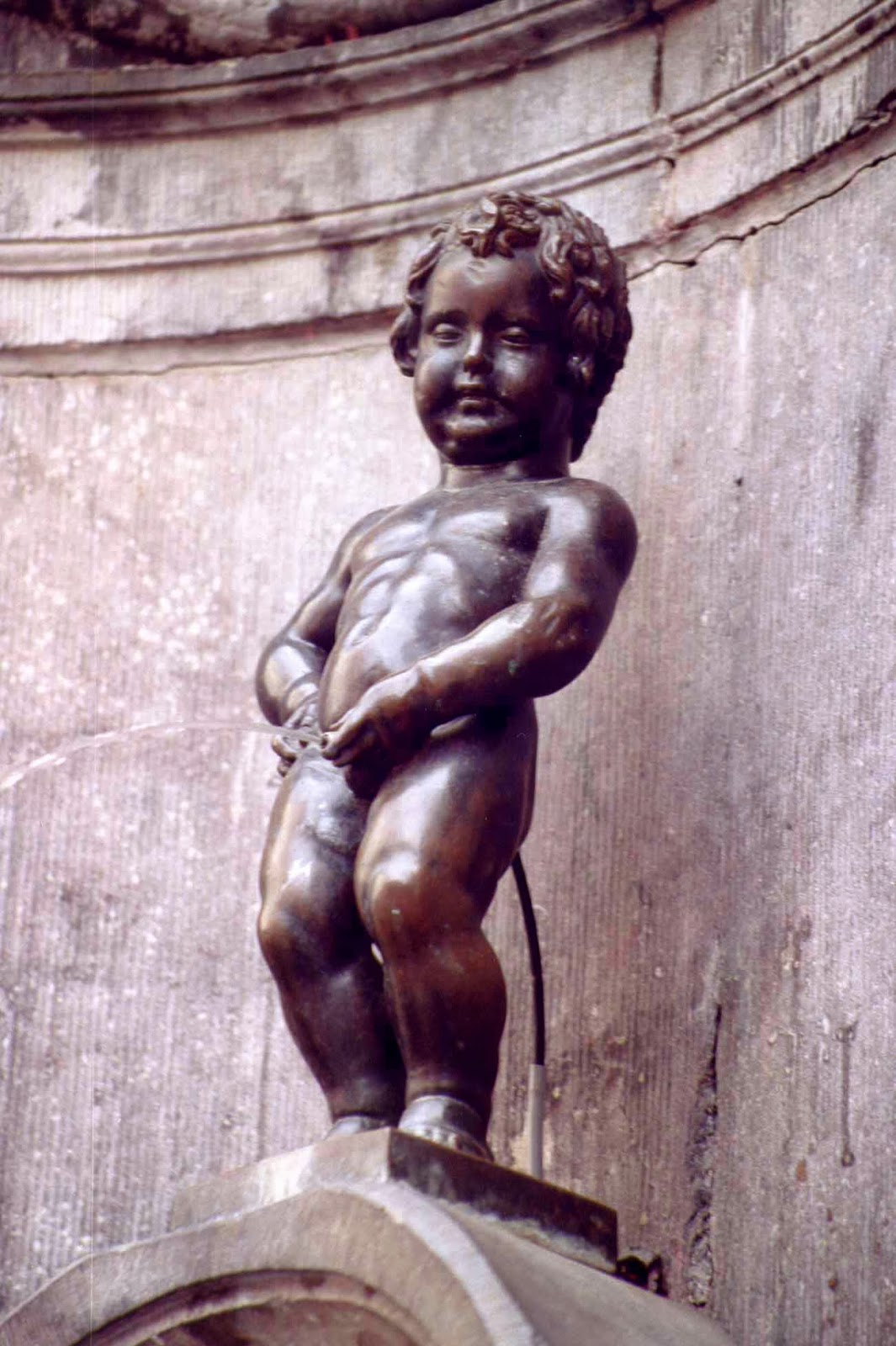
At the heart of the Wake, at the end of one of its densest chapters (Book II, chapter 2 "Night Lessons") the children have begun to take over power from their parents as the old era closes and a new one begins. The children tease their parents in a letter sending "our best youlldied greedings to Pep and Memmy and the old folkers below and beyant" (FW p. 308) while also inscribing doodles in the margins, including an apparent thumb-to-nose image. But the most eminent and comical symbol of this playful "thumbtonosery" (FW p. 253) that Joyce's book represents is the Manneken Pis statue and fountain in Brussels which the Wake makes frequent reference to. The statue depicts a small boy, a "wee mee mannikin" (FW p. 576), continually pissing with a grin on his face. One can see why Joyce took a liking to this statue; in his greatest work he virtually obliterated language, the very foundation of all respectable reasonable rational adult structures, to rubble and took a piss on the ashes.

Thursday, October 10, 2013

The Night Owl Wake Reading Group

I've been to three different Finnegans Wake reading groups before (including my own here in Austin) and each of them would focus in their efforts on just 2 pages or so, but I remembered meeting someone at the Venice Wake group in California who had participated in a group with a much different approach. They would gather in a used bookstore at closing time on Sunday nights and take turns zipping through the text reading aloud.

This, to me, exemplifies the opposite though equally rewarding approach to experiencing the Wake---instead of parsing through each polysemic element on each page like a physicist cracking open matter to its deepest fractal units and appraising the structure of it all, you can also simply let the text sing and dance in its unique way by reading it aloud for pages at a time (or listening to a recording of it).

I reached out to Derek G. who was part of that rapid-recitative-reading group and he responded with some very thoughtful details about it, which I would like to share here:

Yes, though I wouldn't exactly describe them as speed-readings; we would gather around in a circle at Alias Books, lock the doors, and read out loud. We met every Sunday @ 11pm, and would average about 20-40 pages per mtg. It took us about 7 or 8 months to finish the book. This was the first book to kick off our Night Owl bookgroup (running about four years now), and we would experiment with our reading of it. We began reading it conventionally, falling into the normal trap of using conventional language: it must have one setting, one plot, each word must have only one meaning, the book must have one overall message. After discovering how FW aims to destroy this mode of thinking, we decided to experiment with our reading, not take the book so seriously, and let the experience of reading it takeover. 
For instance, during one reading--I wish I could remember where we were in the book--for some reason, almost simultaneously, we all got up and started walking around the bookstore in a single file line, up and down the aisles, until either the page or the paragraph was finished. I do remember we were a fair way through FW, and had learned how to read its rhythms and pauses, and somehow we all agreed to physically mimic them in that one moment. FW is in part an invitation to performance art, as well as being a drama. 
This is probably the best advice I know to give to readers of the Wake: let the text show you how to "read" it, how to perform it, what to do with it, how to use it. Because FW is a book about what has happened as well as what will happen--Joyce was a very unique kind of prophet--FW asks us to pay some attention to the present moment, and to the specific point in time that we are reading it. And as we read it, it read us: collectively, and, in its curious way, individually. 
Another recommendation: private reading. FW has too often been said to be only accessible through out loud group readings. These are awesome ways of using FW and interacting with it, but amazingly enough, if one in isolation simply uses their visual sense on the page, they see that it is not random. Joyce favored audile and tactile senses, but did not neglect the visual. During my first reading of FW alone I thought it to be very visual. It was a giant Gesamtkunstwerk of Irish-surrealist-fantasy. The possibilities of what FW is are endless!