Showing posts with label reading group. Show all posts

Thursday, May 29, 2025

The Late Show with Stephen Colbert roasted FWATX reading group on TV, and quoted me

Stephen Colbert, offering a prayer to the Good Book (FW).

Last week, The Late Show with Stephen Colbert on CBS did a segment roasting the Finnegans Wake Reading Group of Austin, Texas (yes, our group, the one this very blog is about) and he even quoted my words from the recent NPR article about the group. That really happened. Colbert quoted me, on national television, talking about Finnegans Wake.

Watch the clip below (starting at 3:55):


There are layers to the joke here because Stephen Colbert, who is a proud descendant of Irish immigrants, is no lightweight Joycean, in fact, he has been performing passages from Ulysses at Bloomsday events for decades. 


While he's making fun of Joyce's craziest book, he knows of what he speaks, and so he is either in on the joke and making fun of himself too, or, it could be this is Colbert's way of staking his claim that Ulysses is the superior of Joyce's major novels. Maybe a bit of both. 

Either way it's amazing that Colbert was roasting our Finnegans Wake reading group on TV. Just to even see the book cover of Finnegans Wake appear on television is extremely cool! They just awakened millions of new Finnegans, gave birth to new HCEs and ALPs. Here Comes Everybody. 

An added dimension to the joke is that the other subjects Colbert talks about in the segment, like vagina-scented candles, astrology, poop jokes, frauds, pyramids, Indiana Jones, hoarding, etc all of that is essentially akin to what's encountered in reading Finnegans Wake

What's also a funny connection for me is I once encountered Stephen Colbert in person. True story: I was on a tour of the Tower of London on Thanksgiving Day back in 2008 and I happened to be on the same tour with Stephen Colbert and his family. I recognized him and he noticed that but I played it cool. All these years later, and he was quoting me on his tv show.

I've been a fan of Colbert's comedy since way back when he was a regular on the show Strangers with Candy with Amy Sedaris. I enjoyed his time on the Daily Show, and of course his long-running satirical show The Colbert Report was iconic. I find myself cracking up any time I think of the titles of some of his ridiculous books, like I Am America (And So Can You!) (2007) and the prescient America Again: Re-becoming The Greatness We Never Weren't (2012).

A bit more about his Joycean bonafides, from a Kirkus Reviews article: 

Colbert is a longtime admirer of Joyce. When he published his 2012 children’s book I Am a Pole (And So Can You!), he arranged to have the manuscript displayed next to the Ulysses manuscript at the Rosenbach [museum in Philadelphia].

And in March, he recalled how Joyce’s masterpiece landed him in trouble during the 2010 Vancouver Olympics at the Ireland House. “There was a stage up there with a traditional band playing and they had a football game on,” Colbert said. “I went upstage and I said, ‘Who wants to celebrate Irish culture!’ And I took out a copy of James Joyce’s Ulysses. There was a riot, I had to be hustled out by security.”

Back in 2022, on St. Patrick's Day, Colbert tweeted this:


Maybe one of these St. Patty's Days he'll get so drunk that he'll make it through all of Finnegans Wake and then I'll add him to The Pantheon of Finnegans Woke.

Wednesday, May 21, 2025

Interview with Texas Standard (on KUT Austin NPR station) + other recent podcasts


Last week I was interviewed by the Texas Standard radio program on KUT, Austin's NPR station, talking about the Finnegans Wake Reading Group of Austin which has been gathering to discuss Joyce's greatest book for more than 12 years now. Audio clips from the interview with KUT's reporter Sean SaldaƱa appeared here, with a brief article and some pics from the group's history. The premise of the article, of course, is that we've been meeting for a very long time, reading one or two pages per meeting, and we're not nearly finished with the book yet. 

The piece has been shared on social media, garnering some witty responses. My favorite ones are the comments observing that the readers in the picture look like a deadlocked jury trying to reach a decision on a tough case. That pic is from back in the golden era of our reading group when we used to have big gatherings at the Irish Consulate in Austin (eternal thanks to Adrian Farrell, Claire McCarthy, and Paul Breen for all their support over the years). We would also have meetings at the (now defunct) bookstore Malvern Books and they'd put up a big sign in the window advertising our meetings, which is also shown in the article. The KUT interview was a fortunate full-circle cipher completion moment for me because Malvern Books back in those days used to advertise our reading group meetings on KUT, and new people joined the group because of those ads. Nowadays, our meetings are all on Zoom, and our attendees come from far beyond central Texas, although there are still plenty of original members who still participate. 

As I alluded to in the interview, I originally started the group in Austin because I had attended a similar group in Venice, California (the Marshall McLuhan/Finnegans Wake book club run by Gerry Fialka) when I lived in San Diego for a few years, a story that was originally told in The Guardian piece about the Venice Wake group published in late 2023. It's always pretty amusing seeing the response of the general public to these news pieces because to most people it seems super bizarre that a book club would be so focused on a close reading of one book for so long, and yet in the galaxy of Joyce reading groups it's pretty standard practice. I recently shared links to several active Finnegans Wake reading groups around the world, many of whom have been meeting to read the same book for years. 

*   *   *

Here seems like a good place to share some other podcasts I appeared on in the past six months, again discussing Joyce and Finnegans Wake

  • Back in February, to celebrate Joyce's birthday, Gerry Fialka of the Venice Wake reading group organized a panel discussion to talk about Finnegans Wake, the panel featuring some of the most accomplished and prolific Joyce scholars in the world including Sam Slote (Trinity College Dublin), Tim Conley (Brock University), Finn Fordham (Royal Holloway Univ. of London), Roy Benjamin (Borough of Manhattan Community College), as well as myself. It was a huge honor for me to be on a panel with scholars I admire and whose work I have such great respect for, and we got into a pretty lively discussion covering many topics over more than 2 hours. Go check that out HERE.
  • Back in December, I took part in a panel discussion with a big group of several Joyce enthusiasts from around the world as part of the Maybe Night event. This panel was organized by the great artist and Wakean Bob Campbell, and among the many interesting panelists were Toby Malone (from the excellent podcast WAKE), Eric Wagner (who recently published Straight Outta Dublin, a book on Robert Anton Wilson and James Joyce), a few folks from the Ukrainian Wake reading group (including Linda Lotiel whose "Mind Map" illustrations of the Wake are phenomenal), the writer and esoteric thinker Oz Fritz, the creator of FWEET Raphael Slepon, and others, for the winter solstice 2024 event, go check out that video HERE.


Stay tuned!

Saturday, December 16, 2023

Find the Others: The Lightning-Struck

"Remember the lightning-struck? Those who experienced something profound and rare, so they sought out others who had felt what they felt? Other than the coded messages of their newsletter, there’s nothing conspiratorial to their organization. What it really is is a community. And a community, after all, is just a conspiracy everyone’s aware of, in on, participants in. Sure, the bigger communities become, the more complex their problems and the more corrupt their leaders. But in these niche groups that are only nominally conspiracies, because no one knows who they are, you can find the teeny-tiny instance of grace that can make our meaningless trajectories tolerable, even beautiful: the intimacy of sharing ourselves with another person. Although the lightning-struck have modest aims and probably zero influence, their club has given them a method by which they can communicate to their cabal, their little conspiracy of no importance, and share with others what the lightning gave them, because the only reason Those Who Know, know, is because somebody, somewhere, let them in on the secret…" 
(from a recent Esquire article on the 50th anniversary of Gravity's Rainbow)


New York Times: "Peter Quadrino, another member, said that reading Joyce created an urge to discuss his work with others."  

The Guardian: "Peter Quadrino, 38, joined Fialka’s group around 2008 or 2009. He would drive up three hours from San Diego, where he lived, to attend the meeting. “If you’re really interested in Finnegans Wake, it’s kind of hard to find people who will talk about it with you.”"

Washington Post: "“It’s a giant friend group, and it’s like you’re reading a poem — basically a multilingual, multi-referential poem — with so many different people,” said Quadrino."

Smithsonian Magazine: "For many readers, Finnegans Wake isn’t a text to master or a puzzle to solve. Instead, it’s something of a psychoactive agent. The question of what it means is less interesting than how it affects the reader."


"I have always been grateful for what I call the Joyce community, however you define it. It was initially a scattered bunch of readers who shared a common interest. I wouldn't be where I am without all those contacts. In my isolation I needed kindred spirits. Harmless maniacs like the Joyceans tend to flock together, and flock we did, after extended correspondence gave way to more and more gatherings. What I refer to here is not a common or overlapping interest but the many friendships that grew out of it; they can last even if Joyce is given up, as has happened in some cases. I think I am not the only one who feels that in case of a real emergency, material or emotional, there would be Joyceans friends to turn to, and this is reciprocal. Maybe some of us share an underlying despondency as well as some built-in irony. I am not talking about our views on the works or the author, but the people."
- Fritz Senn, Joycean Murmoirs (2007), pg. 50

Sunday, November 12, 2023

The Guardian/Observer Celebrates the Galaxy of Wake Reading Groups

Print edition of the UK Observer/The Guardian from Sunday Nov 12, 2023. Courtesy of Peter Chrisp.

The Sunday edition of The Guardian newspaper, The Observer, prominently featured an article about the Venice Finnegans Wake Reading Group having recently completed a full cycle of reading the text after 28 years. The media ecologist, Venice Wake group founder, and self-described "antiquarian ne'er-do-well" Gerry Fialka receives some great coverage here. And alongside descriptions of other Finnegans Wake reading groups led by renowned Joycean scholars Sam Slote in Dublin and Fritz Senn in Zurich, The Guardian piece interviewed me to discuss the background of the Austin Finnegans Wake Reading Group I've been hosting going on 12 years now, originally inspired by my visits to the Venice group. 

    I am honored to be a part of this celebration of Wake reading groups around the world. The author, Lois Beckett, did a great job covering the oddity of one-page-a-meeting reading groups dedicated to Joyce's bizarre night-book. To look at a global newspaper and see the front page with all the wars and turmoil and then have this article appear next to all of it feels like a celebration of the eternal forces of creativity and imagination. Poetry, the realm of the mind, the joy of art, language and humanity, remains undefeated.


The Guardian
piece appears on the heels of the same story being reported in newspapers and journals all across the world. Over the past couple weeks, the news of Gerry's Venice Wake group passing a 28-year reading cycle has appeared in Chinese, Afrikaans, French, Polish, Czech, various news other weird news venues, as well as the Orange County Register and the Irish Times

"wordloosed over seven seas crowdblast in cellelleneteutoslavzendlatinsoundscript. 
In four tubbloids"
(FW 219.16-17) 

    Gerry's group continues to meet on the first Tuesday of each month. Our Austin collective gathers two Thursdays a month. The Wake Watchers of NYC meet twice a month. Dozens of other collectives around the world continue to excavate the text of Joyce's puzzle book. Novelist philosopher Umberto Eco once described Finnegans Wake as "the book of an epoch of transition, a time in which science and the evolution of social relations propose a vision of the world that no longer obeys the schemas of other, more secure epochs yet lacks any formula for clarifying its own situation.  The Wake attempts to paradoxically define the new world by assembling a chaotic and dizzy encyclopedia from the old one and filling it with explanations that once seemed mutually exclusive. Through his clash and the ‘Big Bang’ of these oppositions, something new is born." (Read more testimonials here.)

    If you enjoyed this, I can also recommend you check out the trove of recorded interviews Gerry Fialka has conducted with accomplished Joyce scholars like Sam Slote of Trinity College Dublin, Roy Benjamin from Borough of Manhattan Community College in NYC, Decio Slomp from Brazil, Benjamin Boysen from Denmark, John Gordon from USA, or the late John Bishop who wrote perhaps the greatest analysis of Finnegans Wake ever. Another good one I heard recently is Gerry's interview with media theorist and author Douglas Rushkoff. Many more such podcasts from Gerry to check out on Youtube. 

    If you want to check out more of my writings on Finnegans Wake, I'd recommend starting with this piece or this book review series or this close reading of a passage, or this video essay I made. Lots more in the works, watch this space.


(Many thanks to Lois Beckett, Peter Coogan, Gerry Fialka and everyone who has ever been to the Austin Finnegans Wake Reading Group.)

Sunday, June 6, 2021

The Portal

Illustration from William Blake's Jerusalem

Some observations on the Gate or Portal in Finnegans Wake I.3

Towards the end chapter 3 (book one) of Finnegans Wake, a drunken German angrily bangs at the locked gate of an Irish pub shouting threats and insults at the pub owner for locking him out after closing time. The gate Joyce places at the entrance of his main character HCE's pub is a megalithic stone structure, described as a "stonehinged gate" (FW 069.15). 

I've been dwelling on the meaning of this gate in chapter 3. The door or portal is a recurrent image in the Wake. One of the many names used for the main character is Mr. Porter. The belligerent at the gate unfurls a litany of insults and nicknames at him including "Sublime Porter" (FW 072.02-3). That word porter has similar etymological roots to the word metaphor meaning "to carry across" like to carry across a threshold. I think that's relevant here because so much of the Wake and especially the part of the book I'm focusing on right now seems to speak in alternating metaphors. 

The banging at the gate calls back to an earlier clash at a doorway in chapter 1 when the Prankquean rains hell on Jarl van Hoother (Earl of Howth) for locking the door of Howth Castle. The "stonehinged gate" on page 69 is "triplepatlockt" and on the adjacent page appears the Prankquean, "a shebeen quean, a queen of pranks." (FW 068.22)

George Cinclair Gibson's insightful study Wake Rites: The Ancient Irish Rituals of Finnegans Wake (University Press of Florida, 2005) discusses the "Banging at the Gate" scene as a parallel enactment of one of the ancient Irish rituals practiced at Tara. The actions of the verbal assailant at the gate, Gibson explains, "are the precise components of the Druidic curse known as the glam dichenn. The most compelling of all ritual curses, the glam dichenn would have been directed at a disgraced leader or failed king and delivered only by a powerful Druid." (p. 123)

As for the location of this scene, Gibson notes: 
...the glam dichenn directed against the fated king of Tara is purposely delivered on a threshold. In Druidic tradition, threshold and liminal locations are the optimal loci for harnessing and generating magical power. Liminal locations---for example, 'the threshold separating the inside of the room or house from the outside world'---can be utilized by a Druid as 'the source of extraordinary powers because the liminal transcends normal distinctions between separate categories" (Nagy, "Liminality," 135-36).  A Druid would use these liminal places (for example, near a door, on the boundary between civilization and wilderness) to create a magically charged "atmosphere" in order to "help generate the power necessary for ritual" (Nagy, "Liminality," 138). 
(Gibson, Wake Rites, p. 124)
The "threshold and liminal locations" which Gibson says "are the optimal loci for harnessing and generating magical power" represent a junction point where worlds intersect. The door in Finnegans Wake is a threshold wedged between the world of wakefulness and deep sleep. The book itself is also represented like a door or gate, the sigla Joyce uses for the book is a square ▢ a type of portal. I think the gate also represents a portal to the afterlife or the underworld, chapters 3 & 4 feature numerous references to the underworld journey of the dead in the Egyptian Book of the Dead

The description of the gate on page 69 includes an odd textual quirk where a capital letter appears unexpectedly with "There" in the middle of a sentence: "Where Gyant Blyant fronts Peannlueamoore There was once upon a wall and a hooghoog wall a was and such a wallhole did exist." The gate, or hole in the wall, is fronted by two giant pencils---"Gyant Blyant" includes the Danish word blyant for "pencil" and "Peannluemoore" is phonetically Irish for "big pencil"---even within the sentence itself, before we get to the gate we first encounter two giants fronting or guarding it. These "faithful poorters" (FW 069.26) are akin to the doorkeepers at Tara, named Camellus and Gemellus, who are directly named later on in the next chapter when the gate incident is re-litigated (see p. 90). Since they are described here as two giant pencils, it would appear these twin guardians of the gate are like two big obelisks. The obelisk is another recurrent image in Finnegans Wake usually representative of the obelisk at Wellington Monument in Phoenix Park, but here since there are two pencils or obelisks it could be invoking the original Egyptian style of placing a pair of obelisks at an entrance way.

This insight about the Egyptians using obelisks in pairs to create a portal between them came from a FW reading group discussion over this chapter last year. Architecture professor and Joyce scholar Marcin Kedzior shared this information with me:
Obelisks were always raised in pairs in keeping with the Egyptian value of balance and harmony; it was believed that the two on earth were reflected by two in the heavens. Egyptologist Richard H. Wilkinson writes:
"The phenomenon of duality pervades Egyptian culture and is at the heart of the Egyptian concept of the universe itself. But rather than focusing on the essential differences between the two parts of a given pair, Egyptian thought may stress their complementary nature as a way of expressing the essential unity of existence through the alignment and harmonization of opposites - just as we today might use "men and women", "old and young", or "great and small" to mean "all" or "everyone" (129)."
(from here: https://www.ancient.eu/Egyptian_Obelisk/)

That point about duality pervading Egyptian culture links back to the Wake because duality and the unity of opposites are also central to Finnegans Wake. And I think the dualities and their powerful conflicts tend to cluster around gates, doors, thresholds in the book. The angry drunk guy berating HCE at the door is an opposing force, a polar opposite of HCE the sleeper himself. The violent confrontations depicted around this section, where the belligerent at the door goes on for pages describing how he wants to break HCE's skull and pummel him, I see these as being clashes within the sleeper HCE himself. The brutality of these clashes I think are similar to the destructive confrontations a soul goes through in its journey through the underworld or the Bardo---the type of thing that goes on in the Egyptian Book of the Dead or the Tibetan Book of the Dead where there are monsters and demons who will tear your flesh to pieces, putting your soul through the trial of your attachments and preparedness for nirvana or for reincarnation. 

I'm getting far afield here, so let me briefly summarize how I see all of this. The gate or portal, the megalithic "stonehinged gate" (FW 069.15) and everything that goes on around this part of the text are suggestive of a number of things: 
  • the sleeper HCE is crossing over a threshold and entering into the void of deep sleep, his persona obliterated. In John Bishop's introduction to the Penguin edition of FW, he notes "Chapters 3 and 4 of Book I are both murkier and harder to read than the first two chapters of FW---in part because HCE recedes even more deeply out of conscious life, now becoming literally absent... and therefore only indirectly represented, in rumor, gossip, and report." (p. xx)
  • Traveling across the threshold of the portal into deep sleep, within HCE are enacted ancient rituals of the divestiture of the High King of Ireland at Tara by the Druids at megalithic sites (see Wake Rites).
  • Descending into the underworld of sleep, HCE experiences the death and resurrection myths of Osiris in the Egyptian Book of the Dead
  • The megalithic portal or doorway which is the entryway to HCE's pub is also the gateway to deep sleep, to death, to rebirth, and an inviting open door for the reader to dive into all of the above, "Opendoor Ospices" (FW 071.13).
  • The megalithic gate becomes representative of HCE himself, or rather HCE transforms into a megalith or monolith or "monomyth" (FW 581.24).
I'll try to expand on all of these points here. While a reader can try to identify a "narrative" or "plot" in chapters 3-4 of the Wake, what I'm usually more interested to follow are the consistent patterns noticeable in the subtext. So much of chapter 3 seems to involve HCE's personal identity fading away as he falls into deeper sleep. The sleeper's sense of individual identity becomes obliterated, as described on page 51, "(since in this scherzarade of one's thousand one nightinesses this sword of certainty that would identifide the body never falls) to idendifine the individuone." Mythological and historical personages abound in this chapter. Siddartha, Buddha, Osiris, Blakean gods, the Prophet Muhammad, ancient Vikings and Celtic Kings and Druid Poets all appear and proliferate in these pages as it seems like the dead from across history and the entire globe gather to arrange for the passage of HCE into the afterlife, he is being "timesported acorss the yawning (abyss)" (FW 056.03). 

The sleeper HCE in ever deeper slumber loses his entire persona, buried in a coffin of sleep paralysis, his consciousness dead to the world, he's "nearvanashed himself" (FW 061.18), his ego extinguished in nirvana and near-vanished in sleep. H.C. Earwicker, or Mr. Porter the pubkeeper, disappears and is replaced by any number of mythological heroes and gods and kings undergoing trials against entities trying to devour him. All these entities seem to be parts of his own being. 

There's an interesting and sort of subtle indication of the interlink between entities when the angry drunk at the gate is berating HCE. Notice the dualities in this description of the language used: "swishing beesnest with blessure, and swobbing broguen eeriesh myth brockendootcsh" (FW 070.03-4). Mixing business with pleasure, or a bee's nest with blessings, and swapping broken Irish with broken Deutsch. I think the presence of the words "eerie" "myth" and "brocken" also indicate a reference here to the Brocken spectre, a phenomenon where an enormous shadow of an observer appears on a cloud, made legendary by the propensity for this spectre to occur when an observer stands atop the Brocken peak in Germany. This phenomenon has been referenced frequently in literature, most memorably for me in Thomas Pynchon's novel Gravity's Rainbow. I think the presence of the Brocken spectre in this passage of Finnegans Wake is confirmed a few lines later with "roebucks raugh at pinnacle's peak" (FW 070.13) plus other references to hikers on a mountain top. 

So the confrontations with hostile entities can be seen as conflicts within HCE himself or with his shadow. One of these encounters takes place at a megalithic stone structure, first introduced as "one of the granite cromlech setts" (FW 061.14). The chapter seems to alternate between describing HCE inside an elaborate coffin and describing HCE being harassed at a doorway, with lots of Egyptian references embedded in these passages. The impression I get when reading this part of the book is that HCE is being prepared for reincarnation, "striving todie, hopening tomellow" (FW 060.29), he's placed inside a pyramid like a dead pharaoh, "reberthing in remarriment out of dead seekness to devine previdence... first pharoah, Humpheres Cheops Exarchas." (FW 62.07-21) Since we're jumping from Druids to Egyptian pharaohs here, it's worth mentioning that Joyce, from his early writings, made connections between the ancient Irish Druids and the Egyptian priests, memorably declaring in "Ireland, Island of Saints and Sages" that, "Ancient Ireland is dead just as ancient Egypt is dead."

Example of a granite cromlech.

HCE in this section seems to be traveling like the sun on a journey under the earth at night and through the stars, this is the mythical image of Osiris in his night-boat. Whether it's Stonehenge or Egyptian pyramids, these ancient temples were usually designed as star-gates and at this point of the book, cosmic elements abound as HCE seems to be floating among the stars in a boat:

"combing the comet's tail up right and shooting popguns at the stars" (FW 065.11)
"gazing and crazing and blazing at the stars" (FW 065.13)
"they all were afloat in a dreamlifeboat" (FW 065.29-30)

We get another reminder that we are actually talking about a coffin but the way it is described, "The coffin, a triumph of the illusionist's art" (FW 066.28), suggests death is an illusion and that our main character will eventually re-appear just "round the coroner." (FW 067.13) I should also point out this section contains a paragraph all about sex for procreation followed by a paragraph about the delivery of a letter through the post. John Bishop in Joyce's Book of the Dark wrote about the letter passage on p. 66 as having to do with a dream experienced by the sleeper and his attempt to transfer this dream information across the threshold of sleep into consciousness in the morning: "Will it ever be next morning the postal unionist's ... strange fate ... to hand in a huge chain envelope... ?" (FW 066.10-14) The passage about posting a letter is bracketed by paragraphs about procreative sex and a special coffin used in a magician's act. In discussing the recurring images of ancient portals throughout FW, George C. Gibson in Wake Rites confirms that "HCE's passage through these perilous thresholds is an act associated with themes of rebirth, Easter, initiation, and the transition from the old world to the new." (Wake Rites, p. 197)

As we get to the passage with the "stonehinged gate" on page 69, we encounter more dualities. The long paragraph preceding the gate scene starts with "Oh! Oh!" (FW 067.32) and ends with "(ah! ah!)" (FW069.02), Joyce's way of summoning alpha and omega. In the "stonehinged gate" paragraph are more celestial references, with the dual "Isther Estarr" and "Yesther Asterr" suggestive of the Mesopotamian goddess Ishtar with the word star evident in both names. The text places us "In the drema of Sorestost Areas, Diseased." There are a number of meanings here (including, phonetically, the Irish for "Irish Free State"), but one of the ways I read it is "Solstice Areas, Deceased" in reference to Stonehenge or some other ancient abandoned solstice temple site. Stonehenge was important for Joyce. There are at least half a dozen direct references to Stonehenge in Finnegans Wake, and as Peter Chrisp mentioned in his blog post about Joyce's development of the HCE character, when James Joyce visited the site of Stonehenge in 1931 he remarked, "I have been fourteen years trying to get here." The quote comes from David Hayman's book A First Draft Version of Finnegans Wake (p. 3), where Hayman says Joyce was referring to the work he was engaged in with Finnegans Wake

The "stonehinged gate" paragraph on page 69 further amplifies the significance of the gate metaphor with several references to Adam and Eve in the Garden of Eden, "to garble a garthen of Odin and the lost paladays when all the eddams ended with aves." (FW 69.09-11) The gate becomes "an applegate" (FW 69.21) suggesting an apple tree in this garden, also inside the gate are sheep and goat and other livestock harvested by the primordial farmers. The etymology of the word paradise literally means "to build an enclosure around." So like we've said, this gate is a portal, an intersection of worlds. It could be a gate to the dreamworld, to the afterlife, to the cosmos, or to the lost paradise. Or all of the above, that's how the Wake works.

Outside the gate, the belligerent drunk German continues to badger HCE with 111 different names mocking him. HCE refuses to "respond a solitary wedgeword" (FW 072.18) and attempts to not acknowledge "his langwedge" (FW 073.01). Those words "wedgeword" and "langwedge" are important and revealing here. We're talking about a "stonehinged gate" which serves as a portal between worlds. The gate would be wedged in between two separate dimensions. HCE doesn't respond and doesn't want to further drive a wedge between he and his assailant. Joyce placing the word "wedge" in association with language here could be alluding to ancient cuneiform writing which was wedge-shaped. But also, as we discussed in our FW reading group when we covered this passage, there's more to it because in architecture a wedge serves as the keystone holding together a doorway. 

Keystone wedge in architecture.


The wedge actually holds dualities together, strengthening the gate structure. This is the "langwedge" of the Wake, uniting opposites, often in this book you'll find polarities merged inside one word or phrase. With the appearances of that word "wedge" at the end of chapter 3, the stone architecture of HCE's gate builds into something more elaborate. No longer just a gate, now it has become a megalithic tomb. A nebulous somebody or nobody is seen to "build rocks over him" (FW 073.09) and he is safely ensconced in an "archcitadel" (FW 073.24) with "chambered cairns" (FW 073.29). Chambered cairns are neolithic burial monuments for the dead:
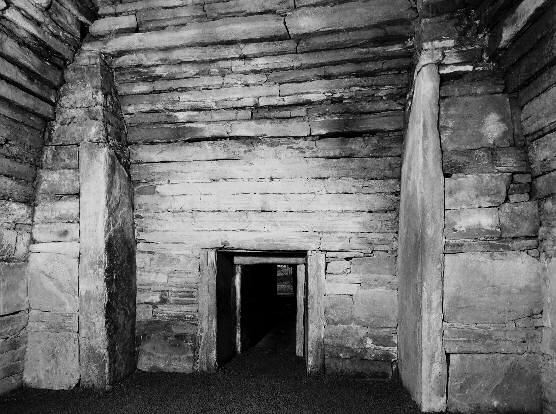

PicMaesEntrance.jpg
By Islandhopper, CC BY-SA 3.0, Link


Even though the text says of HCE within his intricate stone tomb that "he med leave to many a door beside" (FW 073.28), the persona of the man asleep is hard to find. He seemed to say goodbye to his angry assailant right before traversing the portal, crossing over into time-bending dimensions on the other side lightyears away, he "proceeded with a Hubbleforth slouch in his slap backwords... in the directions of the duff and demb institutions about ten or eleven hundred years lurch away in the moonshiny gorge of Patself on the Bach. Adyoe!" (FW 073.18-22) All that's left for us to examine is the increasingly ornate megalithic structure, "skatterlings of a stone" (FW 073.34) forming an "eolithostroton" (FW 073.30). Now separated from HCE by time spans in the thousands of years we become archeologists trying to develop "a theory none too rectiline of the evoluation of human society and a testament of the rocks from all the dead unto some the living." (FW 073.31-33) And then Joyce ends the chapter on the following page with pretty clear indications that the main character has now fallen into deepest sleep. 

In describing the sequence of events from this part of the Wake, John Bishop emphasizes that this all "seems to have to do not only with HCE's disappearance from consciousness, but also with his physical 'arrest,' his immobilization in the world of night; while in chapter 4, a significant turning point in the book, a process of 'disselving' and dispersion begins, as HCE fades from central focus into a remote background." (p. xx, Penguin edition of FW) In chapter 4, we once again encounter some references to Egyptian pharaohs buried deep inside pyramids, HCE's coffin becomes like a torpedo or submarine transporting through an "underground heaven, or mole's paradise" (FW 076.33). Further within chapter 4, HCE officially becomes no longer a somebody but an everybody, on page 88 he is named "Here Comes Everybody" with each letter representing the name of some historical or mythical figure.

By the end of chapter 4, where there was once a person now there is only an increasingly ornate stone structure, envisioned with "beaconsfarafield innerhalf the zuggurat" (FW 100.19). Maybe HCE is now the illuminated inner half of a ziggurat. He's no longer an entity but a geometrical structure, confirmed by "the canonicity of his existence as a tesseract." (FW 100.34-35) By the following chapter he has truly become a megalith, where the "trilithon sign M" (FW 119.17) is a fallen letter E meant to look like a trilithon

FW 119.17


This evolution of HCE into a gateway portal built of stone that is also an elaborate "eolithostroton" (FW 073.30) or ziggurat or tesseract entombing him reminds me of a Gopuram, the monumental and ornate entrance tower to a Hindu temple.

Gopuram, gateway entrance to Hindu temple

This transformation of a seemingly human character into a ziggurat or tesseract stone tumulus is weird and confusingly abstract, but bear in mind that structure is also a gate or door and Joyce repeatedly hints at having dropped keys for the reader. One of these keys might be the aforementioned trilithon sign formed by rotating the E sigla for HC Earwicker, and that seems to be hinted at on page 100 with "tristurned initials, the cluekey to a worldroom beyond the roomwhorld" (FW 100.29). Bear in mind too that the wedge in the aforementioned "wedgewords" and "langwedge" is indicative of the keystone in architecture. So much of what all this is saying seems to be commentary on Finnegans Wake itself, Joyce's own history of the world thru the experience of one person asleep at night, the reader being led on an archeological dig thru the history of the human body and human experience.

That amazing line on page 100 depicting lit up ziggurats, "beaconsfarafield innerhalf the zuggurat" conjures in my head a very similar image as that provided by the recently deceased poet Lawrence Ferlinghetti (himself a Joycean) at the end of his epic poem Time of Useful Consciousness (2012): "Macrotiendas in Teotihuacan/ The pyramids lit up like cupcakes." The below picture shows me sitting atop a ziggurat pyramid structure staring down the Avenue of the Dead in Teotihuacan, Mexico, with a James Joyce shirt on my back.


Exploring that ancient site of a complex pyramid city that was abandoned thousands of years prior, I couldn't help but think of Joyce and Finnegans Wake and the way he designed his book. The tour guide described how archeologists discovered buried remains underneath each of the ziggurat temples, they even found an "underground heaven, a mole's paradise" deep underneath the main ziggurat/pyramid, a series of tunnels decorated with gems to create the atmosphere of a mythical underworld amidst the stars. 

Joyce when he was finishing up writing Finnegans Wake worried that his highly complex masterwork might end up being neglected and abandoned. "Perhaps it will end in failure, be a wreck or ‘catastrophe’ ...and perhaps in the years to come this work of mine will remain solitary and abandoned, like a temple without believers." (Portraits of the Artist in Exile, p. 160-161, my emphasis) I think the Wake will always maintain the aura of an abandoned temple ripe for archeological exploration, but with Finnegans Wake group digs taking place all over the world and even assembling virtually via "Bangen-op-Zoom" (FW 073.26-27) amidst a global pandemic just like ours did, the great temple site has not remained solitary and the gems and treasures yielded from these group digs are invaluable to an appreciation of what the human mind is capable of.  

"So you need hardly spell me how every word will be bound over to carry three score and ten toptypsical readings throughout the book of Doublends Jined... til Daleth, mahomahouma, who oped it closeth thereof the. Dor." 
(FW 020.13-18)


(Thank you to Marcin Kedzior, Madeline Melnick, and the Austin Finnegans Wake Reading Group.)

Saturday, November 28, 2020

Rare Recording of James Joyce Society Meeting in NYC featuring Joseph Campbell, Padraic Colum


This recorded meeting of the James Joyce Society of NY took place on Oct 23, 1951 at Gotham Book Mart in Manhattan. This a must-listen for Wakeans. Joseph Campbell provides a good introduction to newcomers and then reads select passages from the book, really capturing the lilt of the language beautifully. Padraic Colum shares personal memories of his old friend James Joyce. There is a Dr. Schwartz on the recording as well, and I thought it might be Delmore Schwartz (who was captured in a photograph with a group at Gotham Book Mart in 1948) but this Dr. Schwartz seems to have met Joyce personally which Delmore never did. Lately I've developed a great interest in Delmore Schwartz, reading his biography, his journals, and his letters, with no mention of this historic occasion anywhere so it must be a different Schwartz. 

The gathering sounds sort of like a Finnegans Wake reading group. Listening to it I could feel myself there in that tiny Manhattan bookshop in 1951, enthralled listening to Campbell explore the text he loved so much, and seeing James Joyce come to life in the reflections shared by those who had known him personally. This was only ten years after Joyce's death.

"It was cultivated with a meticulosity bordering on the insane" - one of the members describing Joyce's approach to writing Finnegans Wake.

The recording is on YouTube thanks to the account "repetition compulsion" who has also posted the Anthony Burgess FW video and has also shared a video of Jean Erdman (Joseph Campbell's wife) performing her musical play "The Coach with the Six Insides." 

Tuesday, June 23, 2020

Latest Examples of Reading the News inside Finnegans Wake

"News, news, all the news." - FW p. 28.21

"old the news of the great big world" - FW p. 194.23-24


Ever since the coronavirus shut everything down, our local Finnegans Wake Reading Group transferred to online conferences and since the reading group is one of the most fun and fulfilling things going on for many of us right now, we shifted our twice-monthly meetings to now meet every week. The online venue allows us to branch out and bring in people who are outside of Austin, so now we regularly have people joining us from California, Ohio, and even Taiwan. It's been extremely satisfying having these weekly gatherings and doing digital group excavations of pages from Finnegans Wake.

One aspect of being involved in a regular Wake reading group that always intrigues me is how, without any intention on our part, we always manage to encounter material on the page we're reading that seems to speak directly to what is happening in the news that day. I've written about this phenomenon before (most notably when the Wake seemed to offer commentary on our Trump predicament), it is a quality about Finnegans Wake that has interested me for a long time, ever since the first time I attended a Wake reading group many years ago in Venice, California where the guy sitting next to me made a bunch of notes about contemporary references on the page we were reading. The upcoming Super Bowl, Bush and Cheney, oil wars in the Middle East, it was all there on the page. My mind was blown.

Oddly, these synchronicities never stop popping up. Like I said, these connections happen when you aren't looking for them. Finnegans Wake simply cannot help itself, it always has something to say about the news. I want to give you three examples from the last few weeks of our reading group to show you what I mean.

- Usually we read one page per meeting, but when we were on page 66 we found it to be so dense and overflowing with allusions and references and topics for discussion that we split that one page into three separate sessions. So in our last session we read the final paragraph which begins with "The coffin, a triumph of the illusionist's art..." and so on. We spent about two hours unpacking just that one paragraph and what we took from it, if I remember correctly, was that the paragraph was saying even though somebody was in a coffin it was an illusion in the sense that their legacy was only just beginning, their legacy would go on to have a life of its own, giving birth to new cycles of life (through their memory, through their children and their descendants, etc) even while their body was left to decay, consumed by subterranean creatures and reduced to ashes. This is an important theme throughout James Joyce's work, that absence can be the greatest form of presence, that the dead take on a more powerful life after death. Of course, it so happened that the day we read this passage was the day of George Floyd's memorial service where he was mourned as he lay inside a golden coffin. And George Floyd, in death, has now become an incredibly powerful figure, a name known across the world, the impact of his tragic killing has sparked an enormous uprising intent on societal change. I think of Floyd's sweet little daughter sitting atop the shoulders of Floyd's friend Stephen Jackson and proclaiming "Daddy changed the world!"

- The following week we were reading page 67 which features a special constable or policeman taking the stand in a trial and giving an eyewitness account of some occurrence in the book. At one point while the policeman is speaking, Joyce uses the phrase "he guntinued." The presence of this constable character opened up a whole discussion about police and the history of policing, which apparently originated from British colonialism and the need to keep colonial subjects in line. Of course, this discussion about the police and their history sprung up amid the backdrop of heated debates going on in the United States about the need to reform our police system. In a bizarre coincidence, the passage on 67 with the policeman features the phrase "You are deepknee in error, sir" which we couldn't help but connect with the horrific image of the policeman Derek Chauvin putting his knee on George Floyd's neck for nearly ten minutes until he died.
(I should also mention that this same passage with the policeman and subtle appearances of police violence featured the word "tailliur" which conjures up Breonna Taylor, the young black woman who was killed while sleeping in her home in Louisville, Kentucky.)

- The most recent one really struck me as being uncanny. While we were reading page 68 we stopped at this sentence and chewed on it for a while: "Nor needs none shaft ne stele from Phenicia or Little Asia to obelise on the spout, neither pobalclock neither folksstone, nor sunkenness in Tomar's Wood to bewray how erpressgangs score off the rued." It is a very dense and difficult sentence to unpack, but there are some good clues in there. That word "stele" refers to a type of ancient monument, a stone slab with inscriptions. You've got an obelisk, another monument, in there. The portmanteau word "pobalclock" combines two Irish words which basically translate to "folk stone" and there is "folksstone" following right after "pobalclock." Fweet mentioned that there is a stone pillar monument in the town of Folkestone in England marking the spot where Saxon invaders landed on the shores. You see where this is going? The sentence essentially says we don't need monuments to mark where the invaders landed, we don't need to recognize those "erpressgangs"---a word combining the German erpressen meaning "to blackmail or extort" and also press-gangs which were groups that kidnapped men and forced them to enlist in the military. All of this stuff rung an uncanny echo with the ongoing debates in the United States about removing statues and monuments that commemorate Confederate generals or slave owners or other historical figures known for their roles in perpetuating America's history of bigotry and racial oppression. Page 68 is very rich and fascinating, there's a lot to it, but for me it was pretty mind-blowing to come upon this sentence about statues and monuments and how we don't need them if they're commemorating invaders and oppressors in the midst of what is happening in America right now. Finnegans Wake never disappoints.

Wednesday, April 8, 2020

A Tribute to Austin Finnegans Wake Reading Group Member Richard Lee Price (1949-2020)

Memory is not an eye that returns to the past; it is rather the power that allows us to see what is, in its essence, outside of time .... 
- Ermilio Abreu Gomez 
(quoted by Richard Lee Price in his novel Troubadours: Love, Death, Rumba)


Do not go gentle into that good night,  
Old age should burn and rave at close of day; 
Rage, rage against the dying of the light. 
- Dylan Thomas

Yesterday I heard the news that a good friend who was part of our Austin Finnegans Wake reading group for years named Richard Lee Price (June 14, 1949 - April 7, 2020) had passed away. Richard was a truly beautiful soul, a poet, a musician, a songwriter, a scholar professor, a funny and witty chatterbox with a Bronx accent. I loved him and I feel crushed by the news of his loss. Since hearing about it, I have been overwhelmed by feelings of grief and anger that I will never get to see him again. I knew that he was battling an illness, he had been sick for a while but I was holding out hope, I felt sure he would get better and return to our group. I'm really going to miss him and I want to send my heartfelt condolences to his family and loved ones. (You can read an obituary for Richard Lee Price here.)

He was a really unique guy, a true character, lots of fun to be around. Because I grew up in New York City the son of an old school Brooklyn guy with a heavy accent and most of my father's friends and associates were old New York guys with heavy accents, Richard felt like a long lost relative or family friend. Richard grew up in the Bronx, lived in Brooklyn for years, went to school in Queens, he was a true New Yorker. Like my dad and his pals, he was talkative, a super witty and funny and occasionally over-the-top chatterbox. Unlike most of the people I grew up around though, he was an intellectual, a poet, an artist. His NYC street-tinged accent spitting out rants was not raging about petty bullshit, no, he was frequently carrying on about Greek philosophy and mythology, about Shakespeare, about Yeats, about jazz music, about the Bible or eastern religion. He was a passionate and proud Jewish man with a great sense of humor. He had been an English professor for forty years and then became an avid practitioner of Tai Chi and Chi Kung in his retirement, battling back ill health. He had a sage-like presence, a wisecracking old professor who walked around with a cane, but who was a master of the art of kung fu (no kidding). I really enjoyed being around him and I feel sad and angry that I didn't get to spend more time with him and that I can never see him again. What I do have are lots of memories of him that I will cherish.


I want to tell you a few stories about Richard Lee Price that may capture what kind of guy he was.

- First time I met Richard was at a Bloomsday event at Malvern Books in central Austin about five or six years ago. I read an essay about Ulysses from the podium and then this guy with a white beard, wearing a sideways beret, carrying a cane gets up to ask a question and goes on into a longwinded and passionate discussion about Homer's Odyssey and the Molly Bloom chapter in Ulysses and then asks me some super heavy question that I had to think about for a while before I could muster an answer. I don't remember what the question was now, but I remember later on all of us from the group were wondering who the hell was that guy? He and I connected and he soon started attending our meetings.

- Richard was a brilliant guy, he sparked so many ideas and perspectives for me in our discussions. I remember the first time we had a Finnegans Wake reading group hosted at the Irish Consulate, Richard went into detail on an interpretation of the I-Ching appearing on a page we read and what he said became part of my inspiration to write a paper on FW and I-Ching that I delivered in Mexico City last year. I recall many times when he'd point out something in the course of our reading groups, a unique interpretation of a line in Finnegans Wake that was just so perfect and enriching that I'd be pondering it for months and would always thank him. I still have ideas and notes for future pieces to write that sprang from talking with him. As a professor of literature and seasoned scholar he was a mentor figure for me but also a great buddy. I remember one time it must have been a rainy night or something and only he and I showed up to a reading group meeting we had at the Wheatsville food co-op in South Austin. So instead of doing the normal routine of studying a page from the book we just talked in great detail about Finnegans Wake in general, he wanted to hear my theories about it and then he went into long fascinating monologues about Dante and The Divine Comedy and Herman Melville and Moby-Dick. His mind was a treasure trove. Another great memory of him I have is one time at a reading group where Richard and I were discussing a subject related to Finnegans Wake and the next morning he left me a voicemail talking at length about an article he had read online about that same subject, an article he just loved and went on and on in great detail about and said he wanted to read it 10 more times. Then he left me another voicemail immediately afterward where he realized it was actually something I wrote on this blog and he said "in the parlance of my youth, you are one heavy dude, man." I still have these voicemails from him and I will cherish them. (Part of what I loved about Richard is he was genuinely interested in my writing and my ideas about Joyce, he would often read my work and give me really meaningful feedback. That piece he was talking about on the voicemail was one of my favorite pieces ever, called What is Finnegans Wake? A Simulacrum of the Globe (Part 2).)

- Richard was a scholar and a professor of literature for forty years. In our groups he would regularly go off into Greek philosophy and mythology, come back to Judaism and the Bible, veer into old New York City and the Bronx and jazz music, throw in some classic poetry and dirty jokes. He was known to break into song and he had a good voice. He had so many classic poems and amazing lines and lyrics memorized and he was eager to share them. For a while he had his own book group focused on Chaucer's book Troilus and Criseyde which he adored and often mentioned in our Wake discussions. This is the kind of thing that I wish I could hear him talk more about now. At one point some of our reading group members recorded a pilot episode for a podcast, the full recording is something like 4 or 5 hours and Richard is on there giving his typically wide-ranging and long-winded talks. I hope I can share some of that here soon.

- He was a very funny dude, kind of a goofball, always cracking jokes, being ridiculous and witty. One thing I remember that cracked me up was one night the reading group had a party and when Richard and his wife were getting ready to leave I was like "leaving already?" and he responded, "Peter I'm an old man! I gotta go home and have my milk and cookie and go to bed!"

- One of the last times I saw Richard was a Wake reading group night I will not soon forget. In the meeting prior to it, a young college student had attended the group for the first time and later while we all ate pizza afterward she had expressed some unkind opinions about Native Americans which Richard politely but firmly argued against and sorta shut down. The exchange was a little odd I guess but I didn't make much of it at the time. Then in the following reading group meeting a month later, the same young lady returned and brought her boyfriend along. He seemed sorta like a young conservative frat boy kinda dude but, as she boasted, "he knows everything" and he did indeed talk like he thought so. After our group meeting while we all ate pizza across the street again this guy and his girlfriend spouted some egregiously hateful and Islamophobic opinions and racist garbage interpretations of history and I got to witness the old professor, old school Bronx dude, and obligingly confrontational yet calm Tai Chi master Richard, sitting with both hands atop his cane, absolutely school them in the most articulate and info-dense manner possible. This was all an intellectual debate, mind you, but it got pretty heated. The more heated it got, the more calm, articulate and piercingly funny Richard got. I think my feelings on the matter were apparent by my hysterically laughing at how badly Richard was schooling them in this heated argument. God, it was great. He had been slicing through that kinda bullshit from loud, know-it-all assholes for decades. What an inspiring guy he was.

May he rest in peace.

Friday, April 26, 2019

Interview: Derek Pyle and Gavan Kennedy discuss upcoming "Finnegans Wake-End" celebration & "Finnegan Wakes" film project

Artwork by Boris Dimitrov.

[The 80th birthday of Finnegans Wake is next week, May the 4th. (Yes, Finnegans Wake day is also Star Wars day.) With the 80th anniversary of Finnegans Wake approaching, Dublin has been buzzing with events celebrating James Joyce's greatest and weirdest masterpiece. Two pals of mine, Derek Pyle and Gavan Kennedy, will be involved in an upcoming event called Finnegans Wake-End orchestrated by the James Joyce Centre in Dublin. Central to the festivities will be Gavan's ongoing documentary project "Finnegan Wakes" wherein a Here Comes Everybody array of random readers around the world are filmed reciting a page from the text alongside music. I did a Q&A with Derek and Gavan via e-mail discussing the upcoming Finnegans Wake-End event, Gavan's experience with the film project, and their love for Joyce's nightmaze. I'm excited to share this discussion here. Derek's words are in orange, Gavan the Irishman's words are in green. Enjoy! - PQ]

Saturday, March 9, 2019

Carvings in the Claybook: A Reading of Finnegans Wake pgs. 18-19

From Id-Grids and Ego-Graphs: A Confabulation with Finnegans Wake by Jacob Drachler.

After cycling from the last chapter back to the beginning, our Austin Finnegans Wake Reading Group recently finished reading chapter 1. As often happens with this astonishingly rich book, there's been one section of the text that I've been stuck on, pondering for months. It's the part beginning on page 18 immediately after the discordant dialogue between two cartoonish Neanderthals named Mutt and Jute. The passage seems like a direct address to the reader instructing us how to approach the very text we are reading. The more I look at this section, the more I get out of it. In some ways it feels like a mission statement of Finnegans Wake, a convoluted self-commentary outlining the book's archeological treasures.

The entirety of pages 18 and 19 is what interests me but for the purposes of trying to keep this post as neat and focused as I can, let's focus especially on one notable paragraph spanning these pages.

Here's the paragraph, from pages 18-19:

Friday, November 23, 2018

Thunderword No. 2

(Perkodhuskurunbarggruauyagokgorlayorgromgremmitghundhurthrumathunaradidillifaititillibumullunukkunun!) 
- Finnegans Wake, p. 23

This, the second of ten 100-letter thunderwords scattered throughout Finnegans Wake (the tenth containing 101 letters, making 1001 in all), punctuates the climax of the explosive Prankquean fable (p. 21-23) and strikes resonant chords with many of its themes. As with everything in Finnegans Wake, thunderword no. 2 is so many things at once.

Our Wake reading group here in Austin recently made our way through the Prankquean episode and coincidentally, our friends in the Santa Cruz Finnegans Wake group also just finished reading about the Prankquean. Seana Graham wrote a nice blog post discussing their collective interpretations as well as the background of Grace O'Malley, the 16th century Irish pirate queen, a historic figure who became part of Irish folklore and who Joyce renders cartoonishly as the Prankquean. A provocative force who befuddles and terrifies the patriarchal Earl of Howth (called Jarl van Hoother in the Wake), the Prankquean represents feminine energy that forces change. Seana writes: "when I look at what is happening in our country, I see a similar principle at work."

A quick bit of background: the Prankquean episode is based on a story wherein the pirate queen Grace O'Malley showed up at the door of Howth Castle one night hoping for a place to spend the night. Established traditions were that the castle doors remain open during dinner time, yet the Earl of Howth defiantly shut the doors on O'Malley. At this blatant show of disrespect, O'Malley responded by kidnapping the heir of Howth. Instead of a ransom, she demanded the castle doors remain open for visitors. In the two-and-half page Finnegans Wake fairy tale version, the story is repeated three times with slight variations. In each instance, Jarl van Hoother is busying himself doing something creepy ("laying cold hands on himself" or "shaking warm hands with himself") when the Prankquean arrives at the doorstep and drops an unsolvable Zen koan of a riddle on van Hoother who promptly slams the door in her face, so she kidnaps and runs off with each one of twin children Tristopher and Hilary while Jarl van Hoother angrily hollers after her.

Joyce's fable of the Prankquean marks its three stages this way:

"And that was how the skirtmisshes began." (p. 21) 
"But that was how the skirtmishes endupped." (p. 22) 
"For one man in his armour was a fat match always for any girls under shurts." (p. 23)

In the third instance of the Prankquean's assault on the castle, Jarl van Hoother becomes so enraged that he dons an array of armor and his face turns every color of the rainbow in fury "like a rudd yellan gruebleen orangeman in his violet indigonation," but he was no match for the Prankquean. At first I thought the thunder clap was Jarl shutting the door loudly but "the duppy shot the shutter clup" contains the word "dup" which means "to open." That adds new meaning to the phrase "that was how the skirtmishes endupped"---the skirmish ended up with the door being kept open, as the Prankquean demanded. Similarly, after the thunder it says the Prankquean "made a sweet unclose."

Here is a video made by Wake performer extraordinaire Adam Harvey breaking down the sounds of this thunder:


The consonant-heavy thunderword comes as a fitting denouement to an episode marked by fiery storms, combustible anger, and ... bodily excretions. The ferocious Prankquean "lit up and fireland was ablaze" upon her initial arrival. When she departs, the skies rain down "falling angles" or "starshootings." Of course, her beguiling presence makes Jarl van Hoother erupt in volcanic anger and, as was hilariously discovered and discussed in our Wake group, loud explosive diarrhea.

Eric McLuhan's rich study The Role of Thunder in Finnegans Wake breaks down every syllable of each thunderword. In this one he finds a whole host of relevant themes and metaphors including: reference to the word "thunder" in over a dozen languages; lots of nautical terms in multiple languages (kicking off with "Perkod-" recalling Pequod, the ship in Moby-Dick) linking to the sea-faring piratess Prankquean; pairs of peas in a pod (recalling the Prankquean's repeated riddle, "Why am I alook alike two poss of porterpease?" [p. 22] a question for which there is "Noanswa!" [p. 23]); references to battles, enemies, cannon fire; clothing (recall van Hoother covers himself in layers of armor); charm and seduction (Prankquean is a kind of temptress, there are also words for "whore" contained in the thunder).

So, yes, this 100-letter word on one level represents the sound of thunder erupting, on intricate microcosmic levels it has a whole host of words in various tongues striking concordant notes with the episode's major themes, but it also quite simply enacts the onomatopoeic sounds of a loud, long fart. Or more likely a shart. I'm not kidding.

(Perkodhuskurunbarggruauyagokgorlayorgromgremmitghundhurthrumathunaradidillifaititillibumullunukkunun!) 
Finnegans Wake, p. 23
The thunderword is surrounded by indications that Jarl van Hoother is angrily sharting. It is perhaps an appropriate response to the Prankquean who, each time she arrives at the castle door, either defecates ("the prankquean pulled a rosy one" on p. 21, according to Fweet the slang "to pluck a rose" is when a woman defecates or urinates) or she urinates ("and she made her witter before the wicked" on p. 22---she made water). When she arrives a third time, van Hoother has "his hurricane hips up to his pantrybox, ruminating in his holdfour stomachs" (p. 22), clearly he's got an upset stomach. When he orders the castle door to be shut (each time he yells for the door to "Shut!" there's an echo of "Shit!"), it is said that "he ordurd"---there's the word "ordure" meaning excrement. 

Immediately following the reverberation of the thunderword, we are told, "And that was the first peace of illiterative porthery in all the flamend floody flatuous world." Can't help noticing the flaming, floody flatulence there, certainly offering hints that Jarl van Hoother let out a wet fart or a shart. The text also notes that "van Hoother was to git the wind up" which sounds like he farted. With all this in mind, we can't help now seeing words like "shutter" and "shurts" (p. 23) as indicative of van Hoother sharting on himself, angrily in his "violet indigonation."   

The more I read the Wake, the more I marvel at how Joyce blends together so much of the world's history and folklore, science and wisdom, seemingly every language known to man, and yet never does he cease to be silly and absolutely filthy. Yes, the Wake is in many ways a high-brow book, but it also has, on every page, the type of humor that would make schoolchildren laugh.