Showing posts with label hologrammatic prose. Show all posts

Saturday, December 21, 2024

"So This is Dyoublong?" Living Inside the World of the Wake, Part 2

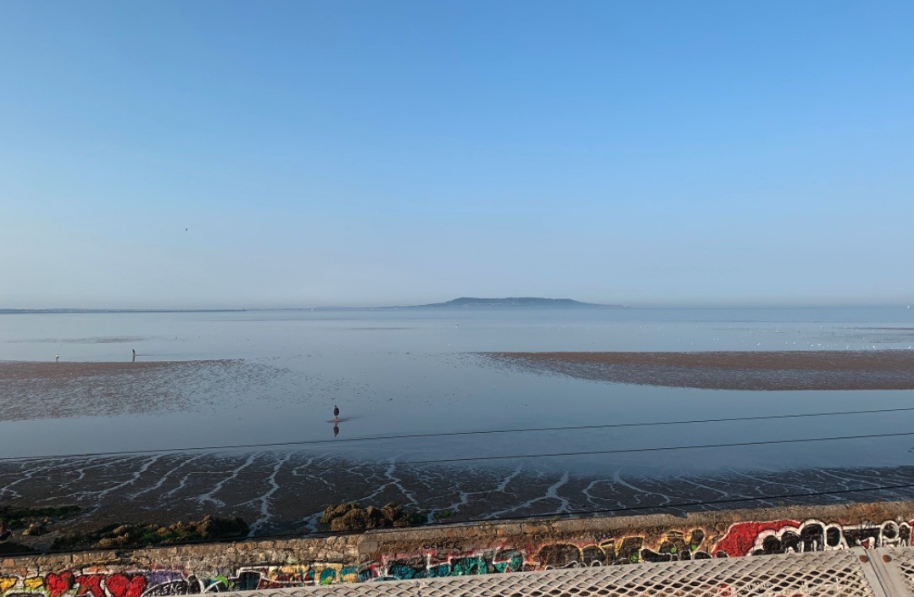
Dalkey Island, southeast of Dublin 


I was on an extended stay in Dublin a few years ago and found myself in a shared space somewhere out in Leopardstown on the outskirts of the city. The Leopardstown horse racing course is mentioned multiple times in Finnegans Wake and is still active to this day. No leopards are found in the area, though, the name was a modification of Leperstown, as it used to be called, because that's where the city had once quarantined its leprous citizens. In the Wake it appears as "Leperstower" (FW 237) and "Leperstown" (FW 462). It comes up in a classroom scene in A Portrait of the Artist as a Young Man when a student is missing during roll call and someone blurts out, "Try Leopardstown!"

No matter where I went, whether all the way out in Leopardstown or in the heart of the city, every time I looked up something nearby it seemed there was mention of it in the Wake. It's hard to overstate how much one feels embedded in the Wake due to the places and place names one encounters in that city. At one point I relocated to the city center and, looking on the map, I notice across the street from my hotel was a funeral parlor by the name of Fanagan. This was on Aungier Street, central Dublin. Sounded familiar, so I looked for it in Finnegans Wake and, sure enough, Fanagan's funeral parlor is punned on several times in the book. They've been in business in the same location since the year 1819. You will find "Fanagan's weak yat his still's going strang" (FW 276.22) among other appearances, "and all the fun I had in that fanagan's week." (FW 351) That's Dublin, the center of Wake world. The text of Joyce's encyclopedic 1939 novel is so wide open it seems to encompass everything that's ever been or will be, yet it all revolves around the reliable center anchor that is Dublin and environs. A real place on a map. The same Dublin I was staying in, strolling through, the same street as present-day Fanagan's undertakers fashioning their own wakes for Finnegans for the last two hundred years. 

Being in Dublin means being at a crossroads of mulitverses, a centerpoint of alternate realities, the axis of a mandala where worlds intersect and converge. Joyce scholar Struther B. Purdy wrote an article for the JJQ entitled, "Is There a Multiverse in Finnegans Wake, and Does That Make It a Religious Book?" In that piece, Purdy argued that Joyce's linguistic manipulations and the unmooring of space/time leads to words creating alternate worlds:

Past and present are coterminous because they are different places. Different places and different times coexist; words make worlds. Worlds are therefore a) plural and b) as unlimited in number as are words. "Budlim" (FW 337.26) is not Dublin distorted phonologically to add to the description of the earth's Dublin but a Dublin-like city in another Ireland, possibly the eerieland/"Ereland" of FW 264.31. The "battle of the Boyne" is locatable as the battle of that name in 1690, while the "bettlle of the bawll" is a shadow battle in a different world. (FW 114.36, 337.34).

Further multiplying the shadow worlds of "Dublin-like" cities in Joyce's "Errorland" (FW 62) or "Aaarlund" (FW69) hovering next to and intersecting with earth's Dublin are the various names for Dublin that proliferate throughout Finnegans Wake. Wander the city, take the bus, or ride the train around Dublin, and you'll frequently encounter the Irish names for places (signs and announcements include both the English and Irish language) especially Baile Atha Cliath, the city's Irish name, which translates to Town of the Ford of Hurdles. Hurdles are basketwork, (hence "at Wickerworks" FW 289) which was used as a ford or bridge to cross the river. In the Wake it appears as "fordofhurdlestown" (203.07). Seeing the words Baile Atha Cliath pop up so often around town always harkens back to the Wake where variations of "Baulacleeva" (FW 134) and "Bauliaughacleeagh" (FW 310) inundate the page, "the deep drowner Athacleeath." (FW 539). In the Dublin of the pre-Viking invasions era, there actually were two settlements along the Liffey named Atha Cliath (hurdle ford) and Dubh Linn (black pool). The two names are now interchangeable. Dear dirty Dublin or "Dix Dearthy Dungbin" (FW 370) the center of the Joycean universe, it is astounding when you consider how devotedly Joyce's books focus on Dublin.

*   *   *

All of Joyce's major published works focus on Dublin and when I was there I was wondering, why did this talented author devote all of his energies to document this place, its neighborhoods and characters and histories? And why did he stay away from Ireland for so long? And, especially, exactly when was it that Joyce had last set foot on the streets of Dublin?

Even after his young and defiant departure from the emerald isle with Nora Barnacle in 1904, Joyce made a few trips back to Ireland, first in 1909 and again in 1912. Never again after that. Biographers note that he stayed away for fear he might be attacked in the street, thinking of an incident that happened to Parnell where an assailant threw quicklime powder in his eyes. Nora and the kids got caught in a crossfire in Galway on a visit once. The period of the Irish Revolution was extremely violent, and nationalists not only might accuse Joyce of not sufficiently supporting their cause, in those days they were likely to be angered by Joyce's depictions of the Irish.

Whether reading Joyce's books or walking the streets of Dublin, the emphasis on psychogeographies leads me to be interested in recalling the facts of when was the last time Joyce was physically present in the country he wrote so much about. Here are some details on the last visits James Joyce made to Ireland:

  • July 1909 the exile returns to Dublin for the first time since he left with Nora in 1904. Joyce arrived by ship into Kingstown Pier (now Dun Laoghaire, same pier from which they had disembarked). First thing he spotted on getting off the ship was Oliver Gogarty's fat back, and he avoided his old nemesis. James and his son Giorgio took the train into the city center and were welcomed by his father and sisters at Westland Row Station (present day Pearse station). This was the trip when Joyce bumped into a friend, Cosgrove, who said he'd taken long walks with Nora after dark when they were first dating. Joyce fell into despair, went over to 7 Eccles Street (in north Dublin) to be consoled by his friend Byrne. These events became integral to Joyce's conception of his novel, Ulysses. On that same trip, Joyce met with his nemesis Gogarty for one final tense encounter. Gogarty would soon be transformed by Joyce's pen into Buck Mulligan, the arrogant foil to Stephen Dedalus in Ulysses. By the time Joyce left Dublin with his son in September 1909, he felt sick of the place. 
  • But he would return shortly thereafter, on 21 October 1909. This time he stayed for more than two months. This time it was a very awkward departure when he left Nora in Trieste. He was heading into Dublin for a business venture, looking to find a good location for the new cinema he was helping to put together, the first of its kind in Ireland. He settled on 45 Mary Street, not far from busy Sackville Street (present day O'Connell Street). On this trip, he was also meeting with publisher George Roberts trying to get his first book Dubliners published. During this trip he "went to Finn's Hotel, visited Nora's old bedroom and wept. After dining there, he sat at the table and wrote to her, sobbing as he did so." (Bowker, p. 189) Joyce and his business partners went up to Belfast looking for more sites to build a cinema. The Volta was opened on Mary Street in Dublin in December. During this long time away from his young wife, Joyce and Nora exchanged naughty letters. Seems he had become so aroused, he couldn't resist going to visit the brothels in Nighttown. There's an implication that he might've caught a venereal disease at this point. He confessed this to Nora who stopped sending letters to him for a while after.
  • July 1912, Joyce rushed off to Dublin with Giorgio to meet Nora and Lucia. Bowker pg. 200-201 details how Nora brought Lucia to Ireland to meet her family in Galway in 1912. They also went east where the Dublin Joyces met the girls at Westland Row station on July 8. That's when John Joyce broke down in tears at the sight of Lucia, feeling sad that he'd become disconnected from his favorite son. James Joyce in Trieste was troubled with jealousy, grew anxious over not hearing from Nora, became sad because she stayed at Finn's Hotel without even mentioning to him that it was where they first met. So he borrowed money from friends and rushed off to Dublin from Italy with Giorgio on July 12. Upon arrival, they stayed at 17 Richmond Place with his brother Charlie and family. Of this visit, Bowker writes: 

Joyce was anxious to refresh his memory of the city which he had made the centre-point of his creative imagination. There were places to revisit and fragments of gossip to be gleaned from every encounter, every visit to a bar, every edition of a Dublin newspaper. (p. 201) 

After more difficulties with the printers and publishers over the publishing of Dubliners, Joyce wrote the broadside "Gas from a Burner" attacking those who refused to publish his works for fear of upsetting the Ireland of the time under British rule and Catholic control. He took a ship back to Trieste, never to return to Ireland again. Soon thereafter he started writing Ulysses

Decades later, in 1941 when Joyce and his family managed to escape Nazi-occupied France to enter into Switzerland, an Irishman named Sean Lester greeted them. Lester, the last Secretary-General of the League of Nations, records Joyce's answer when Lester asked him why he did not go home to Ireland: "I am attached to it daily and nightly like an umbilical cord."
(see more here)


*   *   *

"And Dub did glow that night" FW 329.14

The city today has a population that keeps growing, worsening a severe housing shortage. Dublin has become an international tech hub, home to headquarters of Google, Facebook, Microsoft, Verizon, &c. The many colorful lights gleam at night from ultra-modern architecture along the quays of the “efferfreshpainted livy” (FW 452), the effervescent ever-fresh-painted Liffey. Modernized as it has become, the city still constantly summons connections to Joyce's 1939 novel. Of course, the same applies for Ulysses, that book by itself generates substantial tourism to Dublin. As I mentioned in a previous post, I got to walk around the city during the Ulysses centennial on Bloomsday 2022 and really get a feel for the local pride around that book (John McCourt's recent book Consuming Joyce: 100 Years of Ulysses in Ireland gives a great account of the shift in Ireland's attitude toward Joyce). 

I'm taking you through some of my experiences exploring sites relevant to Joyce's work, especially Finnegans Wake. I had been reading the book for at least a decade before I ever set foot in Dublin. When you gain even a passing familiarity with districts in Dublin, a shockingly significant portion of the text starts to become recognizable. I think it is likely true that nothing could better prepare someone to read Finnegans Wake than to visit Dublin and learn about the city. I don't mean to promote the place, although I do love it there. It's just that the Wake is obsessed with Dublin to the point of absurdity, at one point when the opaque book offers a moment of clarity, for instance, it turns into a commercial promoting the city:

This seat of our city it is of all sides pleasant, comfortable and wholesome. If you would traverse hills, they are not far off. If champain land, it lieth of all parts. If you be delited with fresh water, the famous river, called of Ptolemy the Libnia Labia, runneth fast by. If you will take the view of the sea, it is at hand. Give heed! (FW 540.03-08)

I think it is fair to say the text of the Wake contains even more information about Dublin than Ulysses does. Dublin serves as the setting for Ulysses and it is as thoroughly described as could be. In the Wake, though, Dublin becomes the entire texture of the language. Dublin is the subject, object and predicate. City district names blend, morph, and become verbs. To the extent there are characters in the Wake they are on some level representative of aspects of the environment, the father connected with Howth Head, the mother is the River Liffey, the daughter is a cloud, for example.


        (clouds over Dublin)

Everything in the entire history of this place across varying scales of time all coexists on the same plane in the Wake. Dublin becomes a crossroads of multiverses where time folds into and becomes part of space. You notice there is so much history embedded everywhere around Dublin, and how the text of the Wake seems to embody this landscape, its earth layers filled with centuries of history. There is a Timefulness to the place. This is a term coined by the geologist Marcia Bjornerud to describe spaces containing a palpable presence of deep history. As she explains: "I see that the events of the past are still present… This impression is a glimpse not of timelessness but timefulness, an acute consciousness of how the world is made by–indeed made of–time." (p. 127 Saving Time, Jenny Odell) I thought of this when I saw a Martello Tower or when I saw Howth Castle or the rocky cliffs in Dalkey or the promontory in Bray or the rugged coastline at Greystones. Joyce in the Wake captures the essence of this observation in the phrase "this timecoloured place" (FW 29.20). 

A more expansive example of this timefulness quality of Dublin is provided by Joyce when Stephen is walking along Sandymount Strand in the "Proteus" episode of Ulysses and he has this vision of being among the vikings: 

   Galleys of the Lochlanns ran here to beach, in quest of prey, their bloodbeaked prows riding low on a molten pewter surf. Dane vikings, torcs of tomahawks aglitter on their breasts when Malachi wore the collar of gold. A school of turlehide whales stranded in hot noon, spouting, hobbling in the shallows. Then from the starving cagework city a horde of jerkined dwarfs, my people, with flayers’ knives, running, scaling, hacking in green blubbery whalemeat. Famine, plague and slaughters. Their blood is in me, their lusts my waves. I moved among them on the frozen Liffey, that I, a changeling, among the spluttering resin fires. I spoke to no-one: none to me.


"Famine, plague, and slaughters" marked the years of the brutal Viking invasions of Dublin. What Stephen describes are not only scenes of bloody wars in Scandinavian Dublin but also visions of hordes of locals feeding off beached whale carcasses "hacking in green blubbery whalemeat," and this cluster of images comes up again in the first chapter of the Wake as the reader is guided along on a tour of Dublin. 

Men like to ants or emmets wondern upon a groot hwide Whallfisk which lay in a Runnel. Blubby wares upat Ublanium. (FW 13)

Men feeding off "a groot hwide Whallfisk" whale laying in a runnel or a river channel. And the last part is not just the blubber wares of whale meat but the bloody wars at Eblana, another name Joyce uses for Dublin. (Eblana was the name given by Ptolemy in early maps of the Dublin area.) The bloody wars in Dublin becomes a motif repeated again a few more times in the ensuing paragraphs, while also giving the various names for Dublin. 

Blubby wares upat Ublanium.

Blurry works at Hurdlesford.

Bloody wars in Ballyaughacleeaghbally.

Blotty words for Dublin.
(FW 13-14)

I think what is being captured in the varying names for Dublin being stacked this way is showing the changes across time due to the bloody wars and blurry works. But, again, in the Wake all of these historical eras and events are ongoing and coterminous with each other, all active in the same space. 

In the last post, I was describing visions of Dublin, seeing the ink and paper of Finnegans Wake merging with the sewage, rainwaters, roots and soil of the city. I was thinking of the letter in the book, on one level representing the Wake itself, buried deep under the city, taking root in the inner terrain of Dublin. Interlocking with the city innards, like an artery, soaking in the detritus of the city, draining down to the Liffey. Blackpool. Dubh Linn. 

what was beforeaboots a land of nods, inspite of all the bloot, all the braim, all the brawn, all the brile, that was shod, that were shat, that was shuk all the while, for our massangrey if mosshungry people, the at Wickerworks, still hold ford to their healing (FW pg 288) 


*   *   *

If to be able to read Ulysses it is advisable to relate the movements of the characters to a map of Dublin… in Finnegans Wake it is the text itself that, in a sustained embodiment of modern creativity, becomes the map, the pilot's book, the topographical pattern, the metaphoric grid, the model and the structure capable of projecting the image of the world onto a screen, on a two-dimensional page…   

(Carla Vaglio Marengo, "Mapping the Unknown, Charting the Immarginable, Fathoming the Void: Space, Exploration and Cartography in Finnegans Wake", from Joyce Studies in Italy, 2022)


There is a circularity to the geography of Dublin as it's presented in the Wake. It starts with a sentence that cycles around town starting from Adam and Eve's Church, going along the swerve of shore, out to Vico Road in Dalkey, and then "by a commodious vicus of recirculation" cycling around out to Howth Castle. The drilling down into the history embedded in the layers of the landscape I mentioned above seems like a centripetal spiralling down into the vertical depths of "Shuvlin, Old Hoeland." (FW 359.24-26) The "Nightlessons" chapter (II.2) has a bunch of geographical aspects to it, the lessons studied by the children involve the geography of Dublin. It seems the Euclidean overlapping circles diagram on FW p. 293 has a geographical interpretation to it, maybe that is what the directions are providing in the second paragraph of that chapter (on pg 260), where the reader is given an itinerary through the city, we circle "wheel, to where. Long Livius Lane, mid Mezzofanti Mall, diagonising Lavatery Square, up Tycho Brache Crescent" (FW 260) and so on.

A few pages prior there is a passage with a geographical survey of the city: "where G.P.O. is zentrum and D.U.T.C. are radients write down by the frequency of the scores and crores of your refractions the valuations in the pice of dingyings on N.C.R. and S.C.R." (FW 256.29-32) This denotes the GPO, or General Post Office, on O'Connell Street as the center ("zentrum") of the city, with radii "radients" branching out via the DUTC (Dublin United Tram Company) pathways, and then the "N.C.R." and "S.C.R." are the North Circular Road and South Circular Road. When you stare at the map of Dublin with this in mind, looking at the rounded roads along the north and south you could see how the city might be considered a circular or oval oblong shape, as Joyce calls the city elsewhere in the Wake, "D'Oblong." (FW 266.06) This spatial geomapping has some historical accuracy, as described in Roy Benjamin's book Beating the Bounds (2023), the North and South Circular Roads were originally designed to be the boundaries of the city. 

Just as the historical events of the place are not abstract or in the past but actively occurring alongside each other, the city of Dublin doesn't just exist as a static entity in the Wake, it's constantly in motion taking formation as the streets branch out from the river in the heart of the city forming like veins carrying the lifeblood of the community. When Joyce had sent his patron Harriet Weaver a draft section of the Anna Livia chapter including his annotations shedding light on what was going on in the passage, he explained one of the lines this way: "All this is to give the idea of the growth of Dublin, branching out into one street after another." The branching streets and the tracks of the trams and trains venture out from the heart of the city to the suburbs and back. This is the same network described at the opening of the "Aeolus" chapter of Ulysses with the headline blaring "In the Heart of the Hibernian Metropolis" followed by details of the same radii lines of the Dublin United Tram Company expanding outward from the GPO in the center of the city.

The detailed geomapping with the GPO serving as the centerpoint becomes even more outlandish elsewhere in II.2 when the focus is on the suburb of Chapelizod, to the west of city center, the place where the Mullingar Inn pub is located. This pub is considered to be the location of all the events of Finnegans Wake, with the pub owner and his family asleep upstairs and, according to some interpretations, dreaming all of what we're reading in the book. In a passage on pg. 265 the distance from the Mullingar pub to the GPO is given as "only two millium two humbered and eighty thausig nine humbered and sixty radiolumin lines to the wustworts of a Finntown's generous poet's office." (FW 265.25-28) Naming the GPO "generous poet's office" is fantastic, bravo Joyce, but breaking down the distance into "radiolumin lines" is truly mindboggling. McHugh's notes say that there are 2,280,960 twelfths of an inch in three miles (the distance between the GPO and the Mullingar pub). But "radiolumin lines" conjures not only the radius, but also rays (radius) of light (lumin) which gets into all kinds of physics ideas about lightspeed as a measurement. Too much for me to comprehend right now, but we will come back to the landmark Mullingar pub later on.


*   *   *
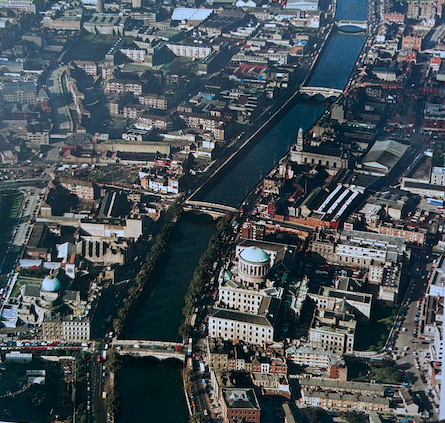

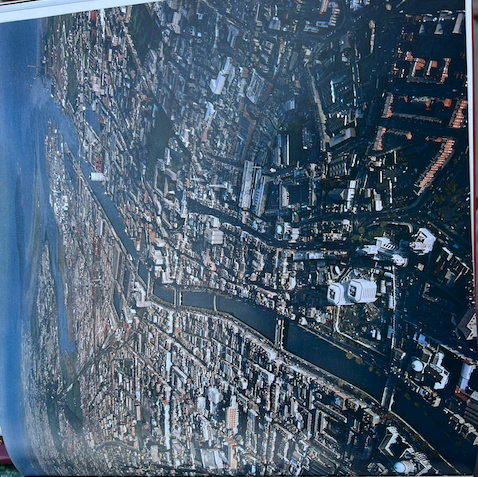
 Centering ourselves at the General Post Office on O'Connell Street, nearby there is the pointed Dublin Spire structure, the city's focal point and a memorial of the site of Nelson's Pillar which once stood there before it was blown up in 1966. If you started from there and walked a few blocks up to Henry Street and turn left, walk a bit and you'll be on Mary Street, a busy shopping area, and you will pass by 45 Mary Street which was the site of the Volta Theater, the first cinema in Dublin, which Joyce had helped arrange on one of his final visits to Ireland. 

From there if you turn left and walk back down toward the river you'll come upon Bachelor's Walk along the north quay of the Liffey—this street is mentioned on pg 214 of the Wake, a part you can listen to Joyce himself reading aloud in a recording, "of a manzinahurries off Bachelor's Walk." From Bachelor's Walk you can cross onto Ha'Penny Bridge to walk across the Liffey onto the south side of the river. This bridge was originally called "Wellington's Iron Bridge" and it appears this way on FW 286.11, with the capitalization and no distortions. On one of my stays in Dublin I was in lodgings right on Bachelor's Walk and got to walk across Wellington's Iron Bridge every day. Here's the view from the bridge after crossing to the southside, where you can see Merchant's Arch, a spot featured in Ulysses.
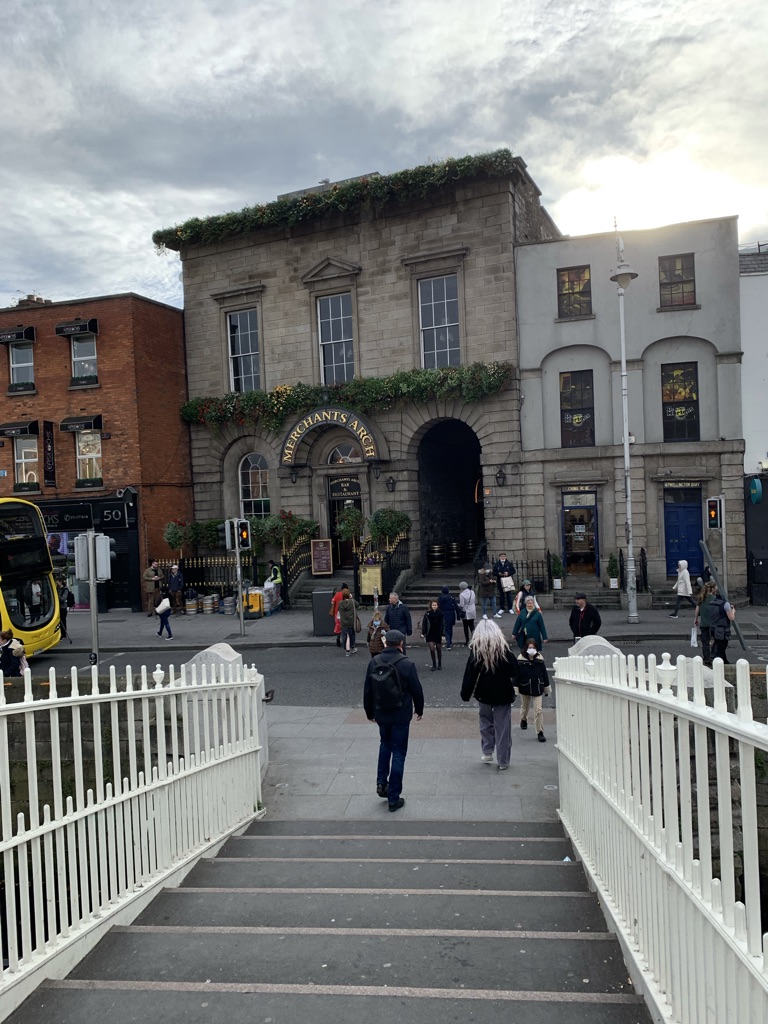

Merchant's Arch from Wellington's Iron Bridge (aka Hapenny Bridge)


Once you cross the bridge you can walk thru the archway, this area used to be filled with bookshops, described in the scene where Bloom is observed scanning books in Ulysses:  "They went up the steps and under Merchants’ arch. A darkbacked figure scanned books on the hawker’s cart." Walk under the archway, go a few blocks then turn left and you'll be heading toward Trinity College. In June 2022, I had the honor of presenting a paper in an auditorium at Trinity for the centennial Joyce conference. It was an incredible moment in my life. I spoke on the morning of Bloomsday. Just outside of Trinity if you walk down Nassau Street you will encounter Finn's Hotel, the site where James and Nora Joyce first met. Finn's Hotel is considered by some scholars to be Joyce's original title for Finnegans Wake. Walk around the corner and you'll find Sweny's Pharmacy and down the street from there is present-day Pearse train station, which used to be Westland Row station which comes up in Ulysses and which Joyce himself had arrived at in one of his last visits to Dublin.

When walking down Nassau Street you can also turn right and go down Dawson Street, and there you will find the historic Hodges Figgis bookstore. This place has been in operation for over 200 years (albeit including moving locations), it is one of the oldest bookshops in the world. It pops up in Ulysses and in Finnegans Wake. It's a fantastic bookstore, a great place to browse for hours. I can tell you that they've got an impressively deep collection of Joyce books. I was there eyeing their several shelves of Joyceana and, can you imagine what it must've felt like when I discovered they had a book on the shelf which named me in the index? I'm not kidding. The book is called James Joyce and the Arts (part of the European Joyce Studies series) and there's an essay in there by Derek Pyle which mentioned THIS BLOG in a footnote. I was in the heart of Dublin, in a bookstore that appears in Ulysses and the Wake, and found my name in a footnote in a Joyce book. Achievement unlocked, life goal accomplished. 

*   *   *

The inspiration for the thoughts I'm sharing here I originally conceived while standing atop Killiney Hill observing the landscape around Dublin, the rolling green Wicklow Mountains in the distance, and I was envisioning how the hills would look in the night in centuries past when, in the words of the Wake, "There were fires on every bald hill in holy Ireland that night" (FW 501). I've been curious about that phrase "holy Ireland" and it doesn't seem to be common, then I saw the same phrase used in a book by the American poet Susan Howe, The Quarry, which mentions "reciting secret languages of holy Ireland." Susan Howe is the daughter of Mary Manning Howe, an author and playwright who was born and raised in Dublin. She was a close friend of Samuel Beckett, and as a playwright she adapted Finnegans Wake to the stage. (see here)

Ireland is a famously evocative environment for writers. I'm focused on Joyce and the Wake here, but Ireland has a rich literary tradition beyond Joyce, and the country today continues to be very welcoming to writers. There are frequent articles about the literary mecca of Dublin, here's one example.

One of the first things that strikes me every time I arrive in Ireland is noticing the old stone walls covered in mossy mold from the sea air, soon as I see the mossy old stone I know where I am. This comes up in the Wake where "though he's mildewstaned he's mouldystoned" (FW 128.02) That moldy stonework and the sea air are part of the recipe for literary brainwork I associate with "holy Ireland."

A passage in Ulysses captures this mixture beautifully:

The air without is impregnated with raindew moisture, life essence celestial, glistening on Dublin stone there under starshiny coelum [Latin, "sky"]. God’s air, the Allfather’s air, scintillant circumambient cessile air. Breathe it deep into thee.

The aforementioned Susan Howe has a sister who is also a renowned poet, Fanny Howe. In her excellent book The Winter Sun, Fanny Howe writes of when she and her sister, both American born, first went back to their Irish mother's home country and encountered Dublin:

"Then we were herded into a bus and headed for Dublin where the clouds were much lower than they were in America. My sister and I gulped in the atmosphere of a new country; it entered our systems like a potion that suffuses the whole and would never leave either of us. It was our mother's body." (pg 30, The Winter Sun: Notes on a Vocation)

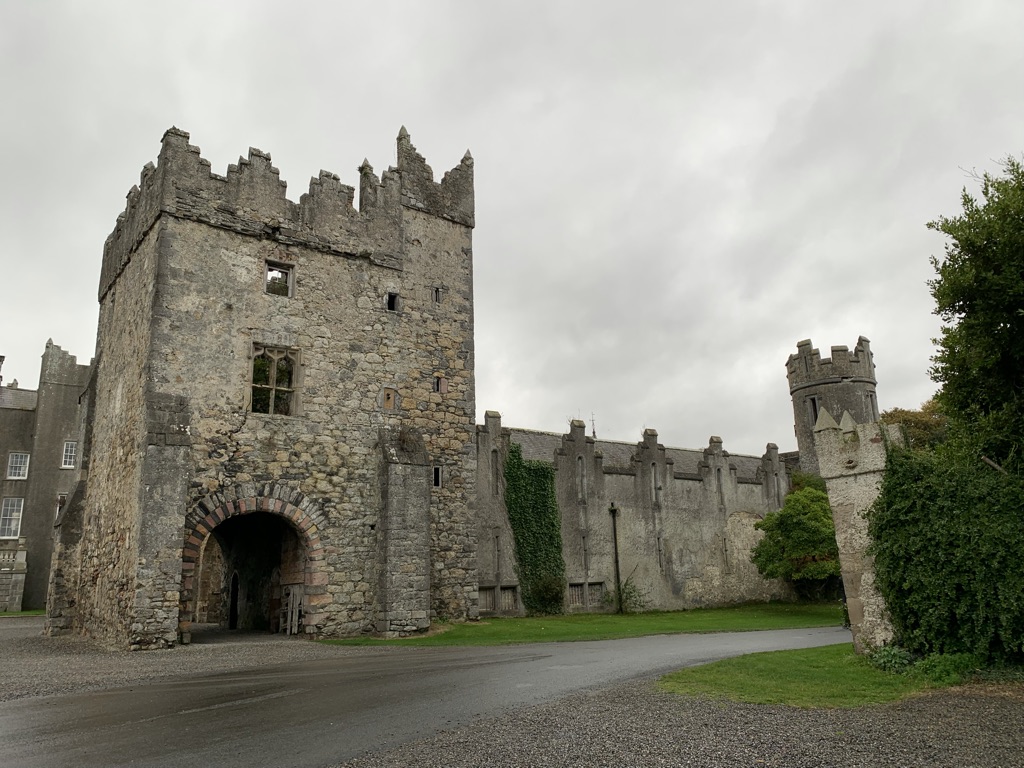
"Holy Ireland." "God's air, the Allfather's air," the atmosphere that was "[their] mother's body." To bring this "back to Howth Castle and Environs", the "scintillant circumambient cessile air" and the mossy stone that make up the poetic potion were noticeable in abundance when I went up to Howth one afternoon. I took the DART, Howth is the northmost stop. Howth feels like how I imagined Ireland would be before I ever visited the country. Howth was very green, chilly, cloudy, soggy wet, misty, lots of boats on the docks, and plenty of old stone structures covered in moss. The vibes feel very historical there. I went and checked out Howth Castle and environs. The piratess prankquean "grace o'malice" had trod this ground, ported at this peninsula. It was so interesting being there observing this real and historical space and considering how deeply it has been lodged into my brain as a mythic site, thanks to the legendary Grace O'Malley scene in the Wake. 

Grace O'Malley was a real person, a female pirate from Ireland who, according to legend, arrived at Howth Castle one night in the 16th century, hoping to stay for the night as it was customary in those days for the castle to keep its doors open to offer hospitality to visitors. After she was denied entry at the door, she kidnapped a child from the royal family. All of this is enacted in the language of a fairy tale in the Wake, where the prankquean "grace o'malice" poses riddles to the doorman and kidnaps two children. I found the experience of walking around Howth surreal, considering there's a street named after Grace O'Malley and you can walk up the Howth Castle door where the prankquean "made her wit foreninst the dour." (FW 21.16) Walking around the castle area it felt imbued with a spooky presence, this was a relic of half a millenia ago, the grounds were well trodden, the walls seemed to be alive. Look at the rotting and tree-rooted parapet in the second picture below, notice the timefulness, this was a space filled with time.

BACK TO HOWTH CASTLE AND ENVIRONS


*   *   *

In the year 1906, James Joyce was living in Rome, working long hours as a clerk at a bank, finding very little time to write, and he felt miserable. His biographer Gordon Bowker notes: "He wished himself far away–beside the sea at Bray…"
    Away from home only a couple years at that point, Joyce longed for the scene of his childhood home by the sea in Bray. Whereas Howth with its rocky promontory is the northernmost stop on the DART train in Dublin, at the opposite end the southernmost stop on the train is in the village of Bray which also has a jutting promontory. Joyce conflates the two places in the Wake, calling it "Brayhowth" (FW 448.18). The train station has a mural of Joyce. I got to spend a few days exploring Bray, a stony beach scene. There's a film studio there, one day as I was walking along the rocky beach I saw a camera crew doing a shoot.

Bray Head

Joyce spent years as a child living with his family in a house on Martello Terrace in Bray, right next to the sea. I got to see the house where Joyce lived from 1887-1891, it is extremely close to the beach. When the Joyces lived there the house would sometimes flood when the waves got especially rough. Being there and seeing how close it was to the shore, seeing the incredible view facing out from the front of the house, looking straight towards the big rocky green Bray Head, seeing the waves and the sea, I thought OF COURSE a future poet would've grown up here. 
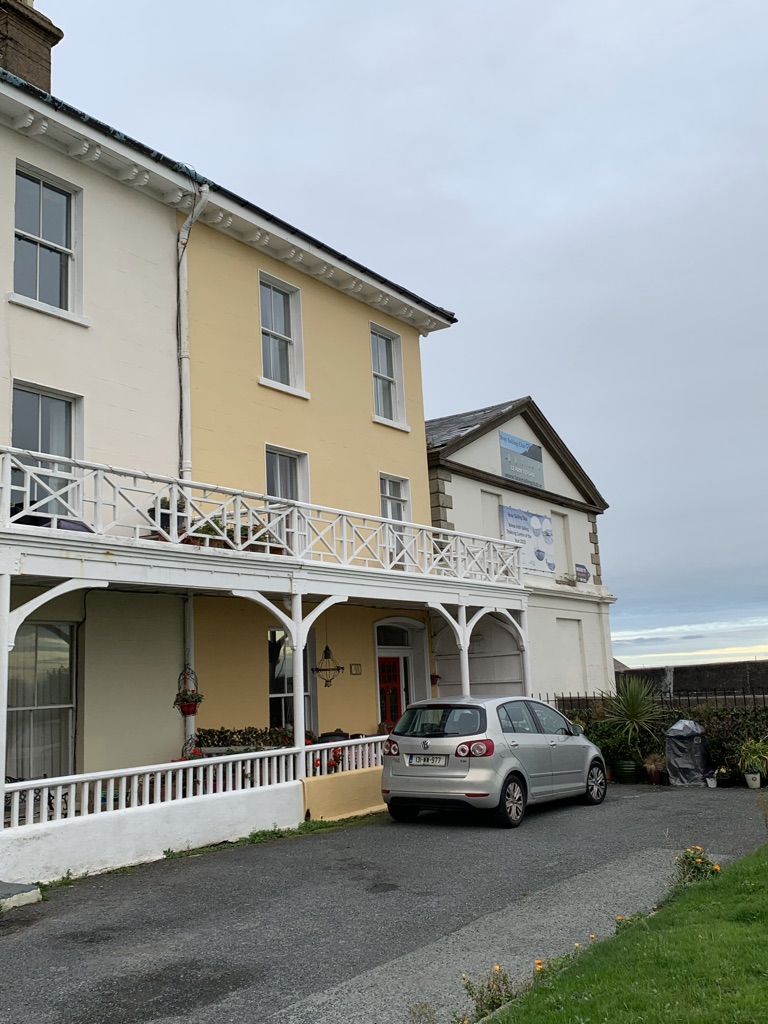

The Bowker biography of Joyce notes: "James would sometimes take [his brother] Stannie for walks along the beach. Living and walking beside the sea became a lifelong pleasure for him." (Bowker 28) This beach was also where Joyce acquired his fear of dogs, he and Stannie once threw rocks at a dog on the beach, it attacked them and bit a chunk out of Joyce's chin, supposedly the goatee he maintained as an adult was to hide the scar. This was also the house where the famous scene of the political fight over Parnell at the family Christmas dinner table that's depicted in A Portrait of the Artist as a Young Man would've taken place.
In 1935, Joyce's daughter Lucia went to stay in Ireland for a summer, and she stayed with some family members in Bray. She thought Bray Head looked like her father's profile (see Lucia Joyce, Schloss, pg. 343). In one of his letters, Joyce wrote to her suggesting she could take the train into Dublin city center to visit the GPO. 

*   *   *

view from Blackrock

About midway between Howth and Bray along the coast is the neighborhood of Blackrock. When riding the train seeing the Irish names for the stops I was interested in the Irish name for Blackrock An Charraig Dhubh, because of the Dubh for black, same as Dubh Linn, for black pool. One night I had dinner at the beautiful home of some friends I'd met in a reading group at Sweny's. The view out their front window looking at the bay was picturesque, with Howth Head prominent on the horizon. When Joyce's family moved from the house by the sea in Bray up to a house in Blackrock, living closer to the city center of Dublin transformed the young Joyce's life. His father would take him around the city showing him sights and telling him stories, as Bowker in his Joyce biography explains:
Joyce was absorbing the intricate layout of the city he was to immortalize in literature... landmarks not just on the map of Joyce's Dublin but also on the map of his creative consciousness. And through those streets of that Victorian city, past shops, cafés, bars and newspaper offices, moved and jostled the Dubliners [who] would people his fictions. John sometimes joined in his son's sightseeing perambulations, regaling them with tales of Dublin life and characters and pointing out places of interest... It was a leisurely city with an air of languor, not subject to the dictates of business or industry. The sights, sounds, smells and texture of Dublin introduced James to a world he would transform into the focus and playground of his imagination. The spirit of the place would permeate his thoughts and writing, wherever he happened to be in the world, and would supply the dream-like setting for the great rumbustious Finnegans Wake. (Bowker, p. 42)
There's an interesting mention of Blackrock in Portrait of the Artist as well, with Joyce once again focused on the geo-mapping of the city:
Outside Blackrock, on the road that led to the mountains, stood a small whitewashed house in the garden of which grew many rosebushes... Both on the outward and on the homeward journey he measured distance by this landmark: and in his imagination he lived through a long train of adventures…
The image above is the view from the train stop at Blackrock. Often the mentions of Blackrock in Finnegans Wake are having to do with the Dalkey-Blackrock-Dunleary tramway, "Dullkey Downlairy and Bleakrooky tramaline" (FW 40.29-30) which I believe would have been essentially the same route as the present day DART train. 

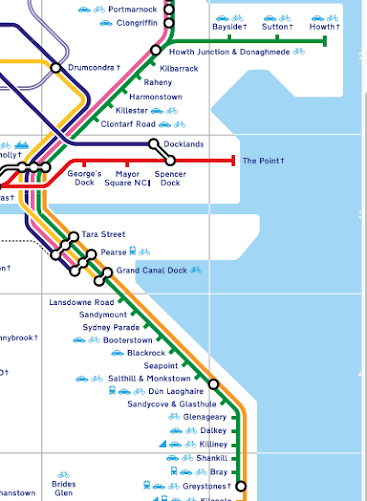
In fact, I found that virtually every single one of the present day DART train stations in Dublin are named in FW. Compare the following list (incl. FW page/line numbers) with the map below:


  • Howth            (too many to list)
  • Kilbarrack 315.28; 327.24
  • Raheny 17.13; 39.09; 129.24; 142.15; 204.18; 497.20
  • Harmonstown (see above, also nearby "Artane" appears twice)
  • Killester 427.01
  • Clontarf Road (too many to list)
  • Connolly (Amiens St) 443.15; 549.31
  • Tara Street (too many to list)
  • Pearse (Westland Row) 553.3
  • Grand Canal Dock several references to streets on Grand Canal
  • Sandymount 247.34; 323.02
  • Sydney Parade 60.27; 553.31
  • Booterstown 132.04; 235.36; 386.24; 390.03; 507.35; 582.33
  • Blackrock 40.30; 83.20; 294.22; 541.02; 582.32
  • Seapoint 129.24; 588.15; 594.34
  • Salthill and Monkstown 261.F04
  • Dun Laoghaire (too many to list)
  • Sandycove/Glasthule 321.08; 529.23
  • Glenageary 529.26
  • Dalkey (too many to list)
  • Killiney 295.F02; 431.21; 433.13
  • Bray 53.30; 313.31; 448.18; 522.30; 537.34; 624.32


*   *   *

Back toward the city center, I remember walking around the streets I'd often encounter the name Kimmage Outer seen on bus tags in the city. It's another thing recognizable from repeated appearances in the Wake, the name of a district in southwest Dublin, right near where Joyce was born.
    There's an odd and obscure pattern to the way Kimmage Outer (K.O.) appears encoded in the Finnegans Wake text, the clatter of noises in the soundwaves of the dreamworld sometimes catches the frequency of radio calls:

pg 13 "Dbln. W. K. O. O. Hear?"
pg 35 "pingping K.O. Sempatrick's Day and the fenian rising" 
pg 72 "ring up Kimmage Outer 17.67"
pg 275 "phone number 17:69 if you want to know"
pg 456: "O.K. Oh Kosmos! Ah Ireland! A.I."


*   *   *


To be continued in Phoenix Park ... 


Wednesday, August 3, 2022

Notes on Ulysses, Pomes Penyeach, and Textual Materiality in Finnegans Wake

It's evident that by the time he got to Finnegans Wake Joyce's unit of attention had narrowed to the single letter. He had fully absorbed the great lesson of his seven years with Ulysses, that what he was engaged in day after day was not "telling stories," no, but formulating minute instructions for printers, whose habit of attention goes letter-by-letter likewise. - Hugh Kenner, "Shem the Textman" from p. 38 of Finnegans Wake: A Casebook

*   *   *

Ever since the big Joyce birthday this past February 2nd of 2022, which was also the centennial of Ulysses (1922) being published, I've been thinking about the richness of Joyce's own descriptions of Ulysses provided in the meta-textual-commentaries within Finnegans Wake (1939). These meta-commentaries show how much Joyce emphasized the material qualities of these texts. In a previous post I touched on scholarly work I was reading showing Joyce's intricate intentions for the final textual product of his books. With the first edition of Ulysses, to give one example, there were specific words referring to specific numbers set to appear on corresponding page numbers. These subtle quirks were lost when pagination was changed in subsequent editions. With Finnegans Wake, mercifully the pagination tends to be fairly consistent across different editions. But material quirks reign across its pages, the whole thing is made of puzzling epiphanic typos, "prepestered crusswords in postpositions" (FW 178.03-4), the reader is continually compelled to "Stop and Think" (FW 88.01) and the book has an entire chapter that serves as a metatextual primer on the appearance of the text itself (Book I, chapter 5). Within that chapter are also fascinating insights about Ulysses from Joyce's perspective, including on its material qualities. 

Taking a look at the Letter chapter (I.5), starting on page 122 we get this commentary about Ulysses:

the toomuchness, the fartoomanyness...the cut and dry aks and wise form of the semifinal; and, eighteenthly or twentyfourthly, but at least, thank Maurice, lastly when all is zed and done, the penelopean patience of its last paraphe, a colophon of no fewer than seven hundred and thirtytwo strokes tailed by a leaping lasso (FW 122.36-123.06)

How better to describe the blizzard of verbal information confronting a reader of one of Joyce's big novels than "the toomuchness, the fartoomanyness"? Overflowing and excessive, too much information packed into too many digressions, unsolvable riddles, and obscure jokes. Within that outlandish approach is a dynamic mixing of different styles, as with the penultimate or "semifinal" chapter of Ulysses, "Ithaca" which overflows with precise mathematical details, or Xs and Ys, in a cut-and-dry unadorned Q&A fashion, described here as "the cut and dry aks and wise form of the semifinal" (ask and whys or x and y's). "Ithaca" is the 17th or "semifinal" chapter of Ulysses but since he had already completed the 18th and final episode, this was actually the last chapter that Joyce was trying to complete before the final typesetting of the text. (In addition to that, Joyce mentioned to his patron Miss Weaver in a letter from Oct. 1921: "Ithaca is in reality the end as Penelope has no beginning, middle, or end.")

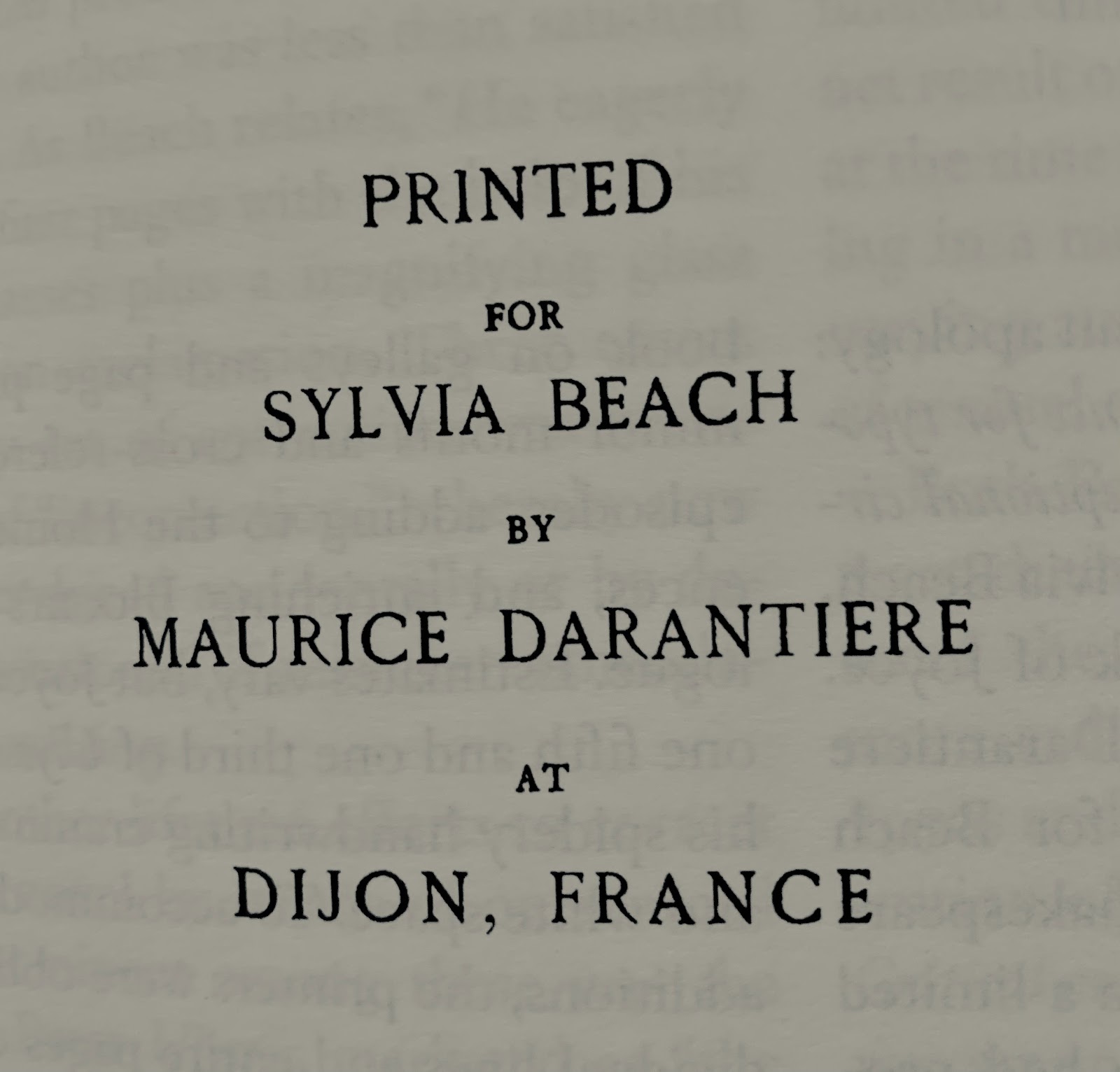
The process of typesetting Ulysses was hectic, not least because the text contains so many idiosyncrasies and the printer Maurice Darantiere ("thank Maurice") was a Frenchman who didn't speak English, but also Joyce kept jotting in more lines to be added into the text.

I recently got to view some of the typescript pages of "Ithaca" and they are filled with these "whiplooplashes" (FW 119), these long curvy lines indicating new blocks of text to insert. This could be in the reference here to "a leaping lasso" the rope-like lines lassoing in new bits to add into the final text. I think it's fascinating that Joyce, within Finnegans Wake, here comments not only on the materiality of his previous book Ulysses (including describing the first edition page count of "seven hundred and thirtytwo") but also the process of its creation, thanking the printer Maurice for his "penelopean patience" in dealing with the frantic final stages of composition.

From Ulysses: A Facsimile of the Manuscript (1975).


The "last paraphe" "when all is zed and done" could refer to a number of things that appear at the end of Ulysses: "paraphe" means initials or signature, a final flourish, which could be the "Trieste-Zurich-Paris, 1914-1921" at the end of the text; or it could refer to the last long paragraph of the Penelope chapter; the word "paraphe" also is immediately followed by "a colophon" which means a printer's emblem at the end of a book, so the expression "thank Maurice" might actually be an allusion to the final page at the end of the first edition of Ulysses, the printer's emblem.

from the Cambridge Centenary Ulysses: 1922 Text with Essays and Notes (2022).

One other more remote possibility for the final "paraphe" at the end of Ulysses could be that mysterious black dot at the very end of the Ithaca episode: since this was the last chapter Joyce wrote, that concluding black dot might be Joyce's final flourish in writing that work (before moving on to his next book where all the characters have become typographical icons, "the Doodles family" or "Mister Typus, Mistress Tope and all the little typtopies" FW 299.F05, FW 20.13).  At an exhibit on "Women and the Making of Joyce's Ulysses" at the Harry Ransom Center here in Austin, I got to witness up close one of the typescript pages for the end of Ithaca where Joyce added in the final question "Where?" and the famous black dot. The typescript page had handwritten instructions in pencil (too faint to see below) in French, specifically addressing Maurice Darantiere about the final dot—"ne pas oublier le point final" ("don't forget the final point") and "imprimer SVP" ("please print"). Having known about this infamous black dot for years, it was incredible to witness the handwritten notes up close. 

Typescript for Ithaca with Joyce's handwritten notes.
(Harry Ransom Center, Univ. of Texas at Austin.)

Continuing with the meta-commentary from the Letter chapter (I.5):

the ulykkhean or tetrachiric or quadrumane or ducks and drakes or debts and dishes perplex... in the case of the littleknown periplic bestteller popularly associated with the names of the wretched mariner... a Punic admiralty report... had been cleverly capsized and saucily republished as a dodecanesian baedeker of the every-tale-a-treat-in-itself variety... (FW 123)

It seems the word "ulykkhean" is the closest thing to Ulysses that appears in the Wake, besides "his usylessly unreadable Blue Book of Eccles" (on FW 179.27). Perhaps it's fitting that the Danish word ulykke which means misfortune or accident, is echoed here. Not only is the story of the Odyssey about a series of misfortunes at sea, in Ulysses mistakes become portals of discovery, and there are several noteworthy "accidents" both large and small throughout the book. My sense is that Joyce is actually conflating Ulysses and Finnegans Wake in this passage, that word "ulykkhean" meaning accidents or mistakes could refer to the Wake where essentially every word is a mistake, a typo.

The Wake is also a book of dots and dashes or a "debts and dishes perplex" and the cryptic words "tetrachiric" and "quadrumane" here both mean "having four hands" which could refer to the four book structure of the Wake, the four stages of the Viconian cycle, the annals of the four masters (medieval history of Ireland), or the four provinces of Ireland (compare pg 325.32 "our quadrupede island"). We are clearly focused on Ulysses when reading of "the littleknown periplic bestteller popularly associated with the names of the wretched mariner… a Punic admiralty report" which gives strong emphasis to the Homeric parallels with Joyce's book. The word "periplic" refers either to circumnavigation or to a sailor's documentation of the ports, coasts, and routes on a voyage. The Punic wars, referred to here, took place in the Mediterranean Sea where the wanderings of Odysseus would have occurred. Every part of this passage is interesting, but for Joyce to describe Ulysses as "the littleknown periplic bestteller popularly associated with the names of the wretched mariner" is especially funny, combining "littleknown" with a popular best-seller or best-teller since Homer was an oral poet. At the time Joyce was writing this passage (late 1920s), Ulysses was stuck in that in-between stage where it was still pretty difficult for a reader to acquire a copy, yet it was also popular, or rather it was notorious. 

This is where I think he conflates Ulysses with the Wake: this popular book about the mariner "had been cleverly capsized and saucily republished as a dodecanesian baedeker of the every-tale-a-treat-in-itself variety" so it sounds like he flipped that book upside down in some clever way, as if the Wake is a capsized version of Ulysses. It also could be saying the original Odyssey was capsized and turned into the "dodecanesian" twelve Bloom-focused episodes at the heart of Ulysses (more about that shortly), but I think that word "dodecanesian" also echoes dodecahedron the "polydron of scripture" that is the Wake, a book with a geometry lesson in its center (II.2). 

Going further into the Wake, looking at Book II.1 has some interesting stuff about Ulysses as well. In that chapter, the Joyce-based character Shem the Penman is now named Glugg. Glugg gets rejected by the girls in a kid's game and runs off into exile where he then composes his art. The text has become weirder and more opaque at this stage of the book, but the annotations suggest references to the events and context surrounding Joyce's composition of Ulysses. Looking on page 228, the densely constructed lines include several puns on World War I trench-digger dialect (Joyce was writing Ulysses in the middle of the war). Then TS Eliot's The Waste Land (1922) which took inspiration from the early serialized episodes of Ulysses (Joyce responded in kind by borrowing inspiration from The Waste Land in the Wake), seems to be present in "He do big squeal like holy Trichepatte" (FW 228.06) because the original title for Eliot's Waste Land was actually "He Do the Police in Different Voices" (taken from a line in Dickens). And most relevantly, the page mentions "ban's for's book" and "banishment care of Pencylmania, Bretish Armerica" because Ulysses was banned in America and England. Returning to the materiality of the book, we then get this encoded allusion to the final words at the end of Ulysses:

quit to hail a hurry laracor and catch the Paname-Turricum and regain that absendee tarryeasty, his citta immediata, by an alley and detour with farecard (FW 228.22)

"Paname-Turricum" with "tarryeasty" becomes a reversal of "Trieste-Zurich-Paris" which appears after the final “Yes” from Molly to conclude Ulysses. These are the cities Joyce lived in during the composition of Ulysses. "Paname" is a nickname for Paris (apparently from Panama hats, which are mentioned several times throughout Ulysses), "Turricum" is the old name for the settlement that became Zurich (the name is actually Turicum with one r, the double-r here brings in turret a tower like the Martello Tower where Ulysses opens), and "tarryeasty" would be the city of Trieste, but also John Gordon suggests Tara for Ireland of the east. I think it could even be a subtle reference to the Irish name of the city of Dublin, Dubh Linn, meaning "black pool" (hence "tarry") on the east coast of Ireland. I think "regain that absendee tarryeasty" also involves regaining his absentee city starting with the letter D, Dublin which Joyce was exiled from but mentally immersed in while he lived in Trieste, "his citta immediata." McHugh suggests there's also subtle reference to Swift here with "quick, hurry" followed by Laracor which is a city in county Meath, Ireland where Swift was a vicar. Also involved here, one of many Irish authors alluded to in this section is the 19th century Irish author Charles Lever, who wrote the novel The Confessions of Harry Lorrequer hence "hurry laracor." Lever was from Dublin, but he actually died in Trieste where he was living on assignment as British consul. This passage in the Wake centralizes train travel, perhaps recalling Joyce's odyssey across Europe in his years of exile, as he tried to avoid the destruction and turmoil upon the outbreak of the Great War, "detour with farecard." The train ticket could also be a metaphor for Joyce's constantly returning to Dublin inside his head while living abroad.

On the following page is where the names of the middle episodes of Ulysses are presented in the form of distorted Wakese:

Ukalepe. Loathers' leave. Had Days. Nemo in Patria. The Luncher Out. Skilly and Carubdish. A Wondering Wreck. From the Mermaids' Tavern. Bullyfamous. Naughtsycalves. Mother of Misery. Walpurgas Nackt. (FW 229)

These are the 12 middle chapters of Ulysses, the Bloom-focused chapters. The first 3 and the last 3 chapters are excluded. This list suggests a couple interesting points (leaving aside the puns and wordplay on the chapter titles): for one thing, by drawing attention to the episode names this way Joyce seems to be expressing the importance of these titles despite them never actually appearing anywhere within the text of Ulysses itself; and secondly, the absence of the first three and last three chapters from this list highlights the emphasis on the Homeric correspondences embodied in the chapters focused on Leopold Bloom, strengthening the case for Ulysses "the littleknown periplic bestteller popularly associated with the names of the wretched mariner" being very much about navigation and seafaring. My friend Decio Slomp, an engineer from Rio de Janeiro, Brazil, recently published a book documenting all of the nautical references embedded in each episode of Ulysses to argue exactly this: it's all about navigation.


*   *   *

In 1927 Joyce was once again broke, hurting for cash, begging Sylvia Beach for help despite the substantial royalties she'd already been sending him for Ulysses. An exasperated Beach bristled at his pleas, listing out the monthly income he was receiving off Ulysses and suggesting he be a better friend "to me who is your friend if ever you had one" and admit that he was spending considerable sums of money (29 April 1927, see Gordon Bowker's Joyce biography, p. 363). Wishing not to upset the proverbial applecart, Joyce sent her manuscripts for Dubliners and Stephen Hero, the friends made peace and eventually agreed to have Shakespeare and Co publish Joyce poems in a new collection, Pomes Penyeach.

Another edition of Pomes Penyeach was printed in 1932 by Obelisk Press. Joyce scholar Katarzyna Bazarnik writes of this edition:

Pomes Penyeach was published once more during Joyce’s lifetime by the Obelisk Press of Paris in 1932. This was the most beautifully designed of all his books, printed on specially imported Japanese paper (called Japan nacre or iridescent Japanese vellum). It consisted of nine loose folio sheets, folded and laid one within the other, placed in a portfolio bound in pale green silk. The poems were printed in black on recto of each leaf, in facsimile of Joyce’s handwriting and opened with illuminated, multi-coloured initials designed by Lucia. Additionally, the pages were interlaid with sheets of transparent tissue on which the title and text of each poem was printed in green in the lower left-hand corner. (Bazarnik, "Joyce, Liberature, and Writing of the Book" from here.) 

Bazarnik shows a copy of this rare 1932 edition of Pomes Penyeach which belonged to Harriet Shaw Weaver that got damaged in a fire in her garage:

Pomes Penyeach, Obelisk Press, H.S. Weaver’s copy
burnt at the edges by a fire in her garage. (KB here.)

Seeing the imprint of Joyce's handwritten title and signature on the cover of this rare, delicate, and nearly destroyed book of poems (or pomes) further fed my fascination with Joyce's own interest in the material presentation of his writing. These ideas actually converge and resonate when Joyce weaves in a mention of Pomes Penyeach within a very rich passage in the middle of Finnegans Wake, p. 302. The passage is worth looking at in detail, since it appears to describe Joyce "signing away in happinext complete" signing autographs from beyond the grave, and now coming back to life ("Can you write us a last line?") sending messages, his letters to the reader sounding like modern-day text-speak:

me elementator joyclid … the aboleshqvick, signing away in happinext complete, (Exquisite Game of inspiration! I always adored your hand. So could I too and without the scrope of a pen. … Can you write us a last line? From Smith-Jones-Orbison?) ...
And i Romain, hup u bn gd grl. Unds alws my thts.  …
Two dies of one rafflement. Eche bennyache. Outstamp and distribute him at the expanse of his society. To be continued. Anon.
(FW 302.12-30)


Joyce as "me elementator joyclid" intertwines Euclid whose Elements pop up throughout this geometry/mathematics lessons chapter (II.2). The way "joyclid" is described as "me elementator" also includes the word mentator, as in one who mentates, drawing our attention to the person whose mental activity gave written life to the consciousness buried in the pages of Finnegans Wake, a glimpse of "me" "joyclid" breaking the fourth wall. It does seems like Joyce is pulling back the curtain here to reveal himself, "the aboleshqvick, signing away in happinext complete"---the abolished bolshevik, still scribbling his signature from the next dimension beyond the grave "in happinext complete."

The paragraph's emphasis on signatures ("signing away","I always adored your hand") calls to mind a line from earlier in the book (FW115.06-08), "why, pray, sign anything as long as every word, letter, penstroke, paperspace is a perfect signature of its own?" The implication seems to be that Joyce knew by the time he was writing this that he was so famous that anything he ever wrote, scribbled, or signed would become valuable as part of his legacy. 

"Exquisite Game of inspiration!" hints at the creative game known as the Exquisite Corpse, made famous by the surrealists. Since Joyce has already brought himself into the equation here as "joyclid" and alluded to his continued existence after death "signing away in happinext complete" the reference to Exquisite Corpse seems a clever way of suggesting his corpse is constantly revivified by readers playing the game of reading this book. Collaboration among creators who are unaware of each other's contributions is the core of how the Exquisite Corpse game works, thus Joyce seems to be directly addressing the collective game of interpretation involved in reading Finnegans Wake. After all, the text at one point expressly considers whether "His producers are they not his consumers?" (497.01) Readers are active participants or collaborators with Joyce in giving meaning to this chaotic text. As Joyce scholar Alan S. Loxterman described in his essay "Every Man His Own God: From Ulysses to Finnegans Wake":

Joyce was working toward his ultimate achievement, an anomaly in the history of literature which expands the way we read. Today, and into our foreseeable future, Finnegans Wake survives not as the completed comprehensible entity which previous fiction (including Joyce's own) had conditioned us to expect. Rather it remains what Joyce first called it, a 'Work in Progress,' an artistic arrangement of words which requires continuous collaboration from its readers to make those words meaningful as a text. (from Joyce's Finnegans Wake: A Casebook p. 115)

The impression I get from the paragraph on FW302 is that it's like Joyce letting the reader know he's still actively writing from beyond the grave, exchanging letters with the reader. Hence, "Exquisite Game of inspiration! I always adored your hand" could be like a reader actively complimenting Joyce on his writing here in the middle of a book. Then they request one last line, "Can you write us a last line? From Smith-Jones-Orbison?" McHugh notes Smith-Jones-Orbison as an allusion to the mathematician and puzzlemaker Henry Dudeney who used the names Smith, Jones, Robinson in his puzzles published in The Strand Magazine in the early 1900s. (Joyce would have been familiar with this magazine, it was published by the same company as Tit-Bits which Bloom reads in Ulysses.) Bringing in a popular puzzlemaker/mathematician makes sense here in the geometry chapter and it's fitting that the usage implies Joyce as the creator of mathematical puzzles. My reading of why Robinson becomes "Orbison" is the "orb" represents Joyce's boast that he had squared the circle, or circled the square. Since Dudeney appears elsewhere in the same chapter in another triptych ("Dideney, Dadeney, Dudeney" see FW 284), I wonder whether Joyce knew of Dudeney having developed a hinge method for turning a triangle into a square, by splicing it into pieces, rotating them (circling) until they form into a perfect square.

"And i Romain, hup u bn gd grl. Unds alws my thts." This is Joyce, writing sometime in the late 1920s, predicting the clipped condensed language of millennial text messages. It's also yet another example of Joyce in the Wake calling attention to individual letters. The lowercase "i" certainly stands out, especially alongside the capital R in "Romain" and together suggests something like "iDomain" or maybe an echo of "iSpace" which appears earlier in the text (124.12), a link that could actually make sense since the German word Raum means "space." This amusing little line comes across in the context of the passage like Joyce answering the request to "write us a last line" with a declaration that he still remains. If "i Romain" really does echo the earlier "iSpace" (FW 124.12) with Raum (space) involved, then it seems to imply Joyce declaring that while he's absent from time, he remains in space through all of his printed works and the "signatures" of his surviving manuscripts and materials, "paperspace." "Unds alws my thts" has implications beyond "and always in my thoughts" which are enhanced by the minimized phrasing---"Unds" in the context hints at girl's undies and in millennial slang "thts" would be thots or promiscuous women, as though he's promising the girl that she remains among his favorite ladies. (This line has a footnote at the bottom of the page which carries similar implications: "Lifp year fends you all and moe, fouvenirs foft as fummer fnow, fweet willings and forget-uf-knots." [FW 302.F04] Not only does Joyce invent fweet here, he's once again calling attention to the visual presentation of the text on the page by using the so-called long S or lowercase F for the letter S in this sentence. The "fouvenirs foft as fummer fnow" are souvenirs left for his readers, and invoking snowfall here recalls the ending of "The Dead" where the snowfall is also described with f-words, "faintly falling"---compare also FW 17.27 "flick as flowflakes." And then "forget-uf-knots" would be the flowers called forget-me-nots, but also seems to be Joyce once again declaring he will not be forgotten, due to the "knots" of riddles his readers are forever unraveling.)

"Two dies of one rafflement." So much information saturates these short sentences. The sound of two dice in "Two dies" along with the presence of the French word rafle for "game of dice" in "rafflement" draws an allusion to Stéphane Mallarmé's groundbreaking poem Un coup de dés jamais n'abolira le hasard (One Throw of the Dice Will Never Abolish Chance). The essay I've referred to throughout this post, Katarzyna Bazarnik's study of Joyce's focus on the textual object discusses the remarkable influence Mallarmé had on Joyce. In his study of Mallarmé and the dice poem, R. Howard Bloch's book One Toss of the Dice: The Incredible Story of How a Poem Made Us Modern (2016) points out that "Joyce kept a copy of 'One Toss of the Dice' close at hand while writing Finnegans Wake." (Bloch, p. 26)

Condensed in here with Mallarmé is also one of Joyce's earliest publications, his essay "The Day of the Rabblement" published in 1901 as a student. The essay was rejected by the university paper, so Joyce and his friend Francis Skeffington (who was later murdered in the chaos following the 1916 Easter Rising) collaborated to publish a pamphlet of two essays together and distributed them throughout Dublin, hence this passage in the Wake concluding with "Outstamp and distribute him."

Joyce's student essay "The Day of the Rabblement" (1901).

The notebook dates at the JJ Digital Archive suggest Joyce was writing these lines around the same time Shakespeare & Co was publishing his poetry collection Pomes Penyeach (1927), thus the echo of the title in"Eche bennyache" resonates. Each, penny each. And then, "Outstamp and distribute him at the expanse of his society." The word "Outstamp" strikes me as another way to say express, but it also alludes to printing, Joyce's printed works for over a century now distributing across the world "at the expanse of his society" literally expanding the Joyce society and doing so at our expense as we shell out each penny, "Eche bennyache." "Eche" also contains the initials HCE for Here Comes Everybody. And McHugh notes the early Middle English word eche means "eternal, everlasting." The writer lives on through his printed works being distributed expansively throughout society, "To be continued. Anon."

Evident in the phrase "Eche bennyache" is also ache, belly ache. Joyce suffered from severe stomach issues while writing the Wake and shortly after the book's publication he died during surgery for an ulcer. Going back again to the section examined earlier (pgs 229-231 of book II.1) some of the same themes and references stand out, where the focus is on the autobiographical Shem character, the riddles he writes, and how "he's knots in his entrails!" (FW 231.25). 

"And oil paint use a pumme if yell trace me there title to where was a hovel not a havel (the first rattle of his juniverse) ..." (FW 230.36-231.02)

Joyce declares, I'll paint you's a poem ("pumme") if you'll trace me the riddle to the title to where was a novel not a novel (the first riddle of his universe). The first rattle of his junior verse, "Et Tu Healy" which he parodies immediately after these lines. This was Joyce's first poem written when he was 9 years old. His father proudly had it printed so he could distribute copies, even sending a copy to the Vatican. No surviving copies of "Et Tu Healy" have been identified as of this writing, though if one were to be discovered it could fetch up to 2 million dollars at an auction. A poem written by a 9-year-old. Only a few lines from the poem are known, and Joyce parodies them on this page (231.05-08). Echoing the earlier quoted assertions of "i Romain" and "To be continued. Anon." this same page also begins a sentence with, "Though he shall live for millions of years a life of billions of years" (FW 231.18-19). 

Saturday, March 30, 2019

New catalogue of illustrated Finnegans Wake pages "The echo is where" by Peter O'Brien


Artist and author Peter O'Brien has been engaged in an effort of illustrating every page of Finnegans Wake, LOTS OF FUN WITH FINNEGANS WAKE, that expansively brings the surface of the text to life with resplendent collages of annotations and illustrative doodlings. I first got to see an exhibit of his work in Toronto in 2017 where he had the Anna Livia Plurabelle chapter on display. Here's a glimpse of those pages:


Peter O'Brien's "Lots of Fun with Finnegans Wake" exhibit at Victoria University, Toronto (2017).  

To mark the 80th birthday of Finnegans Wake, O'Brien has brought forth a catalog called The echo is where, collecting 43 pages of his illuminated manuscripts alongside 43 commentaries from artists, scholars, authors, including a number of notable Joyce scholars (Margot Norris, Finn Fordham, Tim Conley, Michael Groden, among others) and also, I'm honored to say, a contribution from yours truly on pg. 76.

Here's some info on the new project from O'Brien's "LOTS OF FUN WITH FINNEGANS WAKE" webpage where you can find the links to The echo is where:

I am currently glossing / illustrating / disrupting the 628 pages of Finnegans Wake by James Joyce. I consider the book to be the most unstable, protean, multi-voiced, and fertile artwork that we have. This project allows me to yoke together my twinning interests of the illustrative and the intellectual, the palate and the palette, the visual and the verbal.  
In honour and celebration of the 80th anniversary of the publication of Finnegans Wake on 5 May 1939, I have produced a catalogue, “The echo is where,” which includes 43 pages from the project, together with 43 contributions by Joyceans and non-Joyceans from 14 different countries, and ranging in age from 22 to 105.  
There is a high-res PDF of the catalogue here (which will take about 30 seconds to download):  
The echo is where Peter O’Brien 2019  
And a low-res flip-book of the catalogue is here:  
Flip-Book: The echo is where


And here are some details from The echo is where:


Saturday, February 24, 2018

The Secret Life of Mushrooms in Finnegans Wake

Amanita muscaria aka Fly agaric.

Fellow Austin Wake group member Gus Strozier sent me an extremely fascinating article that sparked many ideas for me so I must share the article and some thoughts on it here. David Rose, in his essay "Cryptogrammic Cryptogams: Fungi in Finnegans Wake" explores some of the fungal references in the Wake "to ask if Joyce was really up to something, mycologically speaking" and uncovers some startling insights and tantalizing speculations.

You can read the full essay here.

Rose explicitly channels the amusing NY Times article "You Spigotty Anglease?" where Robert H. Boyle insists that the Wake is in fact all about fly fishing, providing evidence of references to fish and fly fishing on nearly every other page. It's one of the most fascinating characteristics of Finnegans Wake that you can view it through a certain biased lens and find confirmations of your theory all throughout. (I'm still assembling a pile of references to the book as a simulacrum of the globe.)

The evidence for a mycological network underlying the text is evident from its first page: Rose cites the lines "rot a peck of pa's malt" and "oranges laid to rust upon the green" (FW pg. 3) as referring to rotting, fermentation, and parasitic fungi. Those lines are familiar to Wake heads, but who among us has contemplated the mycological aspect lying therein? Or the word "holocryptogam" from page 546----I had always thought it was suggestive of the Wake as a hologram and a cryptogram or encoded text, completely overlooking the word "cryptogam" which literally means "hidden reproduction" and denotes plants that reproduce through spores, like fungi.

And now the text of Joyce's nightbook seems to respond to our inquiry and begins to bloom with fermenting flora. Rose describes this revelation through the eyes of a mycologist:
From the umwelt of the Wake’s quashed quotatoes (183.22) the ricorso of pan-etymological meanderings through the preconscious formation of meaning is oceanic and fluid, recycling through mind and history, recycling through the words themselves. Finnegans Wake is not a disquisition on mycology, but a mycelial mat in which fruiting bodies are knotted deep in the sclerotia of words. 

For the latest edition of the "Waywords & Meansigns" project, my friends and I recorded a selection from pages 613-615 (listen to "Vicocyclometer" at the bottom of this page) which included an extraordinary passage that took residence inside my brain. The passage continues to live in my head and I even recited it from memory at an event during the last Joyce conference in Toronto (it also featured prominently in my essay on war in the Wake). Rose highlights this glorious passage in his essay:
A spathe of calyptrous glume involucrumines the perinanthean Amenta: fungoalgaceous muscafilicial graminopalmular planteon; of increasing, livivorous, feelful thinkamalinks; luxuriotiating everywhencewhithersoever among skullhullows and charnelcysts of a weedwastewoldwevild…  (FW p. 613)
Rose cites John Bishop who describes this passage as a "compressed history of the evolution of botanical life." The passage indeed encapsulates the entire plant world, the planteon, with special focus on fungi and the growth of life feeding on decay and death. A constantly reiterated message in the Wake is that life springs forth even out of the deadest heaps of hollow-skull charnel piles.

The most astounding revelation in the essay comes from Rose's interpretation of this passage from pg. 51 of the Wake invoking the guilt-ridden Earwicker in Phoenix Park or "fungopark":
Those many warts, those slummy patches, halfsinster wrinkles, (what has come over the face on the wholebroader E?), and (shrine of Mount Mu save us!) the large fungopark he has grown! Drink!
Rose sees this as Joyce referring to the hallucinogenic toadstool Amanita muscaria---warts, slummy (slimy), patches, and wrinkles being some of the notable characteristics of the iconic mushroom. And there is also an element of ritual present, as Rose explains:
supplication at the shrine of Mount Mu[shroom] and the imperative Drink!, adumbrating the shamanic use of Amanita muscaria in Siberian cultures where the urine of a person under mushroom intoxication is recycled by the acolyte to perpetuate its intoxicating effects. This is later recapitulated in Mount of Mish (131.01) and sacred sponge (516.25).
Rose speculates on whether Joyce knew about the Amanita muscaria, arguing that he must have because in the "Museyroom" passage (note the hint of mushroom in "Museyroom") he brings in a Tom, Dick, and Harry trio where one of them is called "Touchole Fitz Tuomush" (p. 8) which contains the French word for fly agaric, Tue-mouche (pronounced "too moosh"). I can add further that Joyce seems to reference this again on p. 485 in "Tootoo moohootch!" In his 1968 book Soma: Divine Mushroom of Immortality, R. Gordon Wasson theorized that the Amanita muscaria was in fact the Soma drink of the Rigveda. Rose also informs us that Peter Lamborn Wilson followed that up in 2001 with a study comparing Vedic and Irish literature, suggesting "that an Amanita muscaria cult may have existed in prehistoric Ireland." As is often the case, Joyce in Finnegans Wake seems to have discovered this before anyone even began to search for it. Further fueling this hypothesis, Rose cites the phrase on pg. 229, "megafundum of his tomashunders" which combines important aspects of Wasson's theory, mushrooms and thunder. The word "tomashunders" is an anagram for "soma thunders" and of course thunder plays a powerful role in the Wake. Rose's suggestion of Joyce's foreknowledge of prehistoric Irish cults using a Soma drink made from mushrooms also gives a whole new meaning to the line at the bottom of page 265 about someone testing out a bowl of soup "to find out if there is enough mushroom catsup in the mutton broth." Marinate on that.

Another creative reading by Rose feeds into this mushroom fascination. In the closing pages of the text, as ALP and HCE walk in the woods they spot mushrooms. "Mch? Why them's the muchrooms, come up during the night." (FW p. 625) Proving a very astute Wakean, Rose suggests rotating the "M" in "Mch" 90 degrees counterclockwise (the rotating E appears throughout the Wake representing the main character in different states of being) which would give us ECH, the familiar initials of HCE, whose "Mch" is then reiterated in "muchrooms." I noticed a few pages earlier HCE is described as being "gentle as a mushroom" (p. 618).

Since HCE the mushroom man and monomythic hero also embodies the sacrificial symbol of Christ, whose body is turned into food and ritually eaten multiple times in the Wake (see p. 7, for example), it seems Joyce was tuned into another anthropological mystery that wasn't revealed until after the Wake's publication. It was not until 1970 that the Dead Sea Scrolls scholar John M. Allegro published his notorious book The Sacred Mushroom and the Cross where he argues that Christianity originated with European cults devoted to the celebration and ritual consumption of the hallucinogenic Amanita muscaria mushroom.

Giving some further intrigue to all of this is Terence McKenna's preoccupation with Finnegans Wake and mushrooms. The Irish bard and ethnobotanist McKenna frequently lectured on the history and pharmacology of mushrooms. He also considered Finnegans Wake an essential guidebook. As described in his book True Hallucinations, when Terence and his brother Dennis ventured deep into the Amazon Basin to indulge in shamanic rituals and ingest ungodly amounts of hallucinogenic plants, they brought only two books---the I Ching and Finnegans Wake. The McKenna brothers felt "that Finnegans Wake represented the most complete understanding yet achieved of the relation of the human mind to time and space." (True Hallucinations, p. 147) If only they'd known about the book's revelations about secret mushroom cults.