Showing posts with label what is FW?. Show all posts

Saturday, December 21, 2024

"So This is Dyoublong?" Living Inside the World of the Wake, Part 2

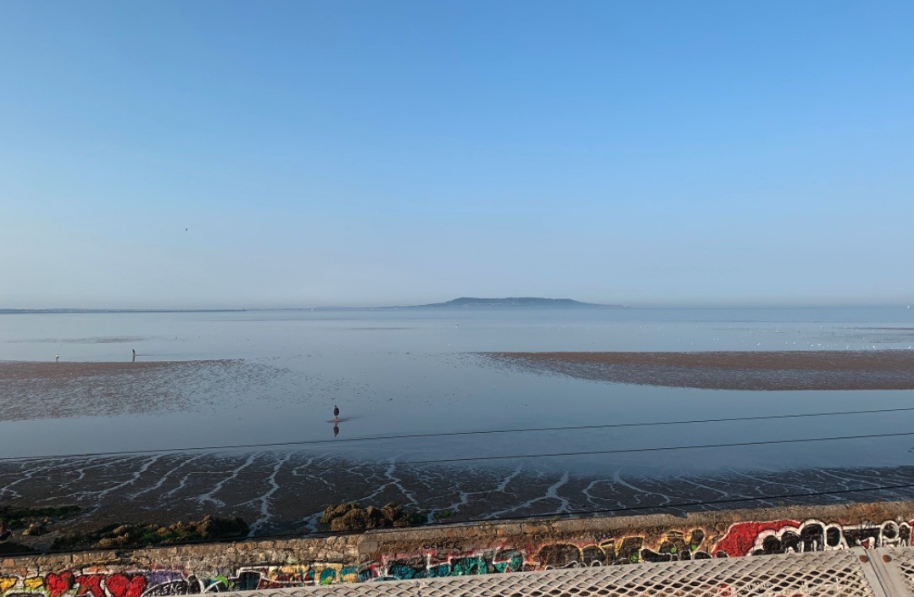
Dalkey Island, southeast of Dublin 


I was on an extended stay in Dublin a few years ago and found myself in a shared space somewhere out in Leopardstown on the outskirts of the city. The Leopardstown horse racing course is mentioned multiple times in Finnegans Wake and is still active to this day. No leopards are found in the area, though, the name was a modification of Leperstown, as it used to be called, because that's where the city had once quarantined its leprous citizens. In the Wake it appears as "Leperstower" (FW 237) and "Leperstown" (FW 462). It comes up in a classroom scene in A Portrait of the Artist as a Young Man when a student is missing during roll call and someone blurts out, "Try Leopardstown!"

No matter where I went, whether all the way out in Leopardstown or in the heart of the city, every time I looked up something nearby it seemed there was mention of it in the Wake. It's hard to overstate how much one feels embedded in the Wake due to the places and place names one encounters in that city. At one point I relocated to the city center and, looking on the map, I notice across the street from my hotel was a funeral parlor by the name of Fanagan. This was on Aungier Street, central Dublin. Sounded familiar, so I looked for it in Finnegans Wake and, sure enough, Fanagan's funeral parlor is punned on several times in the book. They've been in business in the same location since the year 1819. You will find "Fanagan's weak yat his still's going strang" (FW 276.22) among other appearances, "and all the fun I had in that fanagan's week." (FW 351) That's Dublin, the center of Wake world. The text of Joyce's encyclopedic 1939 novel is so wide open it seems to encompass everything that's ever been or will be, yet it all revolves around the reliable center anchor that is Dublin and environs. A real place on a map. The same Dublin I was staying in, strolling through, the same street as present-day Fanagan's undertakers fashioning their own wakes for Finnegans for the last two hundred years. 

Being in Dublin means being at a crossroads of mulitverses, a centerpoint of alternate realities, the axis of a mandala where worlds intersect and converge. Joyce scholar Struther B. Purdy wrote an article for the JJQ entitled, "Is There a Multiverse in Finnegans Wake, and Does That Make It a Religious Book?" In that piece, Purdy argued that Joyce's linguistic manipulations and the unmooring of space/time leads to words creating alternate worlds:

Past and present are coterminous because they are different places. Different places and different times coexist; words make worlds. Worlds are therefore a) plural and b) as unlimited in number as are words. "Budlim" (FW 337.26) is not Dublin distorted phonologically to add to the description of the earth's Dublin but a Dublin-like city in another Ireland, possibly the eerieland/"Ereland" of FW 264.31. The "battle of the Boyne" is locatable as the battle of that name in 1690, while the "bettlle of the bawll" is a shadow battle in a different world. (FW 114.36, 337.34).

Further multiplying the shadow worlds of "Dublin-like" cities in Joyce's "Errorland" (FW 62) or "Aaarlund" (FW69) hovering next to and intersecting with earth's Dublin are the various names for Dublin that proliferate throughout Finnegans Wake. Wander the city, take the bus, or ride the train around Dublin, and you'll frequently encounter the Irish names for places (signs and announcements include both the English and Irish language) especially Baile Atha Cliath, the city's Irish name, which translates to Town of the Ford of Hurdles. Hurdles are basketwork, (hence "at Wickerworks" FW 289) which was used as a ford or bridge to cross the river. In the Wake it appears as "fordofhurdlestown" (203.07). Seeing the words Baile Atha Cliath pop up so often around town always harkens back to the Wake where variations of "Baulacleeva" (FW 134) and "Bauliaughacleeagh" (FW 310) inundate the page, "the deep drowner Athacleeath." (FW 539). In the Dublin of the pre-Viking invasions era, there actually were two settlements along the Liffey named Atha Cliath (hurdle ford) and Dubh Linn (black pool). The two names are now interchangeable. Dear dirty Dublin or "Dix Dearthy Dungbin" (FW 370) the center of the Joycean universe, it is astounding when you consider how devotedly Joyce's books focus on Dublin.

*   *   *

All of Joyce's major published works focus on Dublin and when I was there I was wondering, why did this talented author devote all of his energies to document this place, its neighborhoods and characters and histories? And why did he stay away from Ireland for so long? And, especially, exactly when was it that Joyce had last set foot on the streets of Dublin?

Even after his young and defiant departure from the emerald isle with Nora Barnacle in 1904, Joyce made a few trips back to Ireland, first in 1909 and again in 1912. Never again after that. Biographers note that he stayed away for fear he might be attacked in the street, thinking of an incident that happened to Parnell where an assailant threw quicklime powder in his eyes. Nora and the kids got caught in a crossfire in Galway on a visit once. The period of the Irish Revolution was extremely violent, and nationalists not only might accuse Joyce of not sufficiently supporting their cause, in those days they were likely to be angered by Joyce's depictions of the Irish.

Whether reading Joyce's books or walking the streets of Dublin, the emphasis on psychogeographies leads me to be interested in recalling the facts of when was the last time Joyce was physically present in the country he wrote so much about. Here are some details on the last visits James Joyce made to Ireland:

  • July 1909 the exile returns to Dublin for the first time since he left with Nora in 1904. Joyce arrived by ship into Kingstown Pier (now Dun Laoghaire, same pier from which they had disembarked). First thing he spotted on getting off the ship was Oliver Gogarty's fat back, and he avoided his old nemesis. James and his son Giorgio took the train into the city center and were welcomed by his father and sisters at Westland Row Station (present day Pearse station). This was the trip when Joyce bumped into a friend, Cosgrove, who said he'd taken long walks with Nora after dark when they were first dating. Joyce fell into despair, went over to 7 Eccles Street (in north Dublin) to be consoled by his friend Byrne. These events became integral to Joyce's conception of his novel, Ulysses. On that same trip, Joyce met with his nemesis Gogarty for one final tense encounter. Gogarty would soon be transformed by Joyce's pen into Buck Mulligan, the arrogant foil to Stephen Dedalus in Ulysses. By the time Joyce left Dublin with his son in September 1909, he felt sick of the place. 
  • But he would return shortly thereafter, on 21 October 1909. This time he stayed for more than two months. This time it was a very awkward departure when he left Nora in Trieste. He was heading into Dublin for a business venture, looking to find a good location for the new cinema he was helping to put together, the first of its kind in Ireland. He settled on 45 Mary Street, not far from busy Sackville Street (present day O'Connell Street). On this trip, he was also meeting with publisher George Roberts trying to get his first book Dubliners published. During this trip he "went to Finn's Hotel, visited Nora's old bedroom and wept. After dining there, he sat at the table and wrote to her, sobbing as he did so." (Bowker, p. 189) Joyce and his business partners went up to Belfast looking for more sites to build a cinema. The Volta was opened on Mary Street in Dublin in December. During this long time away from his young wife, Joyce and Nora exchanged naughty letters. Seems he had become so aroused, he couldn't resist going to visit the brothels in Nighttown. There's an implication that he might've caught a venereal disease at this point. He confessed this to Nora who stopped sending letters to him for a while after.
  • July 1912, Joyce rushed off to Dublin with Giorgio to meet Nora and Lucia. Bowker pg. 200-201 details how Nora brought Lucia to Ireland to meet her family in Galway in 1912. They also went east where the Dublin Joyces met the girls at Westland Row station on July 8. That's when John Joyce broke down in tears at the sight of Lucia, feeling sad that he'd become disconnected from his favorite son. James Joyce in Trieste was troubled with jealousy, grew anxious over not hearing from Nora, became sad because she stayed at Finn's Hotel without even mentioning to him that it was where they first met. So he borrowed money from friends and rushed off to Dublin from Italy with Giorgio on July 12. Upon arrival, they stayed at 17 Richmond Place with his brother Charlie and family. Of this visit, Bowker writes: 

Joyce was anxious to refresh his memory of the city which he had made the centre-point of his creative imagination. There were places to revisit and fragments of gossip to be gleaned from every encounter, every visit to a bar, every edition of a Dublin newspaper. (p. 201) 

After more difficulties with the printers and publishers over the publishing of Dubliners, Joyce wrote the broadside "Gas from a Burner" attacking those who refused to publish his works for fear of upsetting the Ireland of the time under British rule and Catholic control. He took a ship back to Trieste, never to return to Ireland again. Soon thereafter he started writing Ulysses

Decades later, in 1941 when Joyce and his family managed to escape Nazi-occupied France to enter into Switzerland, an Irishman named Sean Lester greeted them. Lester, the last Secretary-General of the League of Nations, records Joyce's answer when Lester asked him why he did not go home to Ireland: "I am attached to it daily and nightly like an umbilical cord."
(see more here)


*   *   *

"And Dub did glow that night" FW 329.14

The city today has a population that keeps growing, worsening a severe housing shortage. Dublin has become an international tech hub, home to headquarters of Google, Facebook, Microsoft, Verizon, &c. The many colorful lights gleam at night from ultra-modern architecture along the quays of the “efferfreshpainted livy” (FW 452), the effervescent ever-fresh-painted Liffey. Modernized as it has become, the city still constantly summons connections to Joyce's 1939 novel. Of course, the same applies for Ulysses, that book by itself generates substantial tourism to Dublin. As I mentioned in a previous post, I got to walk around the city during the Ulysses centennial on Bloomsday 2022 and really get a feel for the local pride around that book (John McCourt's recent book Consuming Joyce: 100 Years of Ulysses in Ireland gives a great account of the shift in Ireland's attitude toward Joyce). 

I'm taking you through some of my experiences exploring sites relevant to Joyce's work, especially Finnegans Wake. I had been reading the book for at least a decade before I ever set foot in Dublin. When you gain even a passing familiarity with districts in Dublin, a shockingly significant portion of the text starts to become recognizable. I think it is likely true that nothing could better prepare someone to read Finnegans Wake than to visit Dublin and learn about the city. I don't mean to promote the place, although I do love it there. It's just that the Wake is obsessed with Dublin to the point of absurdity, at one point when the opaque book offers a moment of clarity, for instance, it turns into a commercial promoting the city:

This seat of our city it is of all sides pleasant, comfortable and wholesome. If you would traverse hills, they are not far off. If champain land, it lieth of all parts. If you be delited with fresh water, the famous river, called of Ptolemy the Libnia Labia, runneth fast by. If you will take the view of the sea, it is at hand. Give heed! (FW 540.03-08)

I think it is fair to say the text of the Wake contains even more information about Dublin than Ulysses does. Dublin serves as the setting for Ulysses and it is as thoroughly described as could be. In the Wake, though, Dublin becomes the entire texture of the language. Dublin is the subject, object and predicate. City district names blend, morph, and become verbs. To the extent there are characters in the Wake they are on some level representative of aspects of the environment, the father connected with Howth Head, the mother is the River Liffey, the daughter is a cloud, for example.


        (clouds over Dublin)

Everything in the entire history of this place across varying scales of time all coexists on the same plane in the Wake. Dublin becomes a crossroads of multiverses where time folds into and becomes part of space. You notice there is so much history embedded everywhere around Dublin, and how the text of the Wake seems to embody this landscape, its earth layers filled with centuries of history. There is a Timefulness to the place. This is a term coined by the geologist Marcia Bjornerud to describe spaces containing a palpable presence of deep history. As she explains: "I see that the events of the past are still present… This impression is a glimpse not of timelessness but timefulness, an acute consciousness of how the world is made by–indeed made of–time." (p. 127 Saving Time, Jenny Odell) I thought of this when I saw a Martello Tower or when I saw Howth Castle or the rocky cliffs in Dalkey or the promontory in Bray or the rugged coastline at Greystones. Joyce in the Wake captures the essence of this observation in the phrase "this timecoloured place" (FW 29.20). 

A more expansive example of this timefulness quality of Dublin is provided by Joyce when Stephen is walking along Sandymount Strand in the "Proteus" episode of Ulysses and he has this vision of being among the vikings: 

   Galleys of the Lochlanns ran here to beach, in quest of prey, their bloodbeaked prows riding low on a molten pewter surf. Dane vikings, torcs of tomahawks aglitter on their breasts when Malachi wore the collar of gold. A school of turlehide whales stranded in hot noon, spouting, hobbling in the shallows. Then from the starving cagework city a horde of jerkined dwarfs, my people, with flayers’ knives, running, scaling, hacking in green blubbery whalemeat. Famine, plague and slaughters. Their blood is in me, their lusts my waves. I moved among them on the frozen Liffey, that I, a changeling, among the spluttering resin fires. I spoke to no-one: none to me.


"Famine, plague, and slaughters" marked the years of the brutal Viking invasions of Dublin. What Stephen describes are not only scenes of bloody wars in Scandinavian Dublin but also visions of hordes of locals feeding off beached whale carcasses "hacking in green blubbery whalemeat," and this cluster of images comes up again in the first chapter of the Wake as the reader is guided along on a tour of Dublin. 

Men like to ants or emmets wondern upon a groot hwide Whallfisk which lay in a Runnel. Blubby wares upat Ublanium. (FW 13)

Men feeding off "a groot hwide Whallfisk" whale laying in a runnel or a river channel. And the last part is not just the blubber wares of whale meat but the bloody wars at Eblana, another name Joyce uses for Dublin. (Eblana was the name given by Ptolemy in early maps of the Dublin area.) The bloody wars in Dublin becomes a motif repeated again a few more times in the ensuing paragraphs, while also giving the various names for Dublin. 

Blubby wares upat Ublanium.

Blurry works at Hurdlesford.

Bloody wars in Ballyaughacleeaghbally.

Blotty words for Dublin.
(FW 13-14)

I think what is being captured in the varying names for Dublin being stacked this way is showing the changes across time due to the bloody wars and blurry works. But, again, in the Wake all of these historical eras and events are ongoing and coterminous with each other, all active in the same space. 

In the last post, I was describing visions of Dublin, seeing the ink and paper of Finnegans Wake merging with the sewage, rainwaters, roots and soil of the city. I was thinking of the letter in the book, on one level representing the Wake itself, buried deep under the city, taking root in the inner terrain of Dublin. Interlocking with the city innards, like an artery, soaking in the detritus of the city, draining down to the Liffey. Blackpool. Dubh Linn. 

what was beforeaboots a land of nods, inspite of all the bloot, all the braim, all the brawn, all the brile, that was shod, that were shat, that was shuk all the while, for our massangrey if mosshungry people, the at Wickerworks, still hold ford to their healing (FW pg 288) 


*   *   *

If to be able to read Ulysses it is advisable to relate the movements of the characters to a map of Dublin… in Finnegans Wake it is the text itself that, in a sustained embodiment of modern creativity, becomes the map, the pilot's book, the topographical pattern, the metaphoric grid, the model and the structure capable of projecting the image of the world onto a screen, on a two-dimensional page…   

(Carla Vaglio Marengo, "Mapping the Unknown, Charting the Immarginable, Fathoming the Void: Space, Exploration and Cartography in Finnegans Wake", from Joyce Studies in Italy, 2022)


There is a circularity to the geography of Dublin as it's presented in the Wake. It starts with a sentence that cycles around town starting from Adam and Eve's Church, going along the swerve of shore, out to Vico Road in Dalkey, and then "by a commodious vicus of recirculation" cycling around out to Howth Castle. The drilling down into the history embedded in the layers of the landscape I mentioned above seems like a centripetal spiralling down into the vertical depths of "Shuvlin, Old Hoeland." (FW 359.24-26) The "Nightlessons" chapter (II.2) has a bunch of geographical aspects to it, the lessons studied by the children involve the geography of Dublin. It seems the Euclidean overlapping circles diagram on FW p. 293 has a geographical interpretation to it, maybe that is what the directions are providing in the second paragraph of that chapter (on pg 260), where the reader is given an itinerary through the city, we circle "wheel, to where. Long Livius Lane, mid Mezzofanti Mall, diagonising Lavatery Square, up Tycho Brache Crescent" (FW 260) and so on.

A few pages prior there is a passage with a geographical survey of the city: "where G.P.O. is zentrum and D.U.T.C. are radients write down by the frequency of the scores and crores of your refractions the valuations in the pice of dingyings on N.C.R. and S.C.R." (FW 256.29-32) This denotes the GPO, or General Post Office, on O'Connell Street as the center ("zentrum") of the city, with radii "radients" branching out via the DUTC (Dublin United Tram Company) pathways, and then the "N.C.R." and "S.C.R." are the North Circular Road and South Circular Road. When you stare at the map of Dublin with this in mind, looking at the rounded roads along the north and south you could see how the city might be considered a circular or oval oblong shape, as Joyce calls the city elsewhere in the Wake, "D'Oblong." (FW 266.06) This spatial geomapping has some historical accuracy, as described in Roy Benjamin's book Beating the Bounds (2023), the North and South Circular Roads were originally designed to be the boundaries of the city. 

Just as the historical events of the place are not abstract or in the past but actively occurring alongside each other, the city of Dublin doesn't just exist as a static entity in the Wake, it's constantly in motion taking formation as the streets branch out from the river in the heart of the city forming like veins carrying the lifeblood of the community. When Joyce had sent his patron Harriet Weaver a draft section of the Anna Livia chapter including his annotations shedding light on what was going on in the passage, he explained one of the lines this way: "All this is to give the idea of the growth of Dublin, branching out into one street after another." The branching streets and the tracks of the trams and trains venture out from the heart of the city to the suburbs and back. This is the same network described at the opening of the "Aeolus" chapter of Ulysses with the headline blaring "In the Heart of the Hibernian Metropolis" followed by details of the same radii lines of the Dublin United Tram Company expanding outward from the GPO in the center of the city.

The detailed geomapping with the GPO serving as the centerpoint becomes even more outlandish elsewhere in II.2 when the focus is on the suburb of Chapelizod, to the west of city center, the place where the Mullingar Inn pub is located. This pub is considered to be the location of all the events of Finnegans Wake, with the pub owner and his family asleep upstairs and, according to some interpretations, dreaming all of what we're reading in the book. In a passage on pg. 265 the distance from the Mullingar pub to the GPO is given as "only two millium two humbered and eighty thausig nine humbered and sixty radiolumin lines to the wustworts of a Finntown's generous poet's office." (FW 265.25-28) Naming the GPO "generous poet's office" is fantastic, bravo Joyce, but breaking down the distance into "radiolumin lines" is truly mindboggling. McHugh's notes say that there are 2,280,960 twelfths of an inch in three miles (the distance between the GPO and the Mullingar pub). But "radiolumin lines" conjures not only the radius, but also rays (radius) of light (lumin) which gets into all kinds of physics ideas about lightspeed as a measurement. Too much for me to comprehend right now, but we will come back to the landmark Mullingar pub later on.


*   *   *
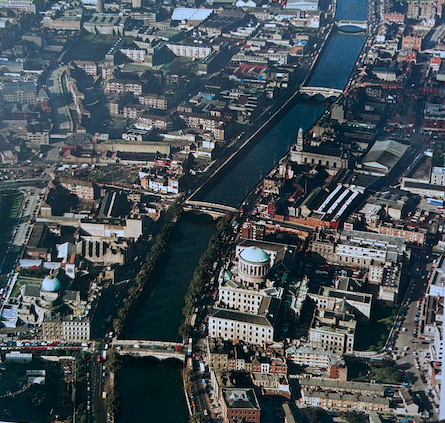

 Centering ourselves at the General Post Office on O'Connell Street, nearby there is the pointed Dublin Spire structure, the city's focal point and a memorial of the site of Nelson's Pillar which once stood there before it was blown up in 1966. If you started from there and walked a few blocks up to Henry Street and turn left, walk a bit and you'll be on Mary Street, a busy shopping area, and you will pass by 45 Mary Street which was the site of the Volta Theater, the first cinema in Dublin, which Joyce had helped arrange on one of his final visits to Ireland. 

From there if you turn left and walk back down toward the river you'll come upon Bachelor's Walk along the north quay of the Liffey—this street is mentioned on pg 214 of the Wake, a part you can listen to Joyce himself reading aloud in a recording, "of a manzinahurries off Bachelor's Walk." From Bachelor's Walk you can cross onto Ha'Penny Bridge to walk across the Liffey onto the south side of the river. This bridge was originally called "Wellington's Iron Bridge" and it appears this way on FW 286.11, with the capitalization and no distortions. On one of my stays in Dublin I was in lodgings right on Bachelor's Walk and got to walk across Wellington's Iron Bridge every day. Here's the view from the bridge after crossing to the southside, where you can see Merchant's Arch, a spot featured in Ulysses.
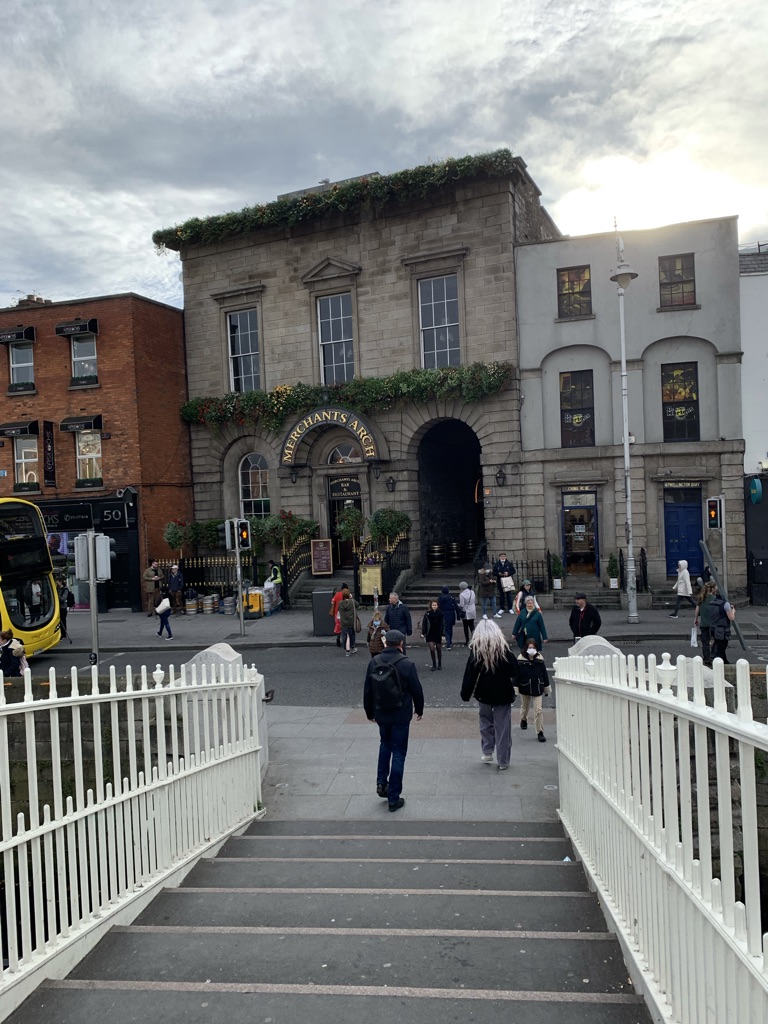

Merchant's Arch from Wellington's Iron Bridge (aka Hapenny Bridge)


Once you cross the bridge you can walk thru the archway, this area used to be filled with bookshops, described in the scene where Bloom is observed scanning books in Ulysses:  "They went up the steps and under Merchants’ arch. A darkbacked figure scanned books on the hawker’s cart." Walk under the archway, go a few blocks then turn left and you'll be heading toward Trinity College. In June 2022, I had the honor of presenting a paper in an auditorium at Trinity for the centennial Joyce conference. It was an incredible moment in my life. I spoke on the morning of Bloomsday. Just outside of Trinity if you walk down Nassau Street you will encounter Finn's Hotel, the site where James and Nora Joyce first met. Finn's Hotel is considered by some scholars to be Joyce's original title for Finnegans Wake. Walk around the corner and you'll find Sweny's Pharmacy and down the street from there is present-day Pearse train station, which used to be Westland Row station which comes up in Ulysses and which Joyce himself had arrived at in one of his last visits to Dublin.

When walking down Nassau Street you can also turn right and go down Dawson Street, and there you will find the historic Hodges Figgis bookstore. This place has been in operation for over 200 years (albeit including moving locations), it is one of the oldest bookshops in the world. It pops up in Ulysses and in Finnegans Wake. It's a fantastic bookstore, a great place to browse for hours. I can tell you that they've got an impressively deep collection of Joyce books. I was there eyeing their several shelves of Joyceana and, can you imagine what it must've felt like when I discovered they had a book on the shelf which named me in the index? I'm not kidding. The book is called James Joyce and the Arts (part of the European Joyce Studies series) and there's an essay in there by Derek Pyle which mentioned THIS BLOG in a footnote. I was in the heart of Dublin, in a bookstore that appears in Ulysses and the Wake, and found my name in a footnote in a Joyce book. Achievement unlocked, life goal accomplished. 
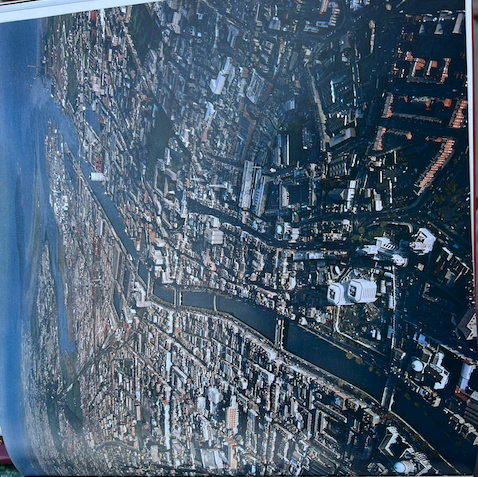

*   *   *

The inspiration for the thoughts I'm sharing here I originally conceived while standing atop Killiney Hill observing the landscape around Dublin, the rolling green Wicklow Mountains in the distance, and I was envisioning how the hills would look in the night in centuries past when, in the words of the Wake, "There were fires on every bald hill in holy Ireland that night" (FW 501). I've been curious about that phrase "holy Ireland" and it doesn't seem to be common, then I saw the same phrase used in a book by the American poet Susan Howe, The Quarry, which mentions "reciting secret languages of holy Ireland." Susan Howe is the daughter of Mary Manning Howe, an author and playwright who was born and raised in Dublin. She was a close friend of Samuel Beckett, and as a playwright she adapted Finnegans Wake to the stage. (see here)

Ireland is a famously evocative environment for writers. I'm focused on Joyce and the Wake here, but Ireland has a rich literary tradition beyond Joyce, and the country today continues to be very welcoming to writers. There are frequent articles about the literary mecca of Dublin, here's one example.

One of the first things that strikes me every time I arrive in Ireland is noticing the old stone walls covered in mossy mold from the sea air, soon as I see the mossy old stone I know where I am. This comes up in the Wake where "though he's mildewstaned he's mouldystoned" (FW 128.02) That moldy stonework and the sea air are part of the recipe for literary brainwork I associate with "holy Ireland."

A passage in Ulysses captures this mixture beautifully:

The air without is impregnated with raindew moisture, life essence celestial, glistening on Dublin stone there under starshiny coelum [Latin, "sky"]. God’s air, the Allfather’s air, scintillant circumambient cessile air. Breathe it deep into thee.

The aforementioned Susan Howe has a sister who is also a renowned poet, Fanny Howe. In her excellent book The Winter Sun, Fanny Howe writes of when she and her sister, both American born, first went back to their Irish mother's home country and encountered Dublin:

"Then we were herded into a bus and headed for Dublin where the clouds were much lower than they were in America. My sister and I gulped in the atmosphere of a new country; it entered our systems like a potion that suffuses the whole and would never leave either of us. It was our mother's body." (pg 30, The Winter Sun: Notes on a Vocation)

"Holy Ireland." "God's air, the Allfather's air," the atmosphere that was "[their] mother's body." To bring this "back to Howth Castle and Environs", the "scintillant circumambient cessile air" and the mossy stone that make up the poetic potion were noticeable in abundance when I went up to Howth one afternoon. I took the DART, Howth is the northmost stop. Howth feels like how I imagined Ireland would be before I ever visited the country. Howth was very green, chilly, cloudy, soggy wet, misty, lots of boats on the docks, and plenty of old stone structures covered in moss. The vibes feel very historical there. I went and checked out Howth Castle and environs. The piratess prankquean "grace o'malice" had trod this ground, ported at this peninsula. It was so interesting being there observing this real and historical space and considering how deeply it has been lodged into my brain as a mythic site, thanks to the legendary Grace O'Malley scene in the Wake. 

Grace O'Malley was a real person, a female pirate from Ireland who, according to legend, arrived at Howth Castle one night in the 16th century, hoping to stay for the night as it was customary in those days for the castle to keep its doors open to offer hospitality to visitors. After she was denied entry at the door, she kidnapped a child from the royal family. All of this is enacted in the language of a fairy tale in the Wake, where the prankquean "grace o'malice" poses riddles to the doorman and kidnaps two children. I found the experience of walking around Howth surreal, considering there's a street named after Grace O'Malley and you can walk up the Howth Castle door where the prankquean "made her wit foreninst the dour." (FW 21.16) Walking around the castle area it felt imbued with a spooky presence, this was a relic of half a millenia ago, the grounds were well trodden, the walls seemed to be alive. Look at the rotting and tree-rooted parapet in the second picture below, notice the timefulness, this was a space filled with time.
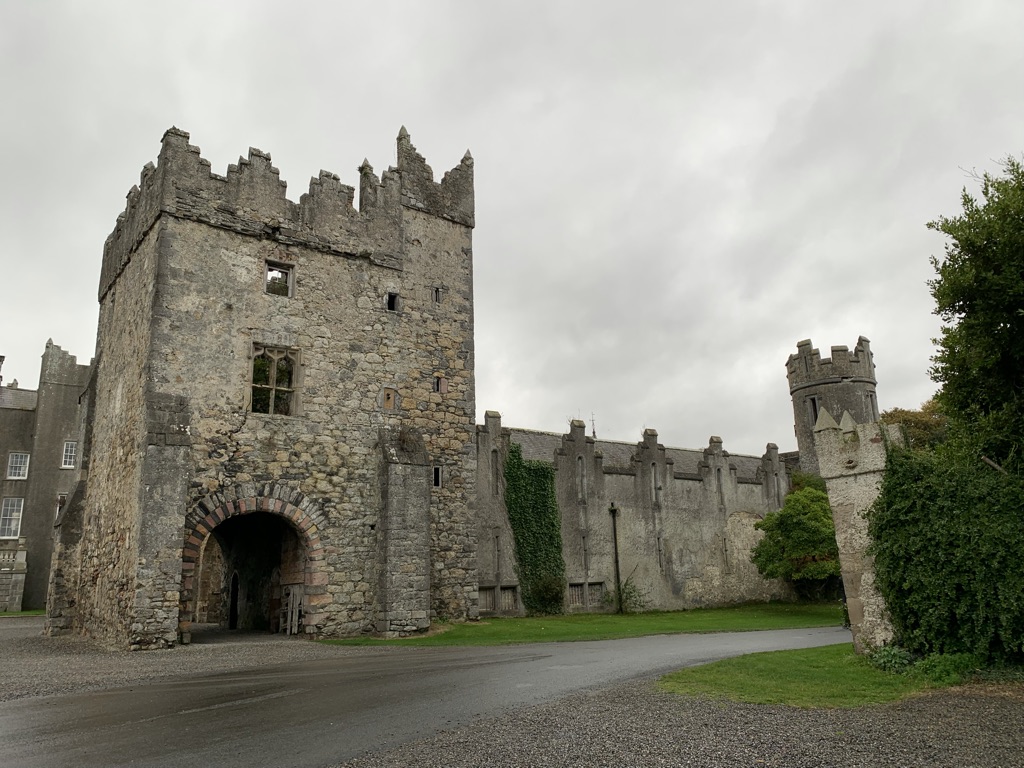

BACK TO HOWTH CASTLE AND ENVIRONS


*   *   *

In the year 1906, James Joyce was living in Rome, working long hours as a clerk at a bank, finding very little time to write, and he felt miserable. His biographer Gordon Bowker notes: "He wished himself far away–beside the sea at Bray…"
    Away from home only a couple years at that point, Joyce longed for the scene of his childhood home by the sea in Bray. Whereas Howth with its rocky promontory is the northernmost stop on the DART train in Dublin, at the opposite end the southernmost stop on the train is in the village of Bray which also has a jutting promontory. Joyce conflates the two places in the Wake, calling it "Brayhowth" (FW 448.18). The train station has a mural of Joyce. I got to spend a few days exploring Bray, a stony beach scene. There's a film studio there, one day as I was walking along the rocky beach I saw a camera crew doing a shoot.

Bray Head

Joyce spent years as a child living with his family in a house on Martello Terrace in Bray, right next to the sea. I got to see the house where Joyce lived from 1887-1891, it is extremely close to the beach. When the Joyces lived there the house would sometimes flood when the waves got especially rough. Being there and seeing how close it was to the shore, seeing the incredible view facing out from the front of the house, looking straight towards the big rocky green Bray Head, seeing the waves and the sea, I thought OF COURSE a future poet would've grown up here. 
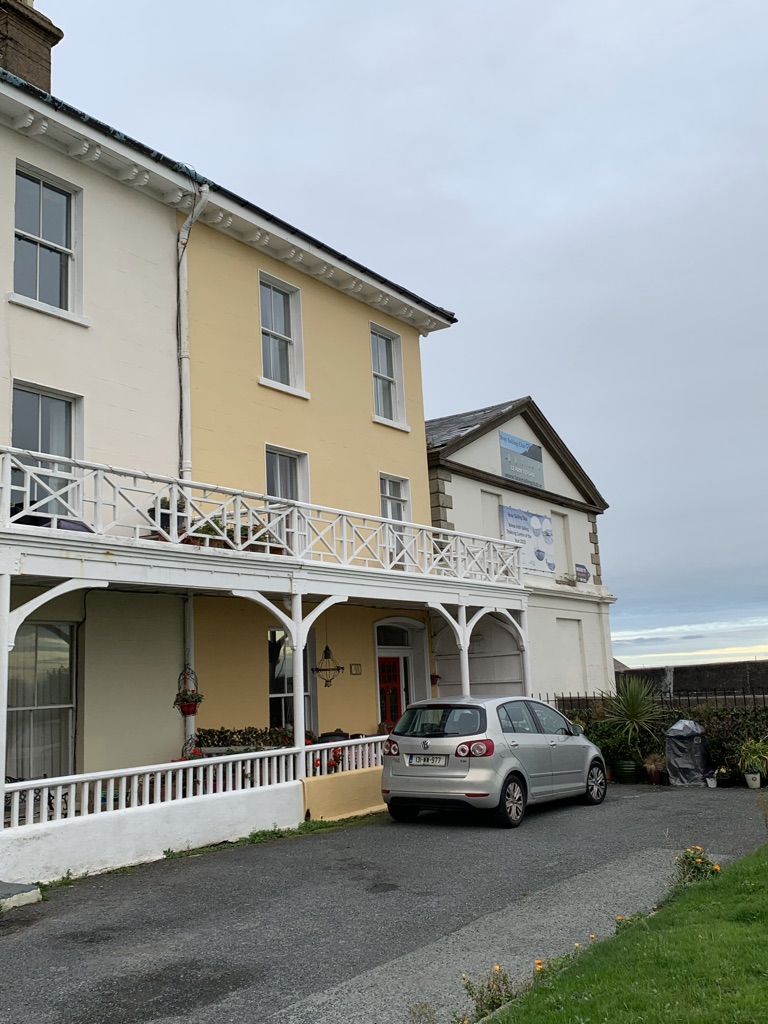

The Bowker biography of Joyce notes: "James would sometimes take [his brother] Stannie for walks along the beach. Living and walking beside the sea became a lifelong pleasure for him." (Bowker 28) This beach was also where Joyce acquired his fear of dogs, he and Stannie once threw rocks at a dog on the beach, it attacked them and bit a chunk out of Joyce's chin, supposedly the goatee he maintained as an adult was to hide the scar. This was also the house where the famous scene of the political fight over Parnell at the family Christmas dinner table that's depicted in A Portrait of the Artist as a Young Man would've taken place.
In 1935, Joyce's daughter Lucia went to stay in Ireland for a summer, and she stayed with some family members in Bray. She thought Bray Head looked like her father's profile (see Lucia Joyce, Schloss, pg. 343). In one of his letters, Joyce wrote to her suggesting she could take the train into Dublin city center to visit the GPO. 

*   *   *

view from Blackrock

About midway between Howth and Bray along the coast is the neighborhood of Blackrock. When riding the train seeing the Irish names for the stops I was interested in the Irish name for Blackrock An Charraig Dhubh, because of the Dubh for black, same as Dubh Linn, for black pool. One night I had dinner at the beautiful home of some friends I'd met in a reading group at Sweny's. The view out their front window looking at the bay was picturesque, with Howth Head prominent on the horizon. When Joyce's family moved from the house by the sea in Bray up to a house in Blackrock, living closer to the city center of Dublin transformed the young Joyce's life. His father would take him around the city showing him sights and telling him stories, as Bowker in his Joyce biography explains:
Joyce was absorbing the intricate layout of the city he was to immortalize in literature... landmarks not just on the map of Joyce's Dublin but also on the map of his creative consciousness. And through those streets of that Victorian city, past shops, cafés, bars and newspaper offices, moved and jostled the Dubliners [who] would people his fictions. John sometimes joined in his son's sightseeing perambulations, regaling them with tales of Dublin life and characters and pointing out places of interest... It was a leisurely city with an air of languor, not subject to the dictates of business or industry. The sights, sounds, smells and texture of Dublin introduced James to a world he would transform into the focus and playground of his imagination. The spirit of the place would permeate his thoughts and writing, wherever he happened to be in the world, and would supply the dream-like setting for the great rumbustious Finnegans Wake. (Bowker, p. 42)
There's an interesting mention of Blackrock in Portrait of the Artist as well, with Joyce once again focused on the geo-mapping of the city:
Outside Blackrock, on the road that led to the mountains, stood a small whitewashed house in the garden of which grew many rosebushes... Both on the outward and on the homeward journey he measured distance by this landmark: and in his imagination he lived through a long train of adventures…
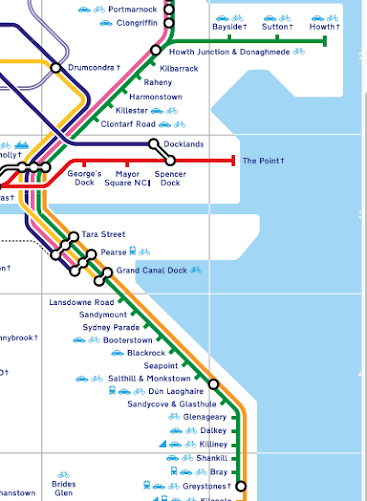
The image above is the view from the train stop at Blackrock. Often the mentions of Blackrock in Finnegans Wake are having to do with the Dalkey-Blackrock-Dunleary tramway, "Dullkey Downlairy and Bleakrooky tramaline" (FW 40.29-30) which I believe would have been essentially the same route as the present day DART train. 

In fact, I found that virtually every single one of the present day DART train stations in Dublin are named in FW. Compare the following list (incl. FW page/line numbers) with the map below:


  • Howth            (too many to list)
  • Kilbarrack 315.28; 327.24
  • Raheny 17.13; 39.09; 129.24; 142.15; 204.18; 497.20
  • Harmonstown (see above, also nearby "Artane" appears twice)
  • Killester 427.01
  • Clontarf Road (too many to list)
  • Connolly (Amiens St) 443.15; 549.31
  • Tara Street (too many to list)
  • Pearse (Westland Row) 553.3
  • Grand Canal Dock several references to streets on Grand Canal
  • Sandymount 247.34; 323.02
  • Sydney Parade 60.27; 553.31
  • Booterstown 132.04; 235.36; 386.24; 390.03; 507.35; 582.33
  • Blackrock 40.30; 83.20; 294.22; 541.02; 582.32
  • Seapoint 129.24; 588.15; 594.34
  • Salthill and Monkstown 261.F04
  • Dun Laoghaire (too many to list)
  • Sandycove/Glasthule 321.08; 529.23
  • Glenageary 529.26
  • Dalkey (too many to list)
  • Killiney 295.F02; 431.21; 433.13
  • Bray 53.30; 313.31; 448.18; 522.30; 537.34; 624.32


*   *   *

Back toward the city center, I remember walking around the streets I'd often encounter the name Kimmage Outer seen on bus tags in the city. It's another thing recognizable from repeated appearances in the Wake, the name of a district in southwest Dublin, right near where Joyce was born.
    There's an odd and obscure pattern to the way Kimmage Outer (K.O.) appears encoded in the Finnegans Wake text, the clatter of noises in the soundwaves of the dreamworld sometimes catches the frequency of radio calls:

pg 13 "Dbln. W. K. O. O. Hear?"
pg 35 "pingping K.O. Sempatrick's Day and the fenian rising" 
pg 72 "ring up Kimmage Outer 17.67"
pg 275 "phone number 17:69 if you want to know"
pg 456: "O.K. Oh Kosmos! Ah Ireland! A.I."


*   *   *


To be continued in Phoenix Park ... 


Saturday, September 19, 2020

Video: Anthony Burgess - "Lots of Fun at Finnegans Wake" (1973)


In this extraordinary video, Anthony Burgess walks us through the basic plot points and features of Finnegans Wake while hanging out inside a pub. He even sings the Ballad of Persse O'Reilly. Check it out.

Sunday, July 26, 2020

Video: Binaries & Bibliomancy: Finnegans Wake as the Western I-Ching


(contributed for Maybe Day 2020 http://maybeday.net/)


This essay was originally presented at the 2019 James Joyce Symposium in Mexico City and earlier this week I recorded it as a video for the virtual Maybe Day celebration on July 23rd celebrating the work of Robert Anton Wilson. "Binaries & Bibliomancy" essentially builds upon the theories presented in Wilson's great book Coincidance where he outlines an isomorphic relationship (in mathematics, systems that are parallel in form) between the I-Ching and Finnegans Wake. In my piece I talk about the machinery of these two distinctly different classics, how both books are built as thinking machines, always up-to-date, always encouraging open readings. The Wake advertises itself as a book of "Opendoor Ospices" (FW p. 71) allowing for open-door readings and "Ospices" or auspices, consulting for prophecy much like the I-Ching. As Finn Fordham described it in his book Lots of Fun at Finnegans Wake, "Through its continuously self-generating transformation, it is a text of modulation and becoming, flux and flow, an alternative classic of change to the I Ching."

Robert Anton Wilson Day was officially declared to be July 23rd by the mayor of Santa Cruz, California. John Higgs wrote a great article in The Guardian years back describing what RAW Day is all about. I enjoy the Santa Cruz connection with RAW because our Austin Finnegans Wake Reading Group has a lot of Santa Cruz links. We've had multiple longtime members from Santa Cruz who became good buddies of mine, the host of the Finnegans Wake Reading Group in Santa Cruz is also an old pal of mine, I got to visit up there and attend their Wake groups multiple times. Robert Anton Wilson also had a Finnegans Wake reading group in Santa Cruz for many years. Last time I was there I got to hear stories from folks who knew RAW and also knew Norman O. Brown, the legendary UC Santa Cruz professor, scholar, and theatrical Wakean.

I want to thank Bobby Campbell (https://bobbycampbell.net/) for putting together the amazing virtual tribute to RAW with contributions from a talented group of RAW readers. There's some incredible visuals, writings, comics, and videos over at the 2020 celebration of Happy Maybe Day. I also got to participate in a live panel with the contributors that was a really inspiring and informative time, really enjoyed it and grateful to be a part of this event.

Sunday, June 28, 2020

16 June 1904 and the Letter in Finnegans Wake

James Joyce and Nora Barnacle in 1929.

It cannot be overstated how important Nora Barnacle Joyce was to the career and life of her loving companion James Joyce. The annual Joycean holiday Bloomsday celebrates Joyce's most famous book, Ulysses, which entirely takes place on June 16th, 1904, immortalizing the day on which they went out for their first date. That wasn't his only dedication to her, though. Nora was the muse that inspired Joyce's entire artistic approach, as he wrote to her in a letter from September 1909:

Guide me, my saint, my angel. Lead me forward. Everything that is noble and exalted and deep and true and moving in what I write comes, I believe, from you. O take me into your soul of souls and then I will become indeed the poet of my race. I feel this, Nora, as I write it.
(p. 169, Selected Joyce Letters, ed. Richard Ellmann, underline in original)

This year as Bloomsday approached, I went back to Brenda Maddox's excellent biography of Nora to read the chapter about the summer of 1904 when Joyce and Nora Barnacle first met. Nora had grown up in Galway before moving to Dublin where she landed a job working as a chambermaid and barmaid at Finn's Hotel on Nassau Street. It was in front of Finn's Hotel where James Joyce was walking by on June 10th, 1904 when he encountered Nora for the first time. It was love at first sight (although Joyce had poor eyesight even then at age 22). He approached her and asked for a date the following week. As Maddox writes in Nora, "In Dublin, far more than in Galway, Nora was vulnerable to unwanted male attentions... Wariness of the male was Nora's strategy for survival. When a well-mannered, well-spoken, amusing and unthreatening young man stepped into her path one day in Dublin, therefore, Nora was quite happy to accept his invitation to meet him one evening. But she did not appear." (p. 40)

They had set a date for June 14th, 1904 but Nora stood him up, likely because she couldn't get off her shift at Finn's Hotel in time. Joyce wrote to her in dismay and reading his letter it's funny to contemplate how close this historic couple came to never linking up in the first place:

15 June 1904 
I may be blind. I looked for a long time at a head of reddish-brown hair and decided it was not yours. I went home quite dejected. I would like to make an appointment but it might not suit you. I hope you will be kind enough to make one with me---if you have not forgotten me!  
James A. Joyce

Although June 16th is supposed to be the day they did finally get together and change the course of history, Brenda Maddox notes that there actually is no clear evidence in their letters that June 16th was the exact date. The main piece of evidence is that Ulysses takes place on that day. When Herbert Gorman was composing his authorized biography of Joyce in the 1930s he submitted a questionnaire to Joyce and received responses in the handwriting of Nora. He'd gotten answers to every question except one:

Q: Why did you pitch on June 16, 1904 for Bloomsday? Was it the day you met Nora? 
A: Reply later. 
(p. 41, Nora)

Gorman never did get a response about this and it was never confirmed during Joyce's life, probably because it was "too personal and too shocking," as Maddox surmises. If you are here reading this blog, I will take it for granted that you understand why that might be the case and what supposedly occurred between James and Nora on June 16th, 1904.

Moving on... in our Finnegans Wake reading group we recently read page 66 where there is a passage about the mysterious letter that keeps popping up all throughout the Wake, and that sparked a discussion about the postal service. Joyce in Finnegans Wake is frequently preoccupied with the postal service and on p. 66 in writing about the delivery of the letter he describes a postal service that sounds sorta like Fedex except there's a hidden meaning in its acronym: "Federals' Uniteds' Transports' Unions' for Exultations' of Triumphants' Ecstasies." The acronym here spells out FUTUE TE which would be the vulgar Latin curse word futue te meaning "fuck you" or "you all fuck." This comes at the tail end of a passage about how people all over the world and all throughout history getting together and having sex is how the species ensures its future (note the root for the word "future" is contained in futue te). If you parse that sentence, a rare Wake line with normal words, you can identify how it is a sophisticated and clinical way of describing people fucking. The first word federal, for instance, originally referred to a covenant and contains the root word for "faith" so this is all part of a faithful covenant, i.e. marriage. Faithful couples uniting in covenant for exultant triumphant ecstasies has allowed for the continuation of the species through time, that's basically what it says.

Immediately after that, Finnegans Wake asks "Will it ever be next morning the postal unionist's (officially called carrier's, Letters Scotch, Limited) strange fate... to hand in a huge chain envelope ...?" The letter and the postal service can be seen to symbolically connote the continuation of the species, hence why the parcel is called "a huge chain envelope." Elsewhere in the Wake we read how "ancients link with presents as the human chain extends" (p. 254) and later on "Since ancient was our living is in possible to be. Delivered as." (p. 614) The "huge chain envelope" to be delivered might be viewed as the DNA chain of humanity through generations, the links in the chain are formed by couples fucking.

The mysterious letter in the book has many different associations: on one level it represents the book itself; on another level it factors into whatever narrative can be said to exist in the Wake since it appears at the end of the book as being written by the wife Anna Livia in defense of her besieged husband Earwicker; on another level it embodies the dream itself and the sleeper's attempt to carry the dream information across the threshold of sleep so he can remember it in the morning, as John Bishop has argued; and one might also see it the way Eric McLuhan did when he suggested the letter is actually a red herring.

Going back to Nora and the summer of 1904 for a moment, though, it appears there might be something more personal to the Wake's obsession with mailing letters. Brenda Maddox writes:
The swift progress of their love affair depended on a superb postal system. There were five deliveries a day, with the first collection at quarter-past one in the morning. Joyce, who liked to write in the small hours of the morning, took full advantage of the service. After he came in from seeing Nora, he would stay up writing long, painful, self-revealing letters ('It is only fair that you should know my mind on most things') and took them to the box, confident that she would get them in the morning. Both of them relied on letters posted before lunch to make or cancel a date that same evening... (p. 46, Nora)

With all of that, it seems there's some good evidence to suggest that the letter in Finnegans Wake may actually be a love letter. That brings us to what I feel is one of the most brilliant studies of Joyce ever written, Benjamin Boysen's book The Ethics of Love: An essay on James Joyce (published in 2013 by University Press of Southern Denmark). In this large and ambitious book, Boysen examines all of Joyce's works (including Chamber Music and Exiles) and argues convincingly that the main theme throughout all of them is Love. Boysen's book has a large section devoted to Finnegans Wake that is especially filled with original insights that I have not seen other Joyceans touch upon. Most relevant to our current consideration is his discussion of the letter.

Boysen calls our attention to a passage that starts on p. 420 of the Wake which describes some of the notable characteristics of the letter. Beyond the familiar qualities that it was written by Shem the Penman and carried by Shaun the Postman, the passage provides a long, cryptic and comical list of the letter's many misadventures in postal conveyance. Here is a list of some examples (with page and line numbers and my clarifying notes in brackets):

- "Initialled. Gee. Gone." p. 420.19 [Initials are gone.]
- "Tried Apposite House." p. 420.21 [Try opposite house.]
- "Nave unlodgeable." p. 420.23 [Name illegible.]
- "Noon sick parson." p. 420.24 [No such person.]
- "No such no." p. 420.25 [No such number.]
- "Opened by Miss Take." p. 420.26 [Opened by mistake.]
- "None so strait." p. 420.28 [No such street.]
- "Wrongly spilled." p. 420.33 [Wrongly spelled.]
- "At sea. D.E.D. Place scent on." p. 420.30 [At sea. Dead. Please send on.]
- "Kainly forewarred." p. 421.05 [Kindly forward.]
- "Overwayed. Understrumped. Back to the P.O." p. 421.07 [Overweight, understamped. Send back to post office.]

Within this catalogue of characteristics, Boysen notices the presence of Leopold Bloom---on p. 420.22 you find the initials "L.B." and p. 420.33 mentions "Return to City Arms" which would be City Arms Hotel in Dublin where Ulysses describes the Blooms as having once lived---and then he also points out the presence of Joyce's loving companion Nora in the phrase "Loved noa's dress." That would be "left no address" but it's also saying "I loved Nora's dress." He further observes the presence of Finn's Hotel, the place where Nora worked when Joyce first met her, in this passage: "Finn's Hot." (p. 420.25) (It's worth mentioning that, according to some sources, Joyce's original planned title for Finnegans Wake was actually Finn's Hotel.) Boysen calls our attention to another appearance of Finn's Hotel later on in the Yawn chapter (III.3) where Yawn is asked for the name and address---"name or Redress" (p. 514.17)---of the Wake's subject and his cryptic response is ".i..'. .o..l." (p. 514.18) We can't be certain but it is very likely the answer there is "Finn's Hotel." If that is indeed the case, Boysen concludes:
it means that all empty spaces, the uncertainties, the indeterminacies, and the obscurities of the book as such are meant to be interpolated by the singular event of James Joyce's coup de foudre [love at first sight, in French literally "stroke of lightning"] when meeting real love for the first time. What I suggest is nothing less than that Joyce's encounter with Nora---as commemorated in Ulysses by choosing 16 June 1904 (the date where Joyce had his first rendezvous with Nora) as the principal day---is similarly pointed out as a fateful event or Hintertext informing Finnegans Wake. (p. 351, The Ethics of Love)

To suggest June 16th, 1904 is a major event at the heart of not only Ulysses but also Finnegans Wake is a groundbreaking assertion for Joyceans and the literary world as a whole, as there's no literary event quite like Bloomsday. Boysen bolsters his theory by informing us that the passage on p. 420-421 which lists out all the addresses of the letter (which, as I mentioned, can be seen as a stand-in for the book itself) in fact lists out the addresses where James Joyce lived in Dublin in the years prior to his life-altering encounter with Nora in 1904.

I won't list them all out here, you can find a list of them at Fweet here, but Boysen makes it abundantly clear that the passage contains not only the names of the Dublin districts where pre-June-1904 Joyce lived but also many of the specific addresses (Fweet lists nine of them). On top of that, all of these addresses where Joyce lived before he met Nora are mutated in the language of the Wake to carry dark, depressing connotations. Quoting from Boysen once again:

As "Destined Tears" (FW p. 421.10), these early addresses (French destinataires) embody tearful destinies, which nonetheless did not come true on account of the amorous meeting. In other words, the letter comes to represent the author's metaphysical love-letter to existence, to love, and to himself as a young man not yet transformed by the amorous event. The letter is the mature author's gift to himself as a young man untouched by the amorous transubstantiation, testifying to Walt Whitman's lesson that "love is to the lover, and comes back most to him, / The gift is to the giver, and comes back most to him - it cannot fail" ('A Song of the Rolling Earth' 2, vv. 15-16). As it says in Issy's love-letter, the letter gives testimony on behalf of "my old evernew" (FW p. 460.36) self, which is transformed and ever renewed by the gift of love and existence. (p. 352, The Ethics of Love)

Elsewhere in his book, Boysen writes: "In sum, Ulysses and Finnegans Wake are to be perceived as great love letters expressing an existential gift to history and humankind." (p. 348) We can now be sure that the historically famous day of June 16th, 1904 is a pivotal day not only for Ulysses but also for Finnegans Wake. Nora Joyce herself, speaking to Joyce's friends after her husband had died, in response to their questions about the great author of Ulysses, responded, "What's all this talk about Ulysses? Finnegans Wake is the important book." While there's no doubt that Ulysses deserves to be celebrated, maybe it's about time we heed Nora's words and start giving some more attention to Joyce's grandest epic, Finnegans Wake, when we celebrate James Joyce every year on June 16th.

Monday, June 11, 2018

Finnegans Wake and Child's Play

"Hide-and-Seek" (1942) by Pavel Tchelitchew.

I've been in Belgium for the past few days, enjoying a nice vacation and preparing for the XXVI International James Joyce Symposium taking place this week in Antwerp. My experience thus far in this wonderful country has led to some thoughts about Finnegans Wake and child's play. There are at least three ways Joyce brings out the child in all of us when we read Finnegans Wake:

1. The first way is the childlike wonder and confusion we experience when encountering this bizarre dream-distorted polyglot language. I touched on this in Part 3 of my review of John Bishop's fantastic book---as Bishop says "Joyce puts his reader into a position roughly analogous to that of a child encountering an unknown language for a first time." Here in Europe I've been experiencing that same feeling listening to passersby chattering away in French or Flemish or German or what have you. As a typical ignorant American who speaks only one language, I've been sort of awestruck and fascinated hearing everyone around me communicating in foreign tongues I can barely understand a word of. During down time on this trip I've been reading Finnegans Wake and noticing that same feeling. The text itself well captures this sense of befuddlement on p. 112: "It is a puling sample jungle of woods." A pure and simple jungle of words. While reading the text, as I'm trying to comprehend what it all means, I'm also constantly tantalized by the bizarre medium itself, the digressive and opaque clusters of etyms that seem meaningless yet which are in fact densely packed with meaning.

2. One of the pleasures of visiting Europe has been sitting outside at a café or restaurant while people-watching all the pedestrians. It's always funny to notice, in the constant stream of people strolling by, a little boy or girl skipping or jumping around as they follow their parents. The world is all about play for them. Finnegans Wake seems to take a similar approach to things. The sound of its language always seems to mimic fairy tales or folklore, stories told in a playful kiddie language. Of course, there are a number of fables told throughout the Wake (the Ondt and the Gracehoper, the Mookse and the Gripes, the Prankquean, etc). In our Austin Wake Reading Group we recently read the Museyroom section and I was struck by how silly and playful Joyce renders what essentially consists of a museum tour guide detailing the events of the Battle of Waterloo. The text is overloaded with references to countless wars from the careers of Napoleon and Wellington and their legendary clash at Waterloo, yet our tour guide describes this grave material in a manner that reduces the belligerents to children playing games. Here's a sample from page 9:
This is the jinnies' hastings dispatch for to irrigate the Willingdone. Dispatch in thin red lines cross the shortfront of me Belchum. Yaw, yaw, yaw! Leaper Orthor. Fear siecken! Fieldgaze thy tiny frow. Hugacting. Nap. That was the tictacs of the jinnies for to fontannoy the Willingdone. Shee, shee, shee! The jinnies is jillous agincourting all the lipoleums. And the lipoleums is gonn boycottoncrezy onto the one Willingdone. And the Willingdone git the band up. This is bode Belchum, bonnet to busby, breaking his secred word with a ball up his ear to the Willingdone. This is the Willingdone's hurold dispitchback. Dispitch desployed on the regions rare of me Belchum. Salamangra! Ayi, ayi, ayi! Cherry jinnies. Figtreeyou!

3. Speaking of children's games, the Wake is loaded with references to old street games. Page 176 contains a cluster of a couple dozen London street games listed out, games like "Eggs in the Bush, Habberdasherisher, Telling Your Dreams, What's the Time, Nap, Ducking Mammy" etc and of course "Battle of Waterloo" is listed among them. More broadly speaking, reading the Wake itself is a sort of game. In the recently published essay collection Joyce's Allmaziful Plurabilities: Polyvocal Explorations of Finnegans Wake, Sean Latham examines Book I, chapter 6, the Quiz chapter, describing it as an "interactive gamespace." That chapter features questions and answers regarding the book's "sigla"---the symbols embodying the core elements of Finnegans Wake. Latham describes how the sigla become elements in a game of interpretation:

Readers or players of the text succeed by exploring the ways in which they can interact with this data by shaping it into more or less successful interpretive configurations. [...]
In this sense, reading Finnegans Wake requires a very specific kind of cognitive activity often associated with gameplay (and other kinds of complex information processing) called 'chunking.' Put simply, this is a process in which an experienced player combines small elements of a closed system into patterns or objects---chunks---that can be processed more quickly.[...]
Like chess masters, readers who become familiar with the text learn to assemble chunks of their own that enable them to play more and more skillfully with the text, recognizing, for example, the importance of the letters HCE (even when in different order or scattered across or between different words). For an adept player of the Wake, in other words, the text resolves into something other than a chaotic jumble of words and letters, becoming instead an intricate array of informational chunks that recombine in shifting patterns as the 'collideorscape' turns. (pgs 96-98)

I woke up today with all of this on my mind because as I've been reading the Wake during this trip and contemplating my passion for Joyce and this book in particular---having traveled all the way from Texas to Belgium for a James Joyce conference---I keep thinking about why the Wake is so appealing for me and the answer is simply: it's so damn fun! You can't read the book for very long without breaking out in laughter merely at the silly sound of it. And I can't overemphasize how much fun we have in our reading group when the interpretations and references are flying around and there's blends of the most profound wisdom with the dirtiest sexual or scatological jokes. The joys of this book are inexhaustible. That oft-repeated chorus line from the song "Finnegan's Wake" couldn't be more apt: There's lots of fun at Finnegans Wake!


(End note: I began this post by referencing my favorite Joyce scholar, John Bishop. Well, I just noticed that Boston University finally posted his wonderful lecture on the Prankquean episode to YouTube. This is highly recommended viewing, and of course it's called Child's Play.)

(Other end note: The picture included here is Pavel Tchelitchew's mesmerizing masterpiece "Hide-and-Seek" depicting a girl counting down as her friends are hiding. In his book The Geography of the Imagination, Guy Davenport analyzes this painting and compares it to Finnegans Wake.)

Saturday, January 23, 2016

What is Finnegans Wake? A Simulacrum of the Globe (Part 2)

Further reinforcing the astounding idea that James Joyce constructed the physical text of Finnegans Wake as a simulacrum of the earthly globe is Roy Benjamin's theory expounded in his excellent article "What Era’s O’ering?: The Precession of the Equinoxes in Finnegans Wake" (from James Joyce Quarterly Vol. 48.1*) where he argues that the Precession of the Equinoxes and the ancient myths revolving around this phenomenon play a central role in the Wake.

It appears that Joyce not only shaped the whole of his book in the form of the spherical earth, he made sure to set it in motion, "whirled without end to end" (FW 582.20) amid the glistening theater of constellations. So accurately did he render its spin that even the earth's slight wobble, like "the spin of a coin" (FW 127.14) or "the spin of the top" (FW 163.18), and the resultant celestial re-positioning that ensues over millennia are featured in his simulacrum.

Remember, Joyce literally put painstaking effort into constructing his works down to the most minute details, especially Finnegans Wake. John Bishop calls it "the single most intentionally crafted literary artefact that our culture has produced." (I cannot refer to that statement enough.) This was not by accident. It's been 75 years since its publication and scholars are still uncovering new forms in its fractal latticework.

Thursday, November 26, 2015

What is Finnegans Wake? A Simulacrum of the Globe (Part 1)

Out of all the alternative theories about Finnegans Wake you can find out there, few are more unique and compelling than this one.

In an essay for the Hypermedia Joyce Studies journal from 2007 entitled "Joyce, Liberature and Writing of the Book," a Joyce scholar from Poland named Katarzyna Bazarnik unveils an entirely new perspective of Joyce's cryptic magnum opus, arguing that the physical text itself was intentionally constructed to be a sort of simulacrum for our earthly globe.

Bazarnik lays out her theory persuasively, beginning by discussing Joyce's history of carefully crafting all of his works to achieve certain meaningful results in the final physical presentation. This tendency goes as far back as his 1914 collection of poems, Giacomo Joyce, which Richard Ellmann felt "could not be properly appreciated without resorting to its actual, physical form." Ellmann was convinced that "the appearance of the work on the page may have become an element of its substance."

Similar intentions are evident in the composition of Ulysses whose text Joyce constantly added onto and tinkered with until the very last minute, resulting in a range of Joycean correspondences such as:
on page 77 “Seventh heaven” was inserted as the seventh sentence in a paragraph where Bloom muses on what people feel taking the holy communion. On page 88 Joyce added: “Aged 88 after a long and tedious illness” to an obituary Bloom is scanning. When Bloom is thinking about weight, gravity, and the rate of falling bodies, he recalls its value: “thirty two feet per second”, in the thirty-second sentence of the paragraph. And in “Calypso” the punctuation of Milly’s letter was so modified as to contain fifteen sentences. Bloom was struck by a coincidence between Milly turning fifteen on the fifteenth of June, the day she wrote the letter...
If one pursued such numerology further, one could notice that the first edition of the novel counts 732 pages. This is the number of nights and days in the leap year; coincidentally, 1904, when Ulysses is set, was a leap year, too. Besides, the diurnal and nocturnal halves of the book are equal: the dawn falls exactly on pages 364-5. “Done half by design” thinks Bloom at that moment, reflecting on the shape of the Dublin Bay.
Many of these little synchronicities are preserved only in the original 1922 text as all subsequent editions included enough additions and modifications to collapse these hidden little houses of cards.

Thankfully, in the case of Finnegans Wake the same pagination has been preserved from the original 1939 publication giving us a chance to pick apart Joyce's astounding structural engineering.

Bazarnik argues that since the Wake describes itself as “the book of Doublends Jined” (FW 20.16) or double ends joined, "we can visualise it as a book opened in such a way that its covers are joined, while its radially extending pages form a circle." This linking of front and back was confirmed, in Bazarnik's view, by the design of the first edition which bore the same lettering on the front and back covers, not to mention the final uncompleted sentence linking to the opening line of the book.

A new way to view the mandala of Finnegans Wake.
Not only does this view of the text give new implications to its length of 628 pages as representing the circumference of a circle (in a simple formula Bazarnik shows as 2r x 3.14 = 628 where r=100), but the shape of the text can now be viewed geographically as a "Shapesphere" (FW 295.04) or
"gllll (... (...) ... (...) ...) lobe" (FW 54.29 - 55.1):


This diagram is the most fascinating visual representation of Finnegans Wake I've encountered aside from John Bishop's relief maps in Joyce's Book of the Dark. I find her theory absolutely stunning. Bazarnik points to a number of references to various polar regions appearing around pages 627, 628, 3, and 4 while in the middle of the text (the South Pole on the map) appear references to a bunch of polar explorers and vessels.

She even offers an entirely new viewpoint for the mysterious clustering of particular languages appearing throughout the text, noting specific languages and references appearing in alignment with the Tropic of Cancer or the Tropic of Capricorn on the globe diagram. Many of these appearances, she emphasizes, were added in the later stages of composition including this apparent reference to the cartographic character of ALP's letter: "But once done, dealt and delivered, tattat, you’re on the map. Rased on traumscrapt from Maston, Boss. After rounding his world of ancient days." (FW 623.29-624.01)

Another late modification was to replace the word "geographical" with "geodetic" emphasizing the book's embodiment of the branch of mathematics dealing with the shape and area of the earth. This change was made on page 114 in the middle of a chapter describing the curious nature of Finnegans Wake itself:
One cannot help noticing that rather more than half of the lines run north-south in the Nemzes and Bukarahast directions while the others go west-east in search from Maliziies with Bulgarad for, tiny tot though it looks when schtschupnistling alongside other incunabula, it has its cardinal points for all that... It is seriously believed by some that the intention may have been geodetic. (FW 114.02-114.15)
She closes by quoting Clive Hart from his book Structure and Motif in Finnegans Wake where he clearly picked up on the same thing writing on pg 111: "The 'intention may have been geodetic' indeed. Finnegans Wake is laid out like a map of the globe---'a chart expanded' (593.19)---for geography is as important to Joyce as history."

Wow. Just...wow.

No wonder Joyce considered himself the greatest engineer who ever lived.

This theory goes along quite nicely with the similarly mind-blowing idea put forth by Joyce scholar Roy Benjamin in a recent James Joyce Quarterly article about the precession of the equinoxes in Finnegans Wake.

We will dig into that in Part 2.

(Credit is owed to the Finnegans Awake Tumblr page which first alerted me to this article.)

Sunday, January 18, 2015

Frank Delaney Describes Finnegans Wake Perfectly

Irish novelist and public intellectual Frank Delaney, who NPR once declared to be "the most eloquent man in the world," hosts a weekly podcast called "Re-Joyce" devoted to deciphering the pages of Ulysses basically one paragraph at a time. After every twelfth episode of the podcast he delivers a so-called "baker's dozen" episode devoted to miscellaneous Joyce topics.

The latest episode answered a listener's question about how best to approach Joyce's work, and Delaney responded with a rundown of each of the books in Joyce's canon. This gave him an opportunity to riff on Finnegans Wake which he does only rarely on his show. His description is quite beautiful:
Finnegans Wake is not a novel....No! No! Finnegans Wake is a poem, it's a symphony by a modern atonal composer. It's an assembly of language tying together floating evanescent ideas. It's a long rapid eye movement dream, it's a marathon technicolored musing that might have been induced by mescaline or LSD...It's a seemingly reckless careening through English and other languages. Yet you know that every word has been considered in this hodgepodge potpourri of miscellaneous and not always aligned thoughts and ideas, in this flamboyant and brilliant linguistic exercise that mimics the intensely illustrated pages of a medieval Irish manuscript. It's a massive rap, as in rapper, as in street talk, as in lingo, as in the heat of the day and the cool of the night captured dreamily and melodiously in words of all shapes and sizes. It's a mirage.
Do not read FW. Feel it. Dip into a page, any page, and if you find something that lights up your synapses, enjoy it... Read Finnegans Wake on any page at any time, and listen to it. Feel the words in your mouth and smile. But above all else: feel it in your spirit.
He also mentions he hopes someday some brave soul will embark on a full explication (to whatever extent that's possible) of the Wake in a podcast or some other medium. After practicing recently for the upcoming Waywords and Meansigns recording project for which I'm doing a chapter, and being surprised at how I wasn't too terribly disgusted by the sound of my own recorded voice, I'm beginning to give consideration to creating a Finnegans Wake podcast sometime down the road. There's a tiny but devout and growing group of Wake devotees around the world, too, so don't be surprised to see it happen in the not too distant future.


(Thank you to Peter Chrisp of the fantastic blog Swerve of Shore to Bend of Bay for calling my attention to this.)

Sunday, July 7, 2013

What is Finnegans Wake? A Mysterious Black Cube

"Joyce's emblem for the book, untitled for years, was □" 
- Eric McLuhan


One of my favorite characteristics of the Wake is its self-reflection and self-commentary. While the book describes a set of characters who take on different shapes and forms throughout history (the Earwicker family) it also describes itself as a physical entity and what it represents in history.

The question of "What is Finnegans Wake?" should become a regular series here as there is no single answer. The book even describes itself in various ways. For now, let's focus on the image of the Wake as a black box or cube.

Right from the start, on page 5, "our cubehouse" is mentioned along with multiple references to the story of the Prophet Muhammad, suggesting the image of The Kaabah ("The Cube"), the black cube building in Mecca that is one of the holiest sites in Islam.


Page 13 has the great phrase "the mujikal chocolat box" suggesting a "musical" black box (the Wake is all about sound, music, awakening the ear) as well as a "magical" box of chocolates, from which ya never know what you're gonna get, exactly as with the Wake which later describes itself as a "beautiful crossmess parzel" (pg. 619) combining Christmas parcel and crossword puzzle.

Some more black cube references:

"kabbaks alicubi on the old house" (p. 34) echoing The Kaabah once more with the sound of "box" and "cube," comes a few lines after the name "Abdullah Gamellaxarksky" appears, Abdullah being the father of Muhammad.

"caabman's shelter" (p. 542) hints at the Kaabah and recalls the cabman's shelter to which Leopold Bloom and Stephen Dedalus go toward the end of Ulysses. The image of a house or shelter also refers to H.C. Earwicker's pub, a place in Chapelizod where the real people (if there are any) exist in Finnegans Wake. Earwicker operates a pub, his family lives and sleeps upstairs.

"the cube of my volumes" (p. 151) is a good description for the medium of the book itself, a voluminous cube. In Joyce's notebooks, and in the Wake (pg. 299) he uses a square hieroglyph to represent the book.

On page 98, "the opulence of his omnibox" and then the recurrence of the word "pillarbox" (pgs. 66, 235, 442) also suggest a coffin, the coffin of Finn or Finnegan (or Osiris) and I think of the clever image on the cover of Roland McHugh's little book The Finnegans Wake Experience:


There we see the text of FW itself looking like a giant sepulture in the middle of a forest, waiting for some intrepid archeologists or anthropologists to discover it. (Looking at the image I always think of a quote from Joyce in which he lamented on the Wake: "perhaps in the years to come this work of mine will remain solitary and abandoned, like a temple without believers.")

The cube as representative of the physical book itself is part of the gist of another memorable and meaning-filled line:


"the canonicity of his existence as a tesseract." (p. 100)

There we have the embedded initials of HCE, the "city" (since HCE "weighs a town in himself" p. 132 and embodies Dublin), the "canon" of the book itself and finally that amazing word "tesseract".

A tesseract is a hyperdimensional cube, a cube within a cube, a geometrical shape also called a "cubic prism." A four-dimensional cube.

Now we're getting somewhere...

Meditating on this piece of geometry for a little while conjures up vague ideas about time as the fourth dimension and what Joyce was trying to portray with his opaque text written "from severalled their fourdimmansions" (p. 367).

During the composition of the Wake, Joyce used to boast that he'd squared the circle. This gif from wikipedia showing a rotating tesseract might gives us a hint as to what the hell he was talking about:


Could that be a representation of the repeating cycles of human history through time and space? What Joyce calls "Our wholemole millwheeling vicociclometer, a tetradomational gazebocroticon" (p. 614)?  The "sameold gamebold adomic structure of our Finnius the old One"?

In my copy of the Wake, I'd drawn a couple strange symbols next to the "tetradomational gazebocroticon" sentence that are essentially squares with spirals spinning in the middle of them. (Joyce once described the Wake as "an engine with only one wheel.") That, to me, is the ultimate symbolic representation of the Wake. But, if we are to take things to higher (hyper) dimensions, that whirling, mesmerizing tesseract would have to be it.

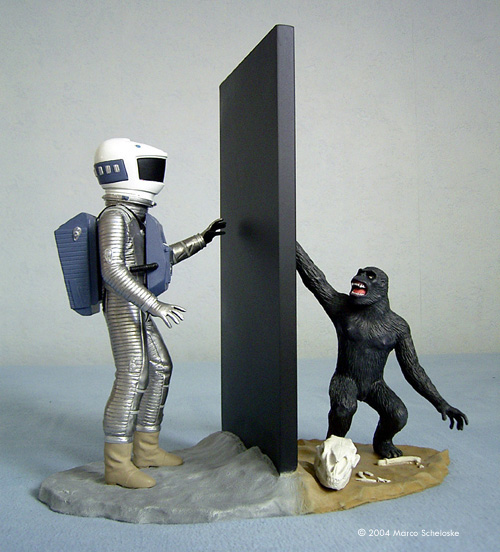
Last but not least, the visual representation of the Wake as a black cube, a mysterious black tablet, certainly seems in alignment with the black monolith of Stanley Kubrick's 2001: A Space Odyssey.


In Kubrick's film, the mysterious monolith is seen as having an important role in the evolution and growth of mankind, moving from violent apes traversing a barren waste land to space explorers venturing through the solar system and beyond. Similarly, the Wake details the evolution of mankind from muttering cavemen groping toward language to the farthest advances of technology, "as modern as tomorrow afternoon" (p. 309), with the Wake itself seen as a futuristic, hyperdimensional cube that somehow contains or mirrors the "monomyth" (p. 581) or formula for human history.

Having identified a mathematical "monomyth" formula, Joyce describes his basic elemental characters being fed through a machine-like device "with a clappercoupling smeltingworks exprogressive process... receives through a portal vein the dialytically separated elements of precedent decomposition for the verypetpurpose of subsequent recombination so that the heroticisms, catastrophes and eccentricities transmitted by the ancient legacy of the past" (p. 614) can be extracted out, manifested in endless multiplicity. Thus Joyce created a piece of art that contains everything that's ever happened and everything that will ever happen ("how minney combinaisies and permutandies can be played on the international surd!" p. 284).

A confounding black monolith indeed.


As for the parallel many have drawn between 2001's black monolith and the iPhone.... well, Joyce already covered that one with the condensed single word "iSpace" (pg. 124).