Sunday, July 7, 2013

What is Finnegans Wake? A Mysterious Black Cube

"Joyce's emblem for the book, untitled for years, was □" 
- Eric McLuhan


One of my favorite characteristics of the Wake is its self-reflection and self-commentary. While the book describes a set of characters who take on different shapes and forms throughout history (the Earwicker family) it also describes itself as a physical entity and what it represents in history.

The question of "What is Finnegans Wake?" should become a regular series here as there is no single answer. The book even describes itself in various ways. For now, let's focus on the image of the Wake as a black box or cube.

Right from the start, on page 5, "our cubehouse" is mentioned along with multiple references to the story of the Prophet Muhammad, suggesting the image of The Kaabah ("The Cube"), the black cube building in Mecca that is one of the holiest sites in Islam.


Page 13 has the great phrase "the mujikal chocolat box" suggesting a "musical" black box (the Wake is all about sound, music, awakening the ear) as well as a "magical" box of chocolates, from which ya never know what you're gonna get, exactly as with the Wake which later describes itself as a "beautiful crossmess parzel" (pg. 619) combining Christmas parcel and crossword puzzle.

Some more black cube references:

"kabbaks alicubi on the old house" (p. 34) echoing The Kaabah once more with the sound of "box" and "cube," comes a few lines after the name "Abdullah Gamellaxarksky" appears, Abdullah being the father of Muhammad.

"caabman's shelter" (p. 542) hints at the Kaabah and recalls the cabman's shelter to which Leopold Bloom and Stephen Dedalus go toward the end of Ulysses. The image of a house or shelter also refers to H.C. Earwicker's pub, a place in Chapelizod where the real people (if there are any) exist in Finnegans Wake. Earwicker operates a pub, his family lives and sleeps upstairs.

"the cube of my volumes" (p. 151) is a good description for the medium of the book itself, a voluminous cube. In Joyce's notebooks, and in the Wake (pg. 299) he uses a square hieroglyph to represent the book.

On page 98, "the opulence of his omnibox" and then the recurrence of the word "pillarbox" (pgs. 66, 235, 442) also suggest a coffin, the coffin of Finn or Finnegan (or Osiris) and I think of the clever image on the cover of Roland McHugh's little book The Finnegans Wake Experience:


There we see the text of FW itself looking like a giant sepulture in the middle of a forest, waiting for some intrepid archeologists or anthropologists to discover it. (Looking at the image I always think of a quote from Joyce in which he lamented on the Wake: "perhaps in the years to come this work of mine will remain solitary and abandoned, like a temple without believers.")

The cube as representative of the physical book itself is part of the gist of another memorable and meaning-filled line:


"the canonicity of his existence as a tesseract." (p. 100)

There we have the embedded initials of HCE, the "city" (since HCE "weighs a town in himself" p. 132 and embodies Dublin), the "canon" of the book itself and finally that amazing word "tesseract".

A tesseract is a hyperdimensional cube, a cube within a cube, a geometrical shape also called a "cubic prism." A four-dimensional cube.

Now we're getting somewhere...

Meditating on this piece of geometry for a little while conjures up vague ideas about time as the fourth dimension and what Joyce was trying to portray with his opaque text written "from severalled their fourdimmansions" (p. 367).

During the composition of the Wake, Joyce used to boast that he'd squared the circle. This gif from wikipedia showing a rotating tesseract might gives us a hint as to what the hell he was talking about:


Could that be a representation of the repeating cycles of human history through time and space? What Joyce calls "Our wholemole millwheeling vicociclometer, a tetradomational gazebocroticon" (p. 614)?  The "sameold gamebold adomic structure of our Finnius the old One"?

In my copy of the Wake, I'd drawn a couple strange symbols next to the "tetradomational gazebocroticon" sentence that are essentially squares with spirals spinning in the middle of them. (Joyce once described the Wake as "an engine with only one wheel.") That, to me, is the ultimate symbolic representation of the Wake. But, if we are to take things to higher (hyper) dimensions, that whirling, mesmerizing tesseract would have to be it.

Last but not least, the visual representation of the Wake as a black cube, a mysterious black tablet, certainly seems in alignment with the black monolith of Stanley Kubrick's 2001: A Space Odyssey.


In Kubrick's film, the mysterious monolith is seen as having an important role in the evolution and growth of mankind, moving from violent apes traversing a barren waste land to space explorers venturing through the solar system and beyond. Similarly, the Wake details the evolution of mankind from muttering cavemen groping toward language to the farthest advances of technology, "as modern as tomorrow afternoon" (p. 309), with the Wake itself seen as a futuristic, hyperdimensional cube that somehow contains or mirrors the "monomyth" (p. 581) or formula for human history.

Having identified a mathematical "monomyth" formula, Joyce describes his basic elemental characters being fed through a machine-like device "with a clappercoupling smeltingworks exprogressive process... receives through a portal vein the dialytically separated elements of precedent decomposition for the verypetpurpose of subsequent recombination so that the heroticisms, catastrophes and eccentricities transmitted by the ancient legacy of the past" (p. 614) can be extracted out, manifested in endless multiplicity. Thus Joyce created a piece of art that contains everything that's ever happened and everything that will ever happen ("how minney combinaisies and permutandies can be played on the international surd!" p. 284).

A confounding black monolith indeed.
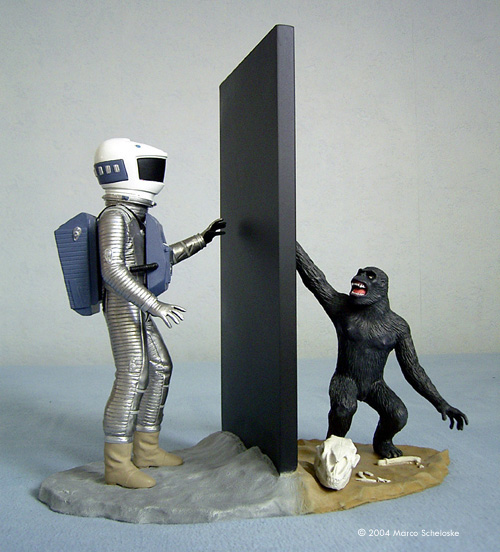


As for the parallel many have drawn between 2001's black monolith and the iPhone.... well, Joyce already covered that one with the condensed single word "iSpace" (pg. 124).

Friday, May 24, 2013

"A Typographic Confabulation with Finnegans Wake"


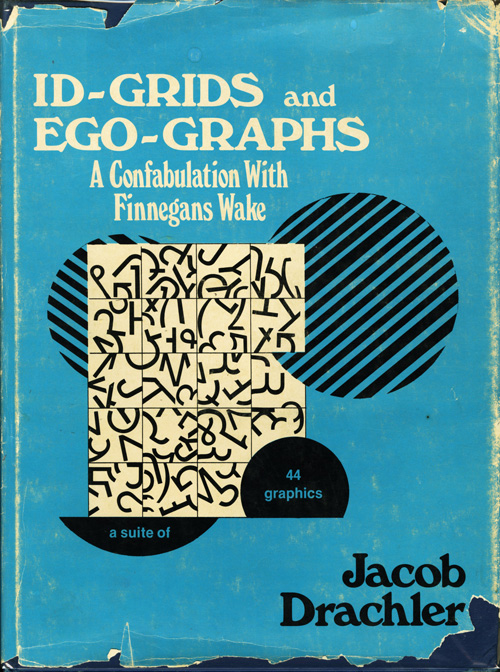
Via the essential creativity blog Brain Pickings, an old out-of-print obscure illustrated book of Finnegans Wake quotes, entitled Id-Grids and Ego-Graphs: A Confabulation With Finnegans Wake. Even though I've been a fan of the Wake for only about 5 years now, I'm pretty astounded that I'd never come across this title anywhere until today.

Go check out Maria Popova's write up for lots of images from the book. Here's a sample:

Beautiful. 

Feels like a prefiguration of Stephen Crowe's artistic experiment with illustrating the Wake one page at a time.

Wednesday, April 24, 2013

Joseph Gordon-Levitt Recites from Finnegans Wake


Page 439 from rcjohnso on Vimeo.


A nicely done visual adaption/image collage with Joseph Gordon-Levitt (of Inception and 3rd Rock from the Sun fame) reciting a page from Shaun's lustful lecture to a bunch of young Catholic school girls in Book III, Chapter 2.

I'd love to hear more stuff like this. The Wake is ripe for interpretive recitation by actors.

Tuesday, April 23, 2013

Reading Group Reminiscences

As it so often tends to do, the Wake made its omniscience humorously obvious to the participants of our latest reading group here in Austin. Prior to digging into the text, we had some discussion about the big Finnegans Wake promotional campaign to promote the first ever Chinese translation of the book, talked about the book's seeming awareness that the reader is reading it, and also about cities as living beings.

We should not have been surprised when, in the course of the two pages we studied, the Wake winked at us with a couple lines that sounded like Chinese, referencing Confucius and other Chinese elements (bottom of pg. 131) while the next page had, among many references to the nature of cities, the line "weighs a town in himself."

I would've liked to have kept thorough notes on all of the Wake meetings we've had here in Austin as well as the other ones I've been to but unfortunately it hasn't worked out that way. I do, on the other hand, know which pages we've looked at in every Wake group I've ever been to and so here I would like to share one or two lines from the different Wake groups I've attended and reflect on those a bit.

Tuesday, March 26, 2013

Finnegans Wake Billboards in China

Billboard in China promoting Chinese translation of Finnegans Wake.
(Photo credit: Ng Han Guan, AP)

Right around the time of James Joyce's birthday (February 2nd) this year the newswires were all buzzing about Finnegans Wake. The first-ever Chinese translation of Joyce's notoriously opaque masterpiece sold out of its first 8,000 copies in China after a big advertising campaign helped spread the word around.

There are so many strange things about this story, but this part is my favorite:
The book, widely considered Joyce's most experimental and inscrutable work, was promoted by an unusual billboard campaign in major Chinese cities — with 16 of them in Shanghai alone. The official Xinhua News agency said it was the first time a book had been promoted that way in China.
There were 16 billboards throughout Shanghai (in the 21st Century) ADVERTISING A NEW EDITION OF FINNEGANS WAKE.

This is something out of an alternate universe, a hilarious Joycean oddity just like the other recent bit of Joyce news.

What's so funny about this is that Finnegans Wake is filled with advertisements and references to advertising, starting with the second page: "the skysign of soft advertisement!" The key role of advertising is made clear on page 181 where there's an ad referring to Joyce himself, sounding like a a hilarious parody of a singles ad on Craigslist:
[Jymes wishes to hear from wearers of abandoned female costumes, gratefully received, wadmel jumper, rather full pair of culottes and onthergarmenteries, to start city life together. His jymes is out of job, would sit and write. He has lately commited one of the then commandments but she will now assist. Superior built, domestic, regular layer. Also got the boot. He appreciates it. Copies. ABORTISEMENT.]
Joyce was very aware of the growing industry of advertising and how important it would become in modern society. His most famous character, Leopold Bloom in Ulysses, was an advertisement canvasser by trade and throughout his daily musings he ponders creative ad ideas and "the infinite possibilities hitherto unexploited of the modern art of advertisement."

I can't find any academic studies of the importance of advertising in Joyce's work so it's certainly something to look deeper into. Maybe sometime down the road I'll take a crack at exploring it more fully. Leaving aside Bloom's myriad advertising thoughts, the Wake alone is absolutely flooded with ads (just like pop-up ads, since the Wake is after all a lengthy premonition of the web surfing experience). The FWEET search engine shows 63 different references to advertising that you can look at and I'm sure they've barely scratched the surface.

For now I'm still soaking in the surreal nature of the Finnegans Wake billboard campaign in China.

Thursday, February 28, 2013

A Multimedia Examination of "The Mime of Mick, Nick, and the Maggies"

As the massive glittering galactic dream of Finnegans Wake proceeds along, its universal sleeper falling deeper into unconsciousness, the book's content becomes darker, denser, deeper until we reach the most difficult (and multi-allusive) chapters at the very center. As dawn grows nearer, the book grows a little bit lighter until the gorgeous poetic prose of the early morning hours represented in the final chapter.

The first chapter of Book II sets off a stream of difficult but resplendent material with a detailed playbill for "The Mime of Mick, Nick, and the Maggies" (p. 219) featuring all of the book's characters putting on a show in the "Feenichts Playhouse". The play revolves around the children of the book: Mick (the twin brother Shaun representing the Archangel Michael), Nick (twin brother Shem representing Lucifer or the Devil), and the Maggies (little sister Issy and her friends, representing the colors of the rainbow). The playbill promises to enact "a Magnificent Transformation Scene showing the Radium Wedding of Neid and Moorning and the Dawn of Peace, Pure, Perfect and Perpetual, Waking the Weary of the World" (p. 222), a sentence which sounds like a promotion for the Wake in its entirety.

Sunday, February 3, 2013

Glossing The Wake Through Two Pictures

"wipe your glosses with what you know" - FW p. 304

During some pretty idle and aimless book perusing and internet browsing I came across two images which I decided are good illustrations of important elements in Finnegans Wake. A saying goes that if a picture is worth a thousand words then a symbol is worth a thousand pictures. Let's take a brief look at how these two symbolic pictures sum up massive pieces of the Wake.


This is a woodcut by Japanese artist Utagawa Hiroshige from 1853. In imagining the recurring "characters" of Finnegans Wake, a family of five (sort of), I've found that it helps to maintain the idea of these figures as morphogenetic organic elements, not as individual people. A seemingly simple nature scene such as this one then manages to serve as a family portrait when you consider each character's earthly element:

HCE as Mountain
ALP as River
Shem as Tree
Shaun as Stone
Isabelle as Cloud

That's entirely what's represented in that picture. "Because it's run on the mountain and river system" (FW 288.F3). If you want to count the image in the Wake of the Chapelizod pub in which this "family" sleeps you can even find some little buildings in there.

This next one is both simpler in its representation and more difficult in concluding what exactly it means in the Wake.


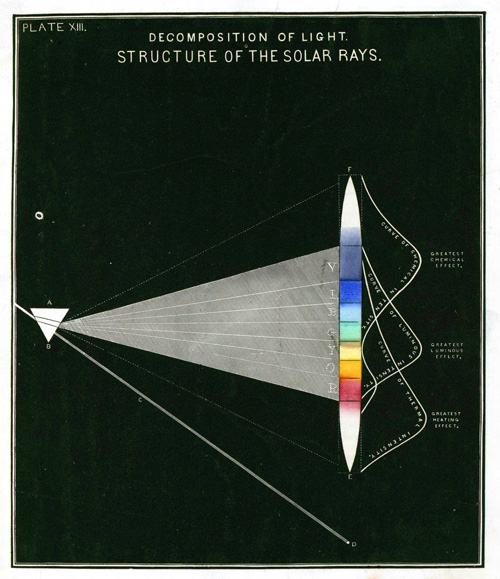
Pretty familiar scene there. What's it got to do with the Wake?

From first page to last, Finnegans Wake is positively loaded with rainbows. The entirety of the 1st chapter in Book II, the stage play of "The Mime of Mick, Nick, and the Maggies" (the enactment of "a rainborne pamtomomiom" as p. 285 describes it) frequently features the seven colors with a dance of the seven rainbow girls who are described in endlessly varying names which always refer to the seven colors, as in "Rose, Sevilla ... Cintronelle ... Esmeralde, Pervinca ... Indra ...Viola" (p. 223) or, spelling out the acronym RAYNBOW on pg. 226:
"R is Rubretta and A is Arancia, Y is for Yilla and N for greeneriN. B is Boyblue with odalisque O while W waters the fleurettes of novembrance."
Page 247 has the line "Split the hvide and aye seize heaven!" which indicates splitting the white (Danish "hvide") so the eye sees seven colors.

In the final chapter of the book, there's a debate between Bishop Berkeley and St. Patrick revolving around light and the visible universe in which the druid Berkeley refers to "the his heptachromatic sevenhued septicoloured roranyellgreenlindigan" (p. 611). There are many interpretations as to the importance and meaning of the recurring rainbows and Joyce himself indicated in his letters that the book features an elaborately developed theory of colors. John Bishop in his outstanding study Joyce's Book of the Dark devotes a lengthy chapter (entitled "Meoptics") to exploring the idea that the Wake's play of colors represents visions streaming across the inside surface of the eyelids of the sleeping person within whose body (Bishop argues convincingly) the whole book takes place. In the midst of his exegesis, we're led to some very intriguing considerations of the human eye, a fleshy filmscreen and projector. (I'll have lots more to say about Bishop's great book and his unique ideas very soon.)

Coming back to the organic scene from the first picture, I'm led to think about the bright white light of the sun interacting with the waters of the river mother evaporating into mist and daughter clouds whose raindrops bend light into rainbows, the rain eventually falling down the slopes of a mountain and turning back into a river ("Because it's run on the mountain and river system" FW288.F3). I could also start talking about the Wake's recurring use of the word "heliotrope" and moving towards the sun but I'll stop here...