Sunday, February 8, 2015

JoyceGeek, Jorn Barger's Return, and other new Wake links


"They had heard or had heard said or had heard said written."   
- FW p. 369 

"For a surview over all the factionables see Iris in the Evenine's World." 
- FW p. 285

The links section in the sidebar of this blog needs updating now with some fresh new Finnegans Wake-focused blogs popping up around the web. Here is a look at some of the great websites I've found recently, some new, some have been around for a little while but slipped through the cracks.


JOYCEGEEK
The notable performer of Wake pages, actor Adam Harvey of New Mexico, has begun his own website called JoyceGeek. This is exciting news as Adam is one of the more knowledgable Wake heads out there. One of the few people in the world who can recite pages-upon-pages of the text from memory, Adam is exactly the kind of evangelist the Wake needs in our world today. Watch him perform the end of the Shem chapter (from memory) here. He hosts a Joyce reading group in Santa Fe, New Mexico and has frequently performed sections of the Wake at Joyce conferences. Most recently he did a show called "Don't Panic it's only Finnegans Wake" that looked really interesting. In that show Adam delivered some audiovisual tutorials on how to recite words or portions from the Wake, on his website you can find videos he's put together breaking down each of the 10 hundred-lettered thunderwords in the Wake. (Though I'm somewhat disappointed he didn't mention any of the material from Eric McLuhan's The Role of Thunder in Finnegans Wake.)

He also writes a blog which already has many interesting posts, the most recent of which examines the available Finnegans Wake audiobooks. Adam is not a particularly huge fan of the Patrick Healy recording, mainly because he feels Healy rushes through the text too much. (I used Healy's recording often during my full-length Wake dive and found it to be pretty fun, but I understand Adam's point.) He also links to a recording of most of the text done by Simon Loekle which I hadn't previously been aware of.


Patrick Horgan's Reading
During our last Austin Wake Reading Group meeting before Christmas, we had some visitors from the NYC Wake group who took part in our reading. One of the visitors, Suzanne from Brooklyn, alerted me to Patrick Horgan's full rendition of Finnegans Wake, a recording he made for the National Library Service for the Blind and Physically Handicapped. Adam mentions this recording in his JoyceGeek post too, it's a really phenomenal performance, definitely far superior to Patrick Healy (whose recording I long thought was the only one available online). Horgan savors the multilingual and rhythmic prose, often adopting an ambiguously European accent that hearkens back to the expressive way Joyce himself performed a few pages in his 1929 recording. I've used Horgan's recording often during my preparation for recording the Yawn chapter for the upcoming "Waywords and Meansigns" project.


The return of Jorn Barger?
One of the things Adam Harvey wrote about on his blog is the loss of so many great websites devoted to James Joyce that now seem to be defunct, lost in the electronic ether (though they remain alive in the internet archives!). One of these happens to be Robot Wisdom, one of the web's original weblogs that was assembled by the mysterious and hirsute character known as Jorn Barger. Jorn is one of the earliest internet users (he coined the term "weblog"), an artificial intelligence aficionado, literary scholar and most importantly, a renowned expert on the work of James Joyce. His now-defunct (but archived) "IQ Infinity" page had tons and tons of notes on all of Joyce's work, most notably lots of material on the early drafts of Finnegans Wake. While the Robot Wisdom website went down a while back, I've noticed a few new Wake blogs have popped up with extremely thoroughgoing genetic analysis of the text and I strongly suspect that these blogs could be the work of Mr. Barger.

See for yourself:
Finnegans Wake Origins
Finnegans Wake Annotated
Etcetera Etcetera


FINNEGANS AWAKE
This Tumblr page has quickly become one of my favorite things about the internet. FINNEGANS AWAKE is absolutely filled with Joyce-related material with an emphasis on FW. It is an overflowing wealth of photos and quotes and artwork that one can easily get lost in. Really, go there now and scroll through the archive for a few minutes and see if you don't get completely absorbed into it. There is soooooo much great material there. THANK YOU to whoever created this thing and please keep up the great work.

Work in Progress manuscript page seen at FINNEGANS AWAKE.

Alternate cover for the latest edition of FW by Eoin Ryan,
seen at FINNEGANS AWAKE.


Vagabond Bohemia
On a similar note, while not strictly focused on Joyce, this Tumblr page is also a new favorite of mine. Plenty of Joyce material as well as a whole universe of artwork, plus Thomas Pynchon, Marshall McLuhan, Salvador Dali, Robert Anton Wilson, and other great explorers of the frontiers of the mind.
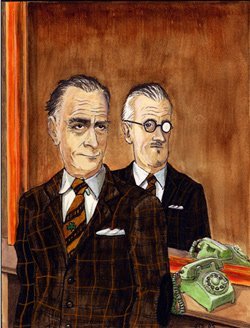
Cryptic Tricksters by Circumambient Peripherization [McLuhan & Joyce]
spotted at Vagabond Bohemia


Wake in Progress
This is not new of course, I've posted about Stephen Crowe's wonderful illustrations of the Wake before, but I just want to call attention to it once more because Stephen continues to update his page regularly and even has some good short essays to read. Check out his recent thoughts on reading the Wake.


The Grammar of Matter
Stumbled upon this extraordinary and quirky blog recently, it contains writings on a number of topics but mostly (as far as I can tell) revolves around archaeology and Finnegans Wake. This all springs from a thesis the author wrote about prehistoric rock art and the Wake. Following that thesis, the author examines archeology and mythology through the Wake as a lens. Robert Anton Wilson called Joyce "the greatest anthropologist who ever lived." This author seems to explore this possibility. It's exactly these kinds of eclectic and fascinating webpages that make the internet so damn special to me. Use this link to see all the Wake-related posts.


The Joyce Project
Lastly, it isn't specifically related to Finnegans Wake, but there is a new project devoted to creating a hypertext version of Ulysses with annotations and links embedded into the text. Worth a look.

Sunday, January 18, 2015

Frank Delaney Describes Finnegans Wake Perfectly

Irish novelist and public intellectual Frank Delaney, who NPR once declared to be "the most eloquent man in the world," hosts a weekly podcast called "Re-Joyce" devoted to deciphering the pages of Ulysses basically one paragraph at a time. After every twelfth episode of the podcast he delivers a so-called "baker's dozen" episode devoted to miscellaneous Joyce topics.

The latest episode answered a listener's question about how best to approach Joyce's work, and Delaney responded with a rundown of each of the books in Joyce's canon. This gave him an opportunity to riff on Finnegans Wake which he does only rarely on his show. His description is quite beautiful:
Finnegans Wake is not a novel....No! No! Finnegans Wake is a poem, it's a symphony by a modern atonal composer. It's an assembly of language tying together floating evanescent ideas. It's a long rapid eye movement dream, it's a marathon technicolored musing that might have been induced by mescaline or LSD...It's a seemingly reckless careening through English and other languages. Yet you know that every word has been considered in this hodgepodge potpourri of miscellaneous and not always aligned thoughts and ideas, in this flamboyant and brilliant linguistic exercise that mimics the intensely illustrated pages of a medieval Irish manuscript. It's a massive rap, as in rapper, as in street talk, as in lingo, as in the heat of the day and the cool of the night captured dreamily and melodiously in words of all shapes and sizes. It's a mirage.
Do not read FW. Feel it. Dip into a page, any page, and if you find something that lights up your synapses, enjoy it... Read Finnegans Wake on any page at any time, and listen to it. Feel the words in your mouth and smile. But above all else: feel it in your spirit.
He also mentions he hopes someday some brave soul will embark on a full explication (to whatever extent that's possible) of the Wake in a podcast or some other medium. After practicing recently for the upcoming Waywords and Meansigns recording project for which I'm doing a chapter, and being surprised at how I wasn't too terribly disgusted by the sound of my own recorded voice, I'm beginning to give consideration to creating a Finnegans Wake podcast sometime down the road. There's a tiny but devout and growing group of Wake devotees around the world, too, so don't be surprised to see it happen in the not too distant future.


(Thank you to Peter Chrisp of the fantastic blog Swerve of Shore to Bend of Bay for calling my attention to this.)

Wednesday, December 10, 2014

New Finnegans Wake Audio Recording Project "Waywords and Meansigns"

Some extremely ambitious Finnegans Wake fans have organized a project to create a new audio recording of the text in its entirety.

From the group's website:
Waywords and Meansigns is an upcoming audio version of James Joyce's famous text, Finnegans Wake, to be read in its entirety. The book will be divided into 17 sections, and there will be a different music/reader/performance group assigned to each section. Featuring established as well as up-and-coming artists, Waywords and Meansigns will offer a version of Joyce's work that is stimulating, accessible, and enjoyable to even the most casual of readers and listeners.
The project will feature various artists, musicians, and other daring creative folks who will each record one of the book's 17 chapters in full. I have signed on to create a recording of one of my favorite chapters, the "Inquest of Yawn" (Book III, chapter 3). Participants are free to add whatever music or effects they want and interpret the text through their reading however they see fit.

I love this idea. This is something Finnegans Wake has needed for a long time, a true Here Comes Everybody recording. It is a book that's meant to be heard, after all. Listening to James Joyce read a few pages from it aloud seems to open up the entire text to new possibilities. When I embarked on a cover-to-cover reading of the book, I found it essential to listen to Patrick Healy's recording in order to appreciate the text's river-like, meandering, extending flow and cacophonous play of consonants and vowels.

Not only to hear it, but to actually read it aloud or perform it really enhances and amplifies the Wake experience. It's a challenge for your mouth; occasionally the extraordinary patterns of employing the lips, tongue, and teeth will cause one to break out into laughter. Take the following passage, for instance.
"For, with that farmfrow's foul flair for that flayfell foxfetor, (the calamite's columitas calling for calamitous calamitance) who that scrutinising marvels at those indignant whiplooplashes; those so prudently bolted or blocked rounds; the touching reminiscence of an incompletet trail or dropped final; a round thousand whirligig glorioles, prefaced by (alas!) now illegible airy plumeflights, all tiberiously ambiembellishing the initials majuscule of Earwicker" - FW, p. 119
To navigate a reading of that passage is to maintain the inflection of one expanding sentence with many interruptions, while encountering strange Joycean mutant words like "whiplooplashes" and "plumeflights" and immediately judging their pronunciation. There's also plenty of fun alliteration. In fact, that snippet encapsulates the reading experience pretty well. It's actually a passage describing the very nature of the Finnegans Wake text itself, taken from a chapter (Book I, ch. 5) that serves as a primer for how to read this bizarre book. It's all about the sound. As readers, we've become so used to eyeing the page and determining meaning from the letters we see. The Wake seeks to reawaken the sound of language, opening up the larger possibilities of the spoken word from which language originally sprung, "here keen again and begin again to make soundsense and sensesound kin again." (FW p. 121)

I look forward to recording my contribution and hearing the rest of the recordings in the "Waywords and Meansigns" project. It'll be a challenging endeavor for all involved, but it also promises to be lots of fun. I'm thankful for the brave souls who are putting it all together and wish them the best of luck.

Saturday, November 1, 2014

Book Review (Part 4 of 4): Joyce's Book of the Dark by John Bishop


"For too long were the stars studied and man's insides neglected. An eclipse of the sun could be predicted many centuries before anyone knew which way the blood circulated in our own bodies."
- James Joyce 

The eighth chapter of Finnegans Wake is perhaps its most famous section. Known for containing the names of over a thousand of the world’s rivers embedded in its prose, the chapter is devoted to the mother goddess archetype in Joyce’s mythology, the river-woman Anna Livia Plurabelle, “angin mother of injons… the dearest little moma ever you saw” (FW p. 207). In Joyce’s numerology the number 8 is associated with the female, the feminine life-renewing energy, perhaps because 8 is the symbol of infinity ∞ upright. In Ulysses, the 18th chapter is dedicated to Molly Bloom's final soliloquy consisting of 8 long sentences, and her birthday is on September 8th (also the birthday of the Virgin Mary). The centrality of the female in his final work is hinted at right from the opening word of Finnegans Wake, “riverrun” which contains 8 letters.

James Joyce considered the Anna Livia Plurabelle (ALP) chapter to be the showpiece for his entire book. It was his pride and joy, the chapter upon which he was “prepared to stake everything." While the public and his own supporters were questioning the merit (and sanity) of the early published fragments from his Work in Progress, Joyce declared in a letter to his patron “either [ALP] is something, or I am an imbecile in my judgment of language.” Fellow Irishman James Stephens agreed, declaring it to be “the greatest prose ever written by a man.”

Joyce went through seventeen different revisions of the chapter during the Wake’s creation, constantly weaving new river names and foreign words into its pun-laden network, while exhausting himself into a “nervous collapse,” as he told Ezra Pound, from the thousands of hours he worked on it.

The chapter opens with the text forming a triangular shape, the delta symbol ∆ of ALP:

O
tell me all about
Anna Livia! I want to hear all
about Anna Livia. Well, you know Anna Livia? Yes, of course,
we all know Anna Livia. Tell me all. Tell me now. (FW p. 196) 

The ALP chapter consists entirely of a dialogue between two washerwomen scrubbing clothes on opposites sides of a river while chattering and gossiping to each other about ALP and her husband. All throughout the chapter, the inquisitive washerwoman (later referred to as “Queer Mrs Quickenough” FW p. 620) excitedly begs her opposite (“odd Miss Doddpebble” FW p. 620) to divulge more about Anna Livia: “Onon! Onon! tell me more. Tell me every tiny teign. I want to know every single ingul” (FW p. 201). As the chapter comes to a close, night begins to fall, the river widens and rushes more loudly, and the two women can no longer hear each other over the “hitherandthithering waters of. Night!” (FW p. 216).

A beautiful audio recording from 1929 captures Joyce reciting the closing pages of ALP with a playful and theatrical brogue, giving us our one single glimpse at how he intended his enigmatic work to sound. It’s noticeably mellifluous and musical, with Joyce rolling his r's and lilting the vernacular between the two chattering washerwomen.

John Bishop acknowledges that this flowing sonority is the most frequently praised feature of the chapter, but as with the rest of the Wake though, there is so much more to this poetic prose than its "sounddance" (FW p. 378). Initiating the need to explore deeper into the sediments of ALP, Bishop admits: “Not many readers, however, are likely to struggle through very many pages of prose so torturous as the Wake’s simply because, though they may not mean anything, they sound nice.” It is this often overlooked meaning that Bishop endeavors to elucidate.

For the ultimate crescendo of his unique and fascinating analysis of the Wake, Bishop devotes the final chapter of his Book of the Dark study to an investigative plunge into the “riverpool” (FW p. 17) of Anna Livia. With Joyce putting so much emphasis and hard work into his showpiece chapter, Bishop surmises, “we might make the chapter something of a test case of the book as a whole.” Similarly, while there are so many great insights throughout Bishop's Book of the Dark, its final chapter is so rich, enlightening, original and compelling that it could in fact stand as a “test case” for Bishop’s book as a whole. So, to conclude this lengthy summary of Bishop’s delightful and dense book, we shall take a close look into this last chapter, which he entitled "A Riverbabble Primer."

Emphatically putting the final flourishing touches on his fascinating and well-argued thesis that Finnegans Wake represents a rendering of the sleeping state of one man, Bishop takes a microscope to the vivacious streams of the ALP chapter to confirm his theory. He finds ALP’s massive network of rivers is undulating with the sound and pace of a pulse. In short, Bishop argues that the riverwoman Anna Livia Plurabelle represents the watery bloodflow heard pumping inside the sleeper’s body throughout the night.

This accounts for the overall back-and-forth dialogue structure as well as the recurrent rhythm of twos found “ufer and ufer” (FW p.214) again, echoing the binary sounds heard in “the pulse of our slumber” (FW p. 428). The sleeping mind absorbs and amplifies these sounds, unconsciously creating the dream association of flowing rivers until the sleeper becomes immersed in a “watery world” (FW p. 452).

Bishop extends this thread of logic further until we envision the sleeper lying in "foetal sleep" (FW p. 563) with the sounds of pulsing bloodflow triggering reminiscence of and regression to the prenatal bliss of "whome sweetwhome" (FW p. 138) when he was united with the body of his mother or “himother” (FW p. 187). Two hearts beating as one, “uniter of U.M.I. hearts…in that united I.R.U. stade” (FW p. 446).

Of course this is a very radical and unique idea, unlike any interpretation of ALP any Wake scholar has put forth before. It's also fun to ponder and Bishop, a scholar with about as much knowledge about Finnegans Wake as anyone else in the world (he’s been reading it for over 40 years and wrote the introduction to the Penguin edition), presents a most compelling case with his often spellbinding wizardry of exegesis.

Wednesday, October 22, 2014

Finnegan Wakes! as a Royal

"A being again in becomings again." - Finnegans Wake p. 491

I'm pleased to report that Finnegan has reawakened and is participating in this year's World Series.

A young hard-throwing southpaw named Brandon Finnegan is pitching out of the bullpen for the Cinderella story Kansas City Royals. "A kingly man, of royal mien" (FW p. 68) baseball's new Finnegan "our goodsend Brandonius" (FW p. 327) will become the first player ever to participate in both the College World Series and the Major League Baseball World Series in the same year. A scant five months ago the 21-year-old kid was sitting in a college classroom here in Texas.
Finnegan was selected 17th overall out of TCU in June. The 21-year-old made 13 minor league appearances (five starts) split between High-A Wilmington and Double-A Northwest Arkansas before being promoted to the majors in September. Finnegan was the first 2014 draftee to earn a big league promotion. http://nesn.com/2014/10/brandon-finnegan-could-make-history-play-two-world-series-in-same-year/

Surprisingly, Mr. Finnegan is the first ever representative of the Finnegan tribe in MLB history. (There's been a few Finnegans in the minors, none of them named Tim though.)

"Our goodsend Brandonius" (FW p. 327) is wearing jersey number 27.


Through the bizarre magic that Finnegans Wake always creates, if you open to page 27 of the book you'll read: "a blue streak over his bourseday shirt."

And we find "Brandonius" on page 327.

James Joyce laughs.

Friday, September 26, 2014

"Surfing Finnegans Wake" with Terence McKenna


This came up in our last reading group so I figured I'd share it here.

This is Terence McKenna, a celebrated philosopher/ethnobotanist/psychedelic researcher/lecturer and eloquent Irishman known as the Bard, devoting a couple hours to lecturing about Finnegans Wake. He reads from a few pages, dissects them a bit, ponders the psychedelic universe Joyce placed inside a book, and even branches off into talking about Marshall McLuhan.

In a world where seemingly everything is on YouTube, there are surprisingly few recorded discussions related to Finnegans Wake. McKenna's gift for gab is a perfect fit for Joycean reading-and-exegesis, making this a very special rare gem.

Enjoy.

(Note: He does have a few odd gaffes---calling Joyce a British writer and locating Chapelizod in London instead of Dublin---but otherwise his info is sound.)

Friday, August 8, 2014

When James Joyce went to Africa on a Word-Hunting Safari


(IMPORTANT PRELIMINARY NOTE: I had some suspicions that this was somehow a fictional account. It didn't seem possible to me that Joyce's many biographers would have overlooked such an unusual expedition undertaken during the peak of his fame in the 1920s. Peter Chrisp, whose Swerve of Shore to Bend of Bay blog is a must-read for Joyce fans, confirmed for me that this was indeed a mental rather than a physical trip to Africa. The biggest clue comes from the essay's opening quote in French which translates to: "What's the good of moving when you can travel so magnificently in a chair?" I was tricked. Nevertheless, it's still a fun story to read.)


In 1924, while in the early stages of drafting, pondering, and scribbling notes for what would eventually become Finnegans Wake, James Joyce made two separate trips to Africa... to go word-hunting.

That's right. Joyce, half blind, ventured to the heart of Africa (twice!) to essentially capture some rare and unique words and languages in a butterfly net.

Joyce scholar Robbert-Jan Henkes writes about this in his essay "James Joyce in Africa: An Expedition to the Sources of the Wake" available in entirety here, but strangely there is no mention of these journeys in any of the Joyce biographies. Henkes' essay appeared in the Genetic Joyce Studies scholarly journal so please be forewarned that the genetic studies folks tend to break things down to the most minute elements as transcripted (often sloppily) in Joyce's notebooks. This also appears to be why nothing about these African word safaris have appeared in Joyce material before, the scholarly community only just recently picked up on it from sifting through his travel notebooks. (See note below.)

Henkes uncovers that Joyce was following in the footsteps of Scottish missionary and linguist Dan Crawford who published two books about his African journeys:
Joyce, on his word-safari, followed the itinerary of the two books of Crawford closely, and he brought home many specimens of ‘black thinking’, 103 from his first trip and another 75 from his second one. And from these specimens, a good many found a place in Finnegans Wake: 24 straight from the travel notes and another 21 via the transcription of the notes by Mme. Raphael in the 1930s, so you could say that the expeditions were fruitful.
Joyce absorbed a great deal of words, phrases, and tribal/native perspectives not only from these journeys but from the reflections contained in Crawford's travel books. The essay notes: "This will be typical of Joyce’s collecting procedure and we will see that during the entire journey he will alternate specimens of African ways of saying with noteworthy expressions from Crawford’s hand." Among his eloquent considerations, Crawford wrote that "night blots out the world to reveal a universe" and one can imagine this idea enhancing Joyce's intentions to devote his new and unformed book to the night world.

Among the lexical specimens Joyce acquired were phrases like "talkingtree" which were the name for trees that had writing carved into them, and "shadowstealer" which is what the natives called photographers. But more tellingly, the blind poet learned the ways of the native people who sleep outside in pitch black darkness surrounded by jungle:
Making his way through the jungle in the direction of Lake Mweru, Joyce was struck by the quantity of fruit on the trees. Not all fruit was edible, but how could you find out? Simple. Crawford: A good old rule I find workable is the eating of any fruit nibbled at by the monkeys.’ After which Joyce noted stenographically: ‘what monkeys eat / Man’. The dense African forest by night was full of sounds, all intimately known to the native. Crawford: “For the hundreds of night-sounds — rustlings, twitterings, raspings, tinglings, and roarings — are all known to even Africa’s tot, the ears being called his ‘eyes of darkness.’” These two poetical observations both made it into the Wake. The night sounds appear in I.4 on FW 095.31, when the ‘fourbottle men’ are discussing how Anna Livia got lost in he woods, and the ear as the eye of the dark is now in I.1 on FW 014.29: ‘lift we our ears, eyes of the darkness from the tome of Liber Lividus’.
The Wake is loaded with references to Africa. Besides containing a multitude of African languages or "darktongues" (FW p. 223)* Shem is called a "Europasianised Afferyank" (p. 191) and Anna Livia Plurabelle "our turfbrown mummy" (FW p. 194) has many African qualities. Sheldon Brivic has a whole chapter devoted to ALP's Africanness in his book Joyce's Waking Women where he states that "her African features proliferate as central determinants of her role." There are also frequent references to the Victoria and Albert Nyanzas, two lakes in Africa believed to be the sources of the Nile River.

*Karl Reisman has written a great deal about "the Affrian Way" (FW p.497) in FW at his blog here.

It is the non-visual, ear-opening perspective I find most intriguing out of all this, though. With Joyce's book of the dark, he really tried to reawaken a pre-industrial, ancient tribal oral tradition, to reawaken the sense of hearing. Simply eyeing the Wake's unconventional and original linguistic constructions certainly has great appeal and could keep a reader coming back to it forever but to hear this bizarre poetry bouncing around through time and space often sounds to me delightfully disorienting. Noted Wake evangelist Marshall McLuhan held the theory that Joyce was preparing us for our cyclical re-entry into tribalism, the electronic global village, through his all-inclusive book of "broken heaventalk" (FW p. 261).

If you could withstand a little scholarly pedantry and minuscule nitpicking, I highly recommend going to check out Henkes' piece. It even has a grainy picture of Joyce in safari gear.