Thursday, October 10, 2013

The Night Owl Wake Reading Group

I've been to three different Finnegans Wake reading groups before (including my own here in Austin) and each of them would focus in their efforts on just 2 pages or so, but I remembered meeting someone at the Venice Wake group in California who had participated in a group with a much different approach. They would gather in a used bookstore at closing time on Sunday nights and take turns zipping through the text reading aloud.

This, to me, exemplifies the opposite though equally rewarding approach to experiencing the Wake---instead of parsing through each polysemic element on each page like a physicist cracking open matter to its deepest fractal units and appraising the structure of it all, you can also simply let the text sing and dance in its unique way by reading it aloud for pages at a time (or listening to a recording of it).

I reached out to Derek G. who was part of that rapid-recitative-reading group and he responded with some very thoughtful details about it, which I would like to share here:

Yes, though I wouldn't exactly describe them as speed-readings; we would gather around in a circle at Alias Books, lock the doors, and read out loud. We met every Sunday @ 11pm, and would average about 20-40 pages per mtg. It took us about 7 or 8 months to finish the book. This was the first book to kick off our Night Owl bookgroup (running about four years now), and we would experiment with our reading of it. We began reading it conventionally, falling into the normal trap of using conventional language: it must have one setting, one plot, each word must have only one meaning, the book must have one overall message. After discovering how FW aims to destroy this mode of thinking, we decided to experiment with our reading, not take the book so seriously, and let the experience of reading it takeover. 
For instance, during one reading--I wish I could remember where we were in the book--for some reason, almost simultaneously, we all got up and started walking around the bookstore in a single file line, up and down the aisles, until either the page or the paragraph was finished. I do remember we were a fair way through FW, and had learned how to read its rhythms and pauses, and somehow we all agreed to physically mimic them in that one moment. FW is in part an invitation to performance art, as well as being a drama. 
This is probably the best advice I know to give to readers of the Wake: let the text show you how to "read" it, how to perform it, what to do with it, how to use it. Because FW is a book about what has happened as well as what will happen--Joyce was a very unique kind of prophet--FW asks us to pay some attention to the present moment, and to the specific point in time that we are reading it. And as we read it, it read us: collectively, and, in its curious way, individually. 
Another recommendation: private reading. FW has too often been said to be only accessible through out loud group readings. These are awesome ways of using FW and interacting with it, but amazingly enough, if one in isolation simply uses their visual sense on the page, they see that it is not random. Joyce favored audile and tactile senses, but did not neglect the visual. During my first reading of FW alone I thought it to be very visual. It was a giant Gesamtkunstwerk of Irish-surrealist-fantasy. The possibilities of what FW is are endless!

Tuesday, October 1, 2013

"The Broken Window of My Soul": Joyce's Horrific Eye Troubles

"If you met on the binge a poor acheseyeld from Ailing..." - FW, p. 148


This hand-drawn pencil sketch of Leopold Bloom done by James Joyce himself has been familiar to me for a little while but I recently learned the fascinating story behind it thanks to a post over at OpenCulture.com.

Quoting from the post written by Mike Springer:
After his seventh eye operation on December 5, 1925, according to Gordon Bowker in James Joyce: A New Biography, Joyce was “unable to see lights, suffering continual pain from the operation, weeping oceans of tears, highly nervous, and unable to think straight. He was now dependent on kind people to see him across the road and hail taxis for him. All day, he lay on a couch in a state of complete depression, wanting to work but quite unable to do so.”
In early 1926, Joyce’s sight was improving a little in one eye. It was about this time (January 1926, according to one source) that Joyce paid a visit to his friend Myron C. Nutting, an American painter who had a studio in the Montparnasse section of Paris. To demonstrate his improving vision, Joyce picked up a thick black pencil and made a few squiggles on a sheet of paper, along with a caricature of a mischievous man in a bowler hat and a wide mustache–Leopold Bloom, the protagonist of Ulysses. Next to Bloom, Joyce wrote in Greek... the opening passage  of Homer’s Odyssey: “Tell me, muse, of that man of many turns, who wandered far and wide.”

The famous Bloom sketch, it turns out, was drawn so Joyce could prove he was able to see out of his badly damaged eyes.

One of the things that fascinates me most about Finnegans Wake is the story of its creation. Joyce labored intensely on what he considered his magnum opus for 17 years, during which time both his daughter and his son's wife suffered mental breakdowns, most of his supporters accused him of wasting his talent or losing his mind, Ulysses (though it received lavish praise from most critics) was confiscated, burned and banned in English speaking countries, and worst of all, he suffered terribly through numerous diseases of his eyes, undergoing more than ten surgeries to try to alleviate the issues.

For most of the time he worked on Finnegans Wake he was basically blind, peering out of a little sliver of sight in one eye. He wrote much of it using crayons, writing with huge letters on large, colored cards. "What are you doing with all those cards?" his wife would ask, to which he answered "Trying to create a masterpiece."

The eye troubles he suffered are so incredibly gruesome that they garner further elaboration. The most concise summation I've come across is from a footnote in John Bishop's superb Joyce's Book of the Dark (which I will have a full review for soon). WARNING: This material is extremely gruesome, horrific, and cringe-inducing. It will probably make your eyes hurt just reading about it.

From a footnote on page 433 of Bishop's book:
No single problem made Joyce's eye operations, most of them on the left eye, necessary. With varying constancy between 1917 and 1941, he suffered from glaucoma, synecchia, iritis, conjunctivitis, episclerotis, retinal atrophy, and primary, secondary, and tertiary cataracts---all of them painful and incapacitating disease whose gravity and scariness no healthy-sighted person should underestimate. Iritis, in early stages it is said to give the sufferer the sensation of having gritty sand in the eye, and so it forces him into incessant, involuntary tearing and blinking whose unrelieving effect is only to exacerbate the condition. Closing the eye, far from relieving the pain, deepens it, and in severe cases, the pain radiates into the brow, the nose, the cheek, and the teeth, ultimately to bring on severe headaches (see Letters, III, 113-14). While sand can be washed out of the eye, iritis cannot. It either goes away or it doesn't, and in the latter case it can spread. Left untreated, it can ravage the affected eye entirely and overtake the second by "sympathetic infection." Advanced cases of iritis were "cured," in Joyce's day, by removing the entire eyeball. Hence the earliest of Joyce's eye operations: an iridectomy on the right eye (his "good eye") in 1917 was followed by two iridectomies on the left ("the broken window of my soul" [Letters, III, 111]). 
The "cures" seems as painful as the affliction. Joyce would have been conscious during these operations, his eyelid forced back and held open with a speculum, his eyeball grasped with a pair of forceps to prevent any involuntary flinching. He would have "seen" the surgical knife, razored on both edges to allow the doctor a minimum of movement, approach his cornea and cut its way, with a sawing motion, through to the anterior chamber and then into the iris, where its work would have been to slice out any infected tissue. Joyce would have undergone in reality, in short, a kind of horror conceived in a film like Un Chien Andalou to be surreal. And he would also have had occasion, during these procedures, to consider how objects can enter the eye of a subject in ways not usually explored in Newtonian or Helmholtzian treatments of optics.
Reading that always makes me appreciate Finnegans Wake a little more for the unyielding dedication he had to completing this strange work, even while tortured by pains as rough as you can fathom. Of course, barely two years after the Wake was finally completed and published, Joyce was suffering badly from a stomach ulcer, underwent surgery to repair it, and died during the surgery. He'd put everything he had into completing a book that baffled or frustrated just about everyone who tried to read it.

Adding some intrigue to the story of Joyce's eye issues is a passage in Robert Anton Wilson's book Quantum Psychology. In discussing self-fulfilling prophecies, psychosomatics, and the power of suggestion, Wilson speculates on the possible psychological origin of Joyce's eye trouble. From pages 127-28:
Readers of James Joyce's Portrait of the Artist as a Young Man will recall the horrific opening scene, in which the child, Stephen Dedalus, becomes thoroughly terrified by a superstitious servant, who tells the boy that if he does not apologize for some unspecified "sin", eagles will come and pull out his eyes. Stephen hides under the table while the threat, with its awkward and unintentional rhyme, pounds through his mind: Pull out his eyes/ Apologize/ Apologize/ Pull out his eyes...

Joyce scholars regard this sequence as autobiographical...
When Joyce began to write novels revealing the sexual side of Irish Catholic life---the Great Unspoken Secret in that country---he became the target of a campaign of vilification almost without parallel in literary history. His eyes began to bother him. He went from one eye specialist to another, and never achieved more than temporary relief. One of the eye specialists said Joyce's problem had psychological roots, but offered no suggestions about how to reach and remove those roots. Others resorted to the knife. Joyce underwent eleven painful eye operations in seventeen years, and became "legally blind" although not "medically blind" toward the end of his life.
The fact that Joyce put the eagle/eye story at the beginning of his most autobiographical novel indicates that, on some level, he understood the "curse" that had been laid on him. It appears that, like the Polynesian tribesman victimised by the death-bone, Joyce could not resist the "curse"---despite his agnosticism and skepticism. This perhaps indicates the degree of our malleability during those sensitive moments that ethologists call points of imprint vulnerability. And it may also indicate Joyce's awareness of the pain his books caused to pious Catholics. (He never did apologize...)

Monday, September 23, 2013

Summaries and Guides to Finnegans Wake

At a recent Wake group meeting, a participant inquired about summary guides to the text. In particular, she wondered what books are out there that can help give one a sense of what a page or section is about (if FW can be said to have any real plot, that is). There are a few such guides out there and all are pretty different so I'm going to list the ones I'm aware of. This is not an all-encompassing list of books about Finnegans Wake, but a list of books that attempt to summarize or walk one through the text.

A Reader's Guide to Finnegans Wake by William York Tindall
This handy guide is perhaps the most compact of any. Tindall summarizes each chapter succinctly and in a very readable, even entertaining style. At the end of his chapter summaries are notes further expanding on particular words, lines, or paragraphs.

A Skeleton Key to Finnegans Wake: Unlocking James Joyce's Masterwork by Joseph Campbell and Henry Morton Robinson
Certainly the most well-known guide, it's the first ever attempt to crack the Wake's code, written just 5 years after Joyce's book was originally published for a baffled and disinterested world. This was my first experience of the Wake (I read it during an unemployed summer in 2008). The most valuable thing about this book is (in my opinion) its introductory section which provides some of the best overall descriptions of the book ever written. The remainder of this hefty tome attempts to turn the prose of Finnegans Wake into a much easier-to-comprehend form of English while inserting frequent commentaries to alert the reader as to what is going on at any particular point. I once talked to Joyce scholar Sheldon Brivic about it and he called this the "Disney version of FW"---it's certainly an adequate introduction but tends to leave out so much important material so as not to overwhelm the new reader. It's also frequently criticized for some of its narrow interpretations which have now become outdated. Nevertheless, I highly recommend this book to anyone interested in the Wake and it will always be the book that officially started my own Wake obsession.

A Guide through Finnegans Wake by Edmund Epstein
I've found this to be the weirdest Wake guide thus far. Epstein's interpretations tend to stray away from everyone else's, sometimes to the point of absurdity, yet he also occasionally seems to catch things the other books don't. Similar to Tindall's book, he summarizes each chapter in an accessible manner. I wouldn't recommend this one, though, as it will probably only serve to confuse one further unless reading it alongside other summary guides.

Joyce's Kaleidoscope: An Invitation to Finnegans Wake by Philip Kitcher

One of the newest books on this list, giving one optimism for the future of Wake studies. The author is a philosophy professor at Columbia University and provides a pretty standard, approachable, and (as far as this can possibly apply to a book like the Wake) understandable overall outlook on Joyce's kaleidoscopic masterwork. Interspersing personal reflections and experiences with philosophical and psychological interpretative threads, this provides a solid introduction to the Wake with a chronological summary of each chapter. While I enjoyed this book, I admit that I was hoping for something a bit more shocking and exciting in its originality (because of the great title). Instead, it's a very readable, well-informed and up-to-date summary of Joyce's dense dream book. Certainly serves to entice the new reader to explore things more deeply.

ReJoyce by Anthony Burgess
I wrote a full review of this book a few years back on my other blog. I consider this a very valuable and approachable intro to Joyce and it definitely helped incite my deep interests in the Irish scribe. Burgess (most famous for A Clockwork Orange) lavishes praise on his favorite writer while devoting chapters for each text in the Joycean ouvre including a nice summary of each chapter of Finnegans Wake. Not very thorough at all but certainly worth checking out.

James Joyce A to Z: The Essential Reference to His Life and Writings
This is a great, daresay essential book for a Joyce student. It covers everything you can possibly be interested in about Joyce, in very good detail. It is essentially a small encyclopedia about Joyce's life and work and included herein are summaries for each chapter of Finnegans Wake as well as more closely detailed discussions of characters and vignettes from the Wake. Great book to thumb through.


Finnegans Wake: A Plot Summary by John Gordon
Narrative Design in Finnegans Wake: The Wake Lock Picked by Harry Burrell

I haven't had the chance to read either of these but they certainly sound like they're perfect for a reader looking for a summary guide. The latter book has come up a few times in our recent Wake reading group meetings and sounds particularly intriguing, from Amazon:
Making bold claims for a new literary interpretation, Harry Burrell presents a forceful analytical model for understanding Joyce’s Finnegans Wake. He argues that Joyce used the genesis story of Adam and Eve as his underlying narrative and interwove it with themes and images from literature and history, thus rewriting the Bible, abolishing the wicked God of the Old Testament, and replacing Him with a gentle, loving female goddess.
Lastly, one of my favorite books about the Wake is Bernard Benstock's Joyce-Again's Wake. It's not along the same lines as the rest of the books listed here because it's more of a collection of essays discussing the book as a whole and what Joyce's unique art form explores. But I bring it up here because at the front of the book, Benstock attempts to give a short one line description for what happens on every single page of the book, so I've always found it worth looking back to. This book is actually available online for free at this link.

Thursday, September 5, 2013

Reading a River Passage: ALP on page 153

Nothing enlivens a Finnegans Wake reading group like the appearance of ALP and her playful, flowing river prose. During our most recent meeting, while reading the fable of the Mookse and the Gripes we came upon the beautiful paragraph atop page 153 where the Mookse "came... upon the most unconsciously boggylooking stream he ever locked his eyes with."
This paragraph (and really this entire page) turned out to be extremely rich in references and layers of meaning, moreso than usual. Marinating on the river passage later on when I got home, some fresh interpretations flowed out so I'd like to briefly examine what's at play here.

Here's a look at the passage:
he came (secunding to the one one oneth of the propecies, Amnis Limina Permanent) upon the most unconsciously boggylooking stream he ever locked his eyes with. Out of the colliens it took a rise by daubing itself Ninon. It looked little and it smelt of brown and it thought in narrows and it talked showshallow. And as it rinn it dribbled like any lively purliteasy: My, my, my! Me and me! Little down dream don't I love thee! (pg. 153)
Well, first thing of note is that the initials of ALP (indicating the river mother Anna Livia Plurabelle) appear twice here: "Amnis Limina Permanent" (Latin: "the bounds of the river remain") and "any lively purliteasy."

We also have the number associated with ALP, 111 ("one one oneth") which stands for renewal but also in Japanese characters represents a river (with the middle line as the flowing river with surrounding banks). [Which I must have learned from here.]

I love that phrase "the most unconsciously boggylooking stream"---Ulysses was famous for its stream of consciousness technique but Finnegans Wake represents the everflowing stream of the unconscious, the prose of the book is that river itself (first word of the text being "riverrun"). This river is always flowing under the surface, whether we're awake or asleep. The word "boggy" means watery, soft, wet and actually stems from an Irish-Gaelic word meaning "soft".

"Out of the colliens it took a rise by daubing itself Ninon." Enjoyed this line when we read it as Colleen is my girlfriend's name (Irish word meaning "young girl") but it's also the French colline which means "hill"---the river begins up in the hills where it rains and then flows down. The word "daubing" means to cover a surface but also implies "dubbing" or naming (and surely includes a reference to Dublin too). "Ninon" is a great word---here is condensed a reference to the fascinating historical character Ninon de Lenclos (a French female courtesan and patron of the arts, aunt of Voltaire), while also tying together the Greek words nun ôn ("ever present") and ninnion ("baby, doll"). The ever present, female river essence flows on through history.

"It looked little and it smelt of brown and it thought in narrows and it talked showshallow."
Throughout the Wake, the river is described as being brown and dirty, just like the tea-colored Liffey in Dublin. It's also brown because it carries the dirt and debris of history toward constant renewal. I could also go off on a long riff about Anna Livia Plurabelle's African roots ("a bushman woman, the dearest little moma ever you saw" pg. 207), but that's a post for another time. Anna Livia's hair is also frequently described as being brown or auburn, "she's flirty, with her auburnt streams" (p. 139).

"And as it rinn it dribbled like any lively purliteasy"
As it ran, or flowed (German rinnen = to run, flow) it sang a little song in a purling language. That word "purl" appears a few times in the Wake, a simply beautiful word that refers to the rippling murmur of water.

The song "dribbled" by the river is to the tune of the old folk song "Little Brown Jug":


These lyrics are interesting, though:
"Little down dream don't I love thee!"

The "down dream" is the "brown stream" but I wondered for a while about the word down here. Why "down"? For one thing, rivers flow downward, starting up in the hills and flowing down by gravity. That's what keeps it flowing. It's also the "little down dream" of one sleeping underneath a down blanket or a down pillow. Down is the fine feathers of birds, especially baby birds, that is so soft and cozy that it's used in pillows, blankets, and jackets. This also brings to mind another version of ALP that frequently appears, that of the hen. And of course the egg is a major symbol in the book that recurs often.

Let all that trickle through your mind tonight as you rest and slowly slip into the "unconsciously boggylooking stream" that lies everflowing within us all.

Tuesday, August 27, 2013

New documentary "The Joycean Society" follows FW Reading Group

A brand new documentary, "The Joycean Society", about a Finnegans Wake reading group has been making the rounds at film festivals lately and getting some very positive reviews. Spanish artist Dora Garcia researched Joyce and the Wake for years and followed along with a reading group in Zurich led by prestigious Joyce scholar Fritz Senn, documenting the unique world of Wake reading groups in her short feature.

From a review/report about the film:
"Finnegans Wake is a book that chooses its readers; however, it’s not a book that touches everyone,” Garcia says. “It’s a book for people who want to understand the world absolutely, almost Indiana Joneses of language. So it’s an elitist book, but not for the rich or the beautiful, but for the brave who are skeptical at the same time."
From another review in The Hollywood Reporter:
In theory a "highbrow crowdpleaser" should be a contradiction in terms, but Dora Garcia's delightful featurette The Joycean Society comes mighty close to squaring that circle. In less than an hour, the film immerses us in the playfully erudite company of what must be one of the world's more rarefied reading-groups, a gathering of James Joyce enthusiasts who each week meet in Zurich to go through his experimental magnum opus Finnegans Wake page by page, line by line, word by word. The result is an accessible, original, amusing and thought-provoking enterprise, of a length ideal for small-screen slots and of a quality eminently deserving big-screen film-festival exposure.
Some more words about the film from Dora Garcia herself can be found here and here:
I have always been attracted to Joyce in relation to concepts such as “the destruction of the English language”, the “explosion of language”, “the end of literature”. This had, of course, a punk, countercultural quality I was very attracted to.
Hopefully the general public can get a look at this intriguing film soon.

Sunday, August 4, 2013

Adam Harvey performs from Shem chapter


Adam Harvey is an actor from New Mexico who holds the distinction of being capable of reciting long portions of Finnegans Wake at length from memory, with dramatic effect. I had the privilege of seeing him perform the Mookse and Gripes fable at the 2011 North American James Joyce conference and it was unlike anything I'd ever beheld.

In this video clip, Adam reads the closing passages (pg. 193-195) of the Shem chapter (Book 1, chapter 7). This hilarious chapter, considered a favorite among many Wake readers, features brother Shaun describing the disgusting habits and living conditions of his shameful twin brother Shem. Shem, of course, is a version of James Joyce himself.

A few pages before Adam's selection, while the chapter starts to reach its conclusion, Shaun takes the form of a dramatic personage named JUSTIUS and gets his last words in on his pathetic brother. The whole thing is ridiculously comical as Shaun even asks Shem to help him come up with a proper denunciatory title:
you (will you for the laugh of Scheekspair just help me with the epithet?) semisemitic serendipitist, you (thanks, I think that describes you) Europasianised Afferyank! (p. 191)
At the end of his monologue is the very intriguing description of Shaun either putting the living to sleep, to death, or both:
He points the deathbone and the quick are still. Insomnia, somnia somniorum. Awmawm. (p. 193)
The Latin translates to "Sleeplessness, dream of dreams" while also mimicking the end of the Catholic liturgy which goes "forever and ever, amen."

It is here where Adam Harvey's wonderful selection begins.

Here in the final pages of a chapter spent deriding him in the absolute lowest of terms, Shem appears (under the dramatic personage of MERCIUS) to confess his sins and reverts toward a sad self-hatred until, so perfectly demonstrated in Adam's peformance, the ever-forgiving, ever-renewing river mother suddenly flows through him: "O me lonly son, ye are forgetting me!, that our turfbrown mummy is acoming."

She carries news headlines, playful trickling splashy watery language, "as happy as the day is wet" and has "tramtokens in her hair," our "giddygaddy, grannyma, gossipaceous Anna Livia."

And with the affirming, renewing, forgiving mother energy having revived the reviled Shem, we get that magnificent juxtaposition against his brother's "deathbone" curse:
He lifts the lifewand and the dumb speak.
The final spoken "Quoiquoiquoiquoiquoiquoiquoiq!" features seven repetitions of the French "what" as Shem revives the dead/sleeping human race but it also takes the sound of ducks quacking, presumably along the flowing river and perfectly leading into the next chapter, the famous ALP chapter of a thousand rivers (which you can hear Joyce himself recite from here).

Lastly:
Here is an interview with Adam Harvey by my good friend and the curator of the long-running Venice Finnegans Wake/Marshall McLuhan reading group, Gerry Fialka.

You can hear Robert Anton Wilson recite this passage and another from the same chapter in Part 2 of his excellent interview about Finnegans Wake.

Sunday, July 7, 2013

What is Finnegans Wake? A Mysterious Black Cube

"Joyce's emblem for the book, untitled for years, was □" 
- Eric McLuhan


One of my favorite characteristics of the Wake is its self-reflection and self-commentary. While the book describes a set of characters who take on different shapes and forms throughout history (the Earwicker family) it also describes itself as a physical entity and what it represents in history.

The question of "What is Finnegans Wake?" should become a regular series here as there is no single answer. The book even describes itself in various ways. For now, let's focus on the image of the Wake as a black box or cube.

Right from the start, on page 5, "our cubehouse" is mentioned along with multiple references to the story of the Prophet Muhammad, suggesting the image of The Kaabah ("The Cube"), the black cube building in Mecca that is one of the holiest sites in Islam.


Page 13 has the great phrase "the mujikal chocolat box" suggesting a "musical" black box (the Wake is all about sound, music, awakening the ear) as well as a "magical" box of chocolates, from which ya never know what you're gonna get, exactly as with the Wake which later describes itself as a "beautiful crossmess parzel" (pg. 619) combining Christmas parcel and crossword puzzle.

Some more black cube references:

"kabbaks alicubi on the old house" (p. 34) echoing The Kaabah once more with the sound of "box" and "cube," comes a few lines after the name "Abdullah Gamellaxarksky" appears, Abdullah being the father of Muhammad.

"caabman's shelter" (p. 542) hints at the Kaabah and recalls the cabman's shelter to which Leopold Bloom and Stephen Dedalus go toward the end of Ulysses. The image of a house or shelter also refers to H.C. Earwicker's pub, a place in Chapelizod where the real people (if there are any) exist in Finnegans Wake. Earwicker operates a pub, his family lives and sleeps upstairs.

"the cube of my volumes" (p. 151) is a good description for the medium of the book itself, a voluminous cube. In Joyce's notebooks, and in the Wake (pg. 299) he uses a square hieroglyph to represent the book.

On page 98, "the opulence of his omnibox" and then the recurrence of the word "pillarbox" (pgs. 66, 235, 442) also suggest a coffin, the coffin of Finn or Finnegan (or Osiris) and I think of the clever image on the cover of Roland McHugh's little book The Finnegans Wake Experience:


There we see the text of FW itself looking like a giant sepulture in the middle of a forest, waiting for some intrepid archeologists or anthropologists to discover it. (Looking at the image I always think of a quote from Joyce in which he lamented on the Wake: "perhaps in the years to come this work of mine will remain solitary and abandoned, like a temple without believers.")

The cube as representative of the physical book itself is part of the gist of another memorable and meaning-filled line:


"the canonicity of his existence as a tesseract." (p. 100)

There we have the embedded initials of HCE, the "city" (since HCE "weighs a town in himself" p. 132 and embodies Dublin), the "canon" of the book itself and finally that amazing word "tesseract".

A tesseract is a hyperdimensional cube, a cube within a cube, a geometrical shape also called a "cubic prism." A four-dimensional cube.

Now we're getting somewhere...

Meditating on this piece of geometry for a little while conjures up vague ideas about time as the fourth dimension and what Joyce was trying to portray with his opaque text written "from severalled their fourdimmansions" (p. 367).

During the composition of the Wake, Joyce used to boast that he'd squared the circle. This gif from wikipedia showing a rotating tesseract might gives us a hint as to what the hell he was talking about:


Could that be a representation of the repeating cycles of human history through time and space? What Joyce calls "Our wholemole millwheeling vicociclometer, a tetradomational gazebocroticon" (p. 614)?  The "sameold gamebold adomic structure of our Finnius the old One"?

In my copy of the Wake, I'd drawn a couple strange symbols next to the "tetradomational gazebocroticon" sentence that are essentially squares with spirals spinning in the middle of them. (Joyce once described the Wake as "an engine with only one wheel.") That, to me, is the ultimate symbolic representation of the Wake. But, if we are to take things to higher (hyper) dimensions, that whirling, mesmerizing tesseract would have to be it.

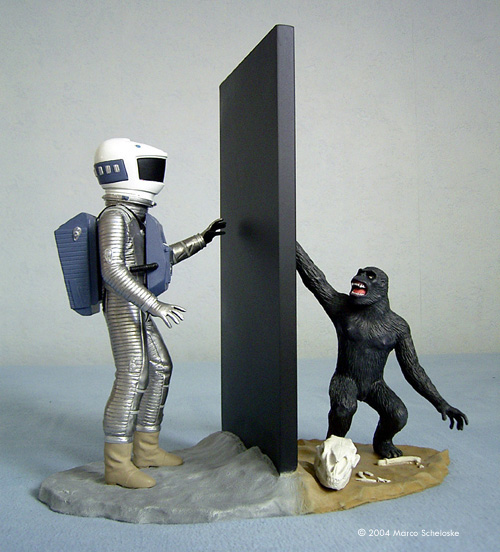
Last but not least, the visual representation of the Wake as a black cube, a mysterious black tablet, certainly seems in alignment with the black monolith of Stanley Kubrick's 2001: A Space Odyssey.


In Kubrick's film, the mysterious monolith is seen as having an important role in the evolution and growth of mankind, moving from violent apes traversing a barren waste land to space explorers venturing through the solar system and beyond. Similarly, the Wake details the evolution of mankind from muttering cavemen groping toward language to the farthest advances of technology, "as modern as tomorrow afternoon" (p. 309), with the Wake itself seen as a futuristic, hyperdimensional cube that somehow contains or mirrors the "monomyth" (p. 581) or formula for human history.

Having identified a mathematical "monomyth" formula, Joyce describes his basic elemental characters being fed through a machine-like device "with a clappercoupling smeltingworks exprogressive process... receives through a portal vein the dialytically separated elements of precedent decomposition for the verypetpurpose of subsequent recombination so that the heroticisms, catastrophes and eccentricities transmitted by the ancient legacy of the past" (p. 614) can be extracted out, manifested in endless multiplicity. Thus Joyce created a piece of art that contains everything that's ever happened and everything that will ever happen ("how minney combinaisies and permutandies can be played on the international surd!" p. 284).

A confounding black monolith indeed.


As for the parallel many have drawn between 2001's black monolith and the iPhone.... well, Joyce already covered that one with the condensed single word "iSpace" (pg. 124).